Welcome to ServLifts Official Website

How to Choose the Right Dumbwaiter for Your Restaurant: A Complete Guide
Complete guide to choosing the perfect dumbwaiter for your restaurant. Compare side vs rear counterweight, capacity options, costs and installation requirements.

Restaurant dumbwaiter guide: this page takes a restaurant owner through the five decisions that fix the cost and the fit of a restaurant dumbwaiter — capacity, configuration, cabin size, shaft and price — plus the two that decide whether the restaurant dumbwaiter passes inspection.
A restaurant dumbwaiter is a small non-passenger lift, built into a service shaft or a cupboard, sized to carry trays, dishware, stock and cleaning supplies between floors. It is not a passenger lift and it is not a goods lift. It is the one piece of equipment that takes the staircase out of your service route.
Most restaurant dumbwaiter projects that disappoint do not fail at installation. They fail earlier — when capacity is picked off a price list instead of from a real service cycle, or when the shaft is measured after the unit has already been ordered.
This guide is written from the factory side. ServLifts builds traction and manual restaurant dumbwaiters in Wujiang, Suzhou, and ships them to restaurants, hotels and central kitchens in more than forty countries. What follows is the same sequence we walk a buyer through before a single drawing is issued.
Table of Contents
- Why your restaurant needs one, and when it does not
- What a restaurant dumbwaiter is and is not
- Step 1: Determine the load capacity
- Step 2: Choose the configuration
- Step 3: Measure the cabin and the shaft
- Step 4: Understand installation
- Retrofit: adding one to an existing building
- Step 5: Compare the costs
- Matching the unit to your restaurant type
- Compliance, inspection and safety
- Why choose ServLifts
- Frequently asked questions
- Ready to choose?
Why Your Restaurant Needs a Dumbwaiter, and When It Does Not
The case for a restaurant dumbwaiter is not comfort. It is route length. In a two- or three-floor operation every plated dish and every dirty tray crosses the same staircase twice, and that staircase is the slowest, narrowest and most dangerous part of the service route.
Faster service. A tray that used to cost a runner two minutes of stair climbing takes seconds. On a busy Friday that difference is not a convenience, it is table turns.
Lower labour pressure. Many two-floor restaurants dedicate one or two part-time staff to carrying between floors. A restaurant dumbwaiter does not remove the role, but it removes the carrying, which is usually the reason the role exists at all.
Fewer injuries. Hot liquid, heavy plates and stairs are a documented combination for burns and falls. Removing the stair leg removes the exposure. The US Occupational Safety and Health Administration treats slips, trips and falls as among the most common causes of injury in food service.
Better food. Heat loss is a function of time and distance. A dish that travels thirty seconds arrives closer to the temperature it left the pass at, and a plate that arrives hot does not come back.
Now the honest part. A single-floor restaurant does not need one. Nor does a two-floor restaurant whose upper level is storage and gets visited twice a day — you would be buying a restaurant dumbwaiter to serve a staircase you barely use. The National Restaurant Association frames kitchen automation around throughput, and throughput is the right test: count trips per service, not floors.
What a Restaurant Dumbwaiter Is and Is Not
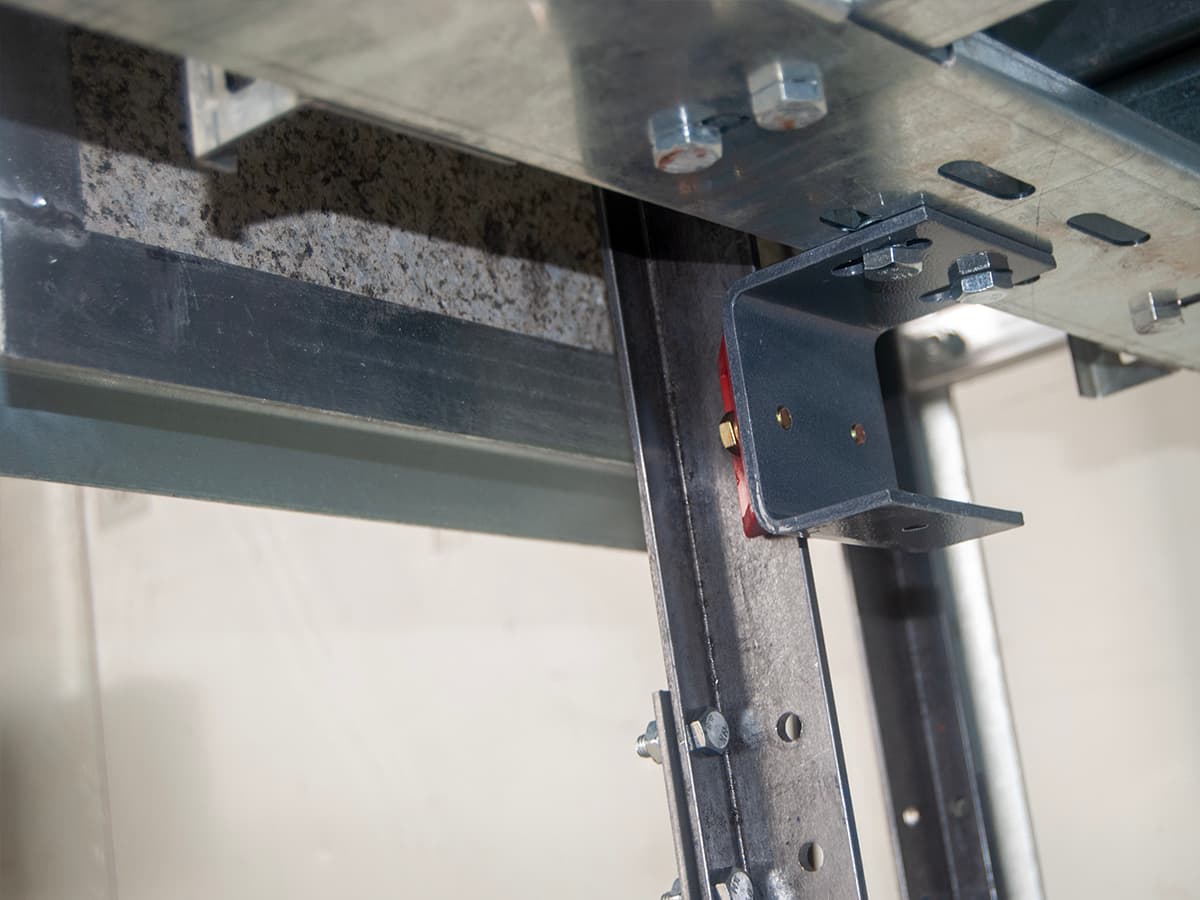
The confusion costs money, so it is worth settling first. A restaurant dumbwaiter is defined by three things: it carries goods and never people, its car is small — typically under one cubic metre — and it is designed for short travel between adjacent floors.
| Equipment | Carries | Typical capacity | What it needs on site |
|---|---|---|---|
| Restaurant dumbwaiter | Goods only | 50–300 kg | Small shaft or cupboard, 220V or 380V |
| Passenger lift | People | 320–1,600 kg | Full shaft, pit, machine room or MRL, licensed inspection |
| Goods or freight lift | Goods, sometimes attended | 500–5,000 kg | Full shaft, pit, heavy power supply |
The distinction that matters legally is the first row. Because a restaurant dumbwaiter is not intended to carry people, it usually falls outside passenger-lift regulation — but “usually” is doing real work in that sentence. The rules depend on jurisdiction, travel height and car size, not on what the supplier calls the thing.
That is why a supplier who says “it needs no approval” without asking where it is going is telling you about their paperwork, not about your project. Our reference page on dumbwaiter regulations by country sets out where those lines actually fall.
If you are still working out the vocabulary, our plain-language answer to what is a dumbwaiter elevator covers the naming mess — food lift, service lift, tray lift, mini freight elevator. They describe the same machine, and the names came from the trades that used them rather than from any standard.
Step 1: Determine Your Restaurant Dumbwaiter Load Capacity
Capacity is the first number on every quotation and the one buyers most often get wrong, usually by oversizing. The right method is not “what is the heaviest thing in the building”. It is “what does one service cycle actually look like”.
How to size the load from a real service cycle
Take the heaviest realistic single trip, not the theoretical maximum. For most restaurants that is one loaded tray stack: a tray of plated mains, or a stack of dirty plates with cutlery and glassware. Weigh it once, at peak.
Then add the car’s own fittings — a stainless tray shelf, a liner, a door — and add a margin for the day someone sends up a crate of oil instead of a tray. That margin is not padding. It is the difference between a restaurant dumbwaiter that runs at seventy percent of its rating and one that trips its overload device every Friday.
| Capacity | Best for | Typical use |
|---|---|---|
| 100 kg (220 lb) | Small cafes, bistros, dessert bars | Single tray, small plates, light supplies |
| 200 kg (440 lb) | Mid-size restaurants | Multiple trays, bulk ingredients, dishware |
| 250 kg (550 lb) | Large commercial kitchens | Heavy pots, trolleys, high-volume operations |
A small bistro usually lands at 100 kg. A mid-size restaurant sending several trays per trip lands at 200 kg. A high-volume kitchen moving pots, trolleys or bulk stock lands at 250 kg. Above that you are in custom territory, and a restaurant dumbwaiter stops being the cheapest tool for the job.
Why oversizing costs more than the price difference
A 250 kg restaurant dumbwaiter is not a 100 kg unit with a bigger sticker. It needs a larger car, a heavier traction machine, larger ropes, a stronger frame and a bigger shaft — and the shaft is the expensive part, because it consumes floor area you have already paid for.
Every step up in capacity is also a step up in structural load at the two floor openings. In a retrofit those openings are the cost centre, so an oversized unit inflates the most expensive line in the project rather than the cheapest one.
The reverse mistake is rarer and worse. A unit running at its limit every service has no margin for a heavy trolley, and the overload device becomes a daily interruption instead of a safety backstop.
Step 2: Choose Your Restaurant Dumbwaiter Configuration
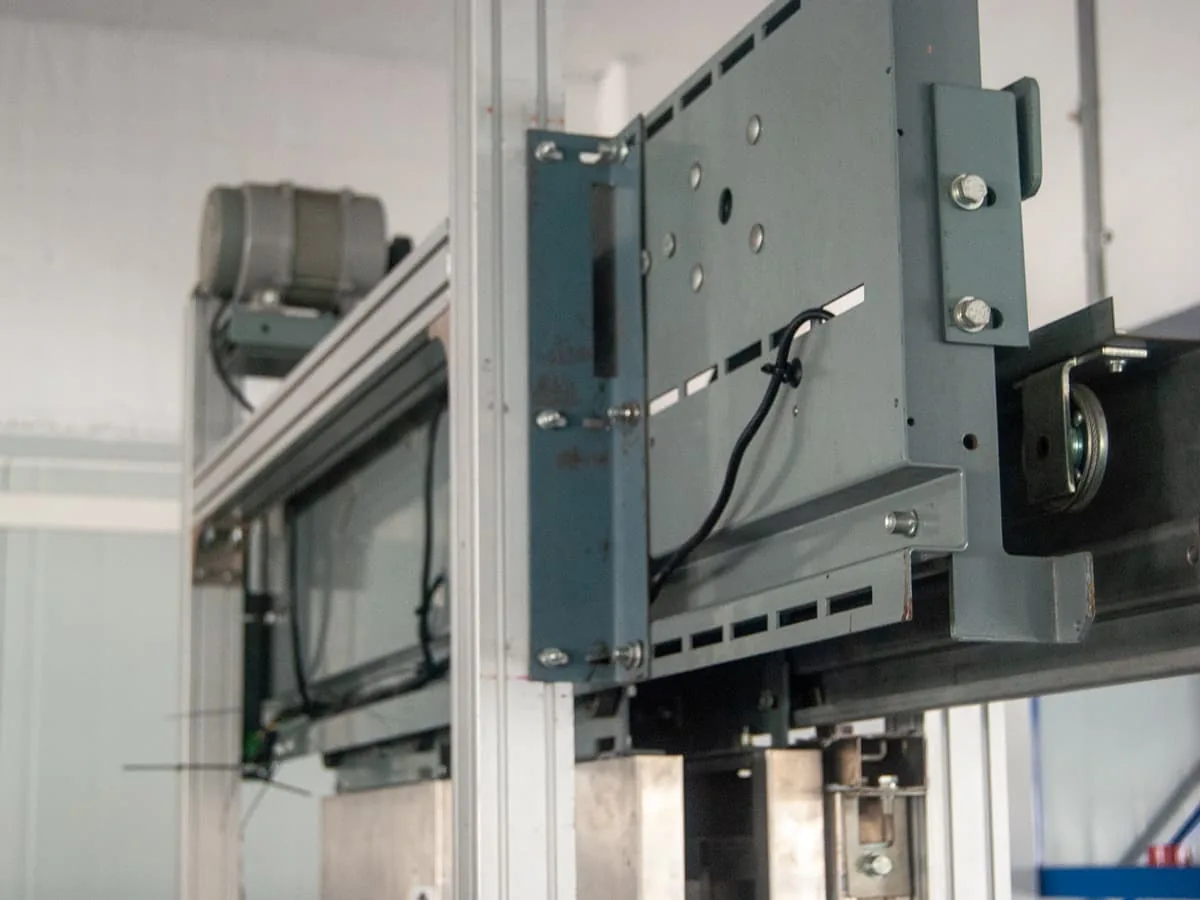
Two choices sit inside the word “configuration”: how the car is driven, and where the counterweight sits relative to the car. Both are fixed at the drawing stage, and neither can be changed later without rebuilding the shaft head.
Traction drive: the default for restaurant work
Traction means a motor drives a rope over a sheave and the car is counterbalanced. It is the standard for restaurant dumbwaiters because it is quiet, smooth and handles frequent cycling, which is exactly the duty a restaurant puts on it. Three services a day, seven days a week, is a great many starts for a small machine.
Screw drive: where it still fits
A screw-driven unit turns a threaded column to raise the car. It needs no counterweight and no headroom above the car, which makes it attractive in tight conversions. The trade is speed and duty cycle: it is slower, noisier under load, and better suited to light occasional use than to a busy service.
Manual: when there is no power at the shaft
A hand-crank or rope-pull restaurant dumbwaiter removes electricity from the specification entirely. It is the right answer in a heritage building where running a circuit to the shaft is impossible, and the wrong answer anywhere the staff are already stretched. Our manual dumbwaiter guide sets out the load a person can genuinely lift by hand.
For the full technical comparison of the three drive systems — costs, speeds, maintenance and failure modes — our traction vs hydraulic vs screw drive comparison goes deeper than this page needs to.
Side or rear counterweight
Where the counterweight sits decides the footprint. A side counterweight runs the weight beside the car; a rear counterweight puts it behind. Side is easier to service and is the default where there is space. Rear exists for the case that decides most retrofits: a corridor or a wall that leaves no room at the side.
Both layouts span the size range, from the SC-A001 (60×60×80 cm, 100 kg) up to the SC-A008 (100×100×120 cm, 250 kg) at the side, and the matching RC-B001 to RC-B008 at the rear.
Doors and loading height
The door decides how fast a tray goes in and out, and it is the part most often specified by default rather than by choice. A counter-height landing door lets staff slide a tray straight across; a floor-level opening means bending, which costs seconds on every trip and backs up in service.
Bifold and vertical-lift doors take less wall space than a swing door. In a narrow service corridor that difference decides whether the door can open at all. Specify the door from the corridor, not from the catalogue.
Step 3: Measure the Cabin and the Shaft
Cabin size follows from what you carry, not from what looks generous. A cabin that is too small forces two trips where one would do. A cabin that is too large forces a larger shaft, and the shaft costs more than the car does.
| Cabin size (cm) | Best for | What fits |
|---|---|---|
| 60×60×80 | Single tray service, cafes | One loaded tray, small plates, glassware racks |
| 80×80×80 | Standard restaurant service | Two trays, a dish crate, a stock box |
| 80×80×120 | Tall items | Extra height for bottles, tall pots, stacked crates |
| 100×100×120 | High volume, trolley work | Small trolley, bulk stock, banquet prep |
Measure the shaft before you order, in three dimensions plus the two openings. The car needs clearance on all four sides for guide rails and rope, so shaft width is not car width. As a working rule, a restaurant dumbwaiter shaft runs roughly 25 cm larger than the car in each horizontal direction — that is the space the frame, the rails and the counterweight occupy.
Two further measurements decide feasibility. The headroom above the top landing, and the depth available below the bottom landing. With tight headroom the answer is a low-headroom layout rather than a smaller car, and our page on low headroom dumbwaiters shows how that is built. The full dimensional matrix is in our dumbwaiter dimensions guide.
Step 4: Understand Installation
A restaurant dumbwaiter is not a plug-in appliance, but it is not a construction project on the scale of a passenger lift either. The work splits cleanly: the shaft and the power belong to the site, the restaurant dumbwaiter and its commissioning belong to us.
What the site has to provide
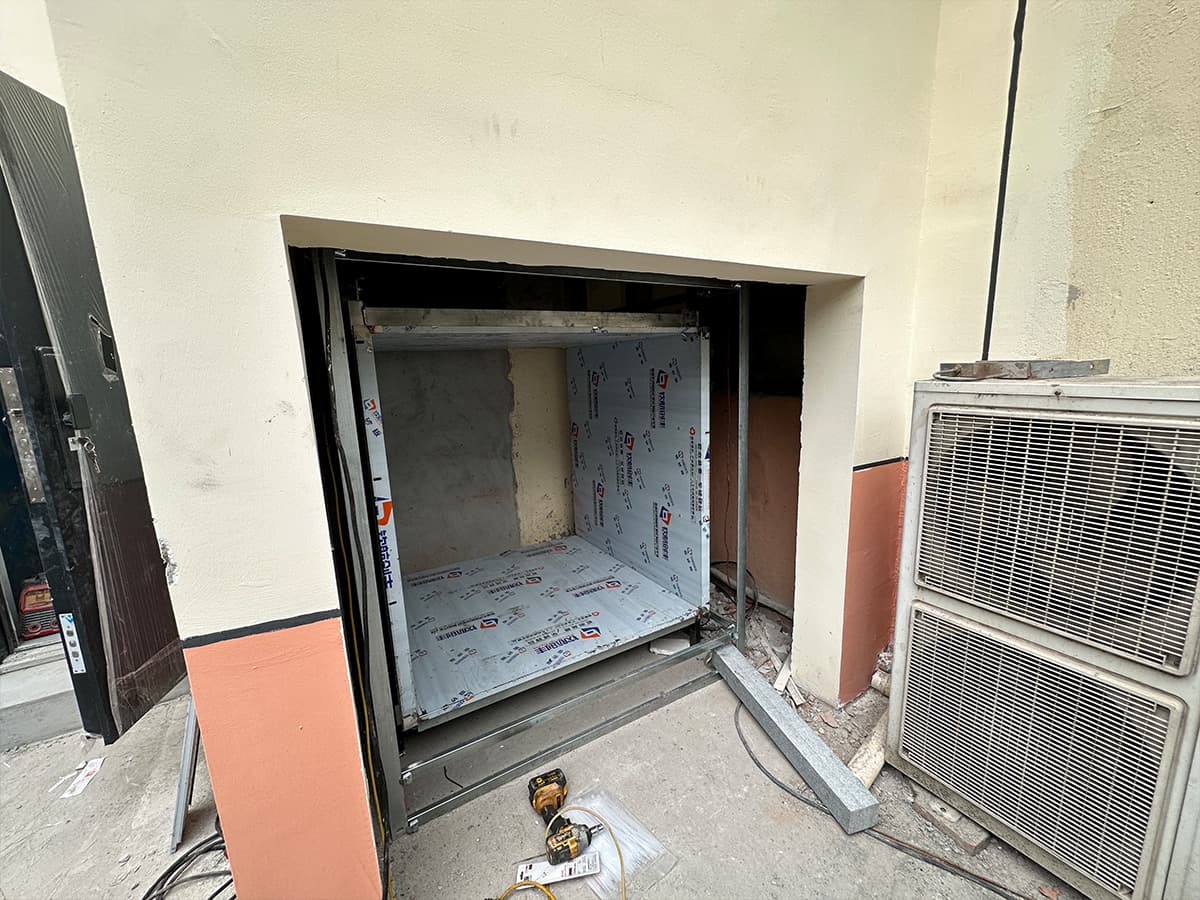
Three things. A shaft or cupboard with the right internal dimensions and a landing opening at each floor. A power supply at the shaft — 220V single phase or 380V three phase, depending on drive and market. A landing surface at each floor that can take the frame fixings.
Compliance with a recognised standard such as ASME A17.1 is the reference most of our export markets work to, with EN 81-31 the European equivalent. Which one applies to you is a question for your local authority, and we will tell you what we can certify rather than what you would prefer to hear.
How long it takes
Installation itself is typically two to three days for a standard two-floor unit, done by a local contractor working from our drawings. Sea freight is the long part: fifteen to twenty-five working days to most destinations, plus customs at your end.
The full sequence, including what to prepare before the crate arrives, is in our dumbwaiter installation guide. We also issue free CAD shaft layout drawings before you commit, so the builder can price the opening from a real drawing instead of a guess. That single step removes most of the rework we see on retrofit jobs.
Retrofit: Adding a Restaurant Dumbwaiter to an Existing Building
Most restaurant dumbwaiter enquiries are retrofits. The building already exists, the kitchen is already downstairs, and the staircase is already the bottleneck. The question is never whether it can be done, but what it costs to create the vertical path.
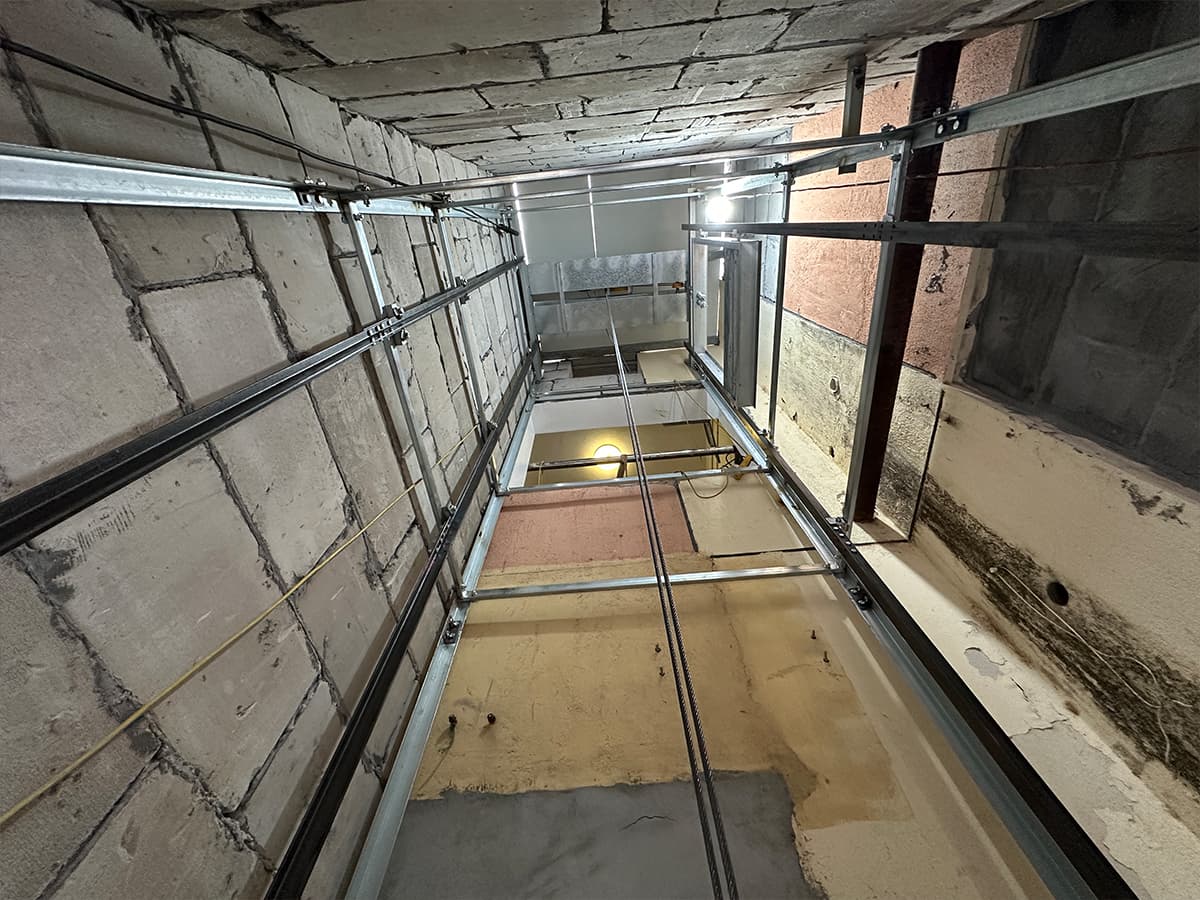
Three ways to get a shaft into an old building
A masonry or stud shaft in a corner. The cheapest option when there is a redundant cupboard, a disused chimney breast or a corner of a storeroom. You lose floor area, not structure.
A self-supporting steel tower. A bolted frame that carries its own load and is tied back to the structure rather than built into it. It costs more than a stud shaft but avoids structural work at the floor openings, which in a leasehold or heritage building is often the deciding factor.
An external or lightwell shaft. Used when no internal route exists. It adds weatherproofing and, in many jurisdictions, planning permission.
What decides the cost of the opening
Two floor openings are structural events. The load they remove has to be carried around the new hole, and the answer is usually a steel trimmer or a lintel rather than a rebuild. Have a structural engineer look at it before you order anything — this is the most common single cause of a stalled retrofit.
In older buildings, also budget for what you find: asbestos in a riser, a floor that is not level, a wall that is not where the drawing says. None of these are reasons not to proceed. They are reasons to survey first, and our regulations reference covers which approvals the work typically triggers.
Step 5: Compare Restaurant Dumbwaiter Costs
Price is where comparison usually breaks down, because two quotes that look different are often not quoting the same thing. A number without a scope is not a price.
| Model | Cabin and capacity | Unit price (USD, FOB) |
|---|---|---|
| SC-A001 / RC-B001 | 60×60×80 cm, 100 kg | $2,265 |
| SC-A008 / RC-B008 | 100×100×120 cm, 250 kg | $2,550 |
Those are ex-works unit prices for a standard two-floor restaurant dumbwaiter, and they are deliberately narrow in scope: machine, car, frame, controller and certification. They do not cover sea freight, insurance, duties, the shaft, the power supply or the local installer.
What actually moves the price
Floors. Every additional landing adds guide rail, rope, door hardware and wiring. A four-floor unit is not double a two-floor unit, but it is not close either.
Cabin size and finish. Stainless inside and out costs more than a painted car. In a kitchen environment the stainless is usually worth it, because a painted car in a wet, greasy, food-acid environment does not stay painted for long.
Control and safety package. Interlocks, slack-rope detection, overload sensing, landing indicators. These are the parts an inspector looks at, and the parts a cheap quote quietly omits.
Delivery terms. FOB, CIF and DDP are three different prices for the same machine. We quote all three so the comparison is honest; the breakdown is in our dumbwaiter price guide.
Judging it as a capital decision
The comparison that matters is not unit price against unit price. It is the annual cost of the equipment against the annual cost of the stair leg it replaces: the part-time hours, the breakage, the injuries, and the tables you cannot turn because the runner is on the stairs.
We do not publish a payback figure. The inputs differ too much by market and wage level for one number to be honest, and a figure invented in a brochure is worse than no figure at all. Every buyer can compute it in ten minutes with their own numbers, and that result will beat anything we could print.
Matching the Restaurant Dumbwaiter to Your Restaurant Type
Different service models put different loads on the equipment. The table below is the mapping we use when a buyer cannot decide between two sizes.
| Restaurant type | Typical capacity | Cabin | What drives the choice |
|---|---|---|---|
| Cafe, dessert bar, small bistro | 100 kg | 60×60×80 | Single tray, low trip count |
| Mid-size à la carte restaurant | 200 kg | 80×80×80 or 80×80×120 | Multiple trays per trip, dish return |
| High-volume or multi-floor restaurant | 250 kg | 100×100×120 | Trolley handling, peak throughput |
| Hotel F&B, banquet floor | 250 kg | 100×100×120 | Banquet prep volume, event peaks |
| Central kitchen, commissary | Custom, above 250 kg | Custom | Bulk stock; a goods lift may be the better tool |
Two patterns are worth calling out. First, dish return is heavier than food delivery: dirty plates, glassware and cutlery weigh more per trip than plated mains, so size for the return leg. Second, an à la carte restaurant with a fixed menu has a predictable peak, while a banquet operation does not. If events are part of the model, size for the event.
If your concept sits outside these rows — a food hall, a cloud kitchen hub, a rooftop bar with a basement prep kitchen — the useful next read is our breakdown of dumbwaiter and lift types by use case rather than a size chart.
Compliance, Inspection and Safety
A restaurant dumbwaiter is not a passenger lift, and that is exactly why the compliance question is easy to get wrong. The exemption that lets you skip passenger-lift regulation depends on the restaurant dumbwaiter genuinely not being able to carry a person.
That is why car size, door height and control layout are safety features as much as design choices. A car large enough for an adult to climb into changes the classification question, whatever the nameplate says. A restaurant dumbwaiter that has quietly grown to passenger-lift dimensions is the worst of both worlds: passenger-lift obligations without passenger-lift capability.
The standards landscape differs by market: ASME A17.1 in North America, EN 81-31 in Europe, national codes elsewhere. What they tend to share is a set of required devices — landing interlocks, slack-rope or broken-rope detection, over-speed protection, and a means of raising a stranded load.
What your inspector asks for is a local question, and the answer changes by city as often as by country. Our country-by-country regulations page is the reference we point buyers to. It is the only regulations content on this site, so treat it as a starting point rather than the final answer.
CE marking matters for the EU and for many markets that follow its practice. We supply the declaration and the technical file, including a version without our branding for buyers who must present it under their own.
Why Choose ServLifts?
ServLifts is the dumbwaiter brand of Suzhou Bsite Express Elevator, a manufacturer in Wujiang, Suzhou, with its own assembly hall rather than a trading desk. That matters for one practical reason: when a restaurant dumbwaiter arrives with a part missing, you are talking to the people who built it.
Factory direct. No importer margin between the assembly line and your loading dock, and the same unit whether you buy one or twenty.
CE certified. Declaration and technical documentation supplied, with a no-logo version of the technical file for buyers presenting it under their own brand.
Twelve-month warranty. Standard parts shipped from stock, against a documented spares list rather than “contact us and see”.
FOB, CIF and DDP. All three quoted, so you can compare landed cost instead of guessing at it.
Free shaft drawings and technical support. CAD layout before you commit, and support after commissioning, including remote help for the local installer.
You can see the plant and the assembly hall on our about page. If you already know the parameters, the dumbwaiter specification guide will get you to a quote faster than this page will.
Frequently Asked Questions
How much does a restaurant dumbwaiter cost?
Our standard two-floor units run from $2,265 for a 60×60×80 cm, 100 kg model to $2,550 for a 100×100×120 cm, 250 kg model, ex-works. Sea freight, duties, the shaft and the local installer are separate. The full cost structure is in our price guide.
How much weight can a restaurant dumbwaiter carry?
The standard range is 100 kg, 200 kg and 250 kg. Above 250 kg the restaurant dumbwaiter becomes a custom build, and at that point a small goods lift is often the better tool for the money.
How long does installation take?
Two to three days for a standard two-floor unit, by a local contractor working from our drawings. Preparing the shaft and the power supply takes longer than the mechanical installation itself, and that is the part you control.
Does it need a machine room?
No. A traction restaurant dumbwaiter uses a compact machine mounted at the shaft head, so there is no separate room to build, ventilate or air-condition. That is one of the reasons a retrofit is feasible at all.
Can it be added to an existing building?
Yes, and most of our restaurant orders are exactly that. The three routes are a corner shaft in an existing room, a self-supporting steel tower, or an external shaft. A structural engineer should review the two floor openings before you order.
What power supply is needed?
220V single phase or 380V three phase, depending on the drive and the destination market. A manual unit needs no supply at the shaft at all — our manual dumbwaiter guide covers that case in detail.
How long does shipping take?
Fifteen to twenty-five working days by sea to most destinations, plus customs clearance at your end. Packing is in export plywood crates sized for a standard container, and the crate is designed to be opened at the shaft rather than in a warehouse.
What maintenance is required?
Monthly inspection and lubrication of the rope, sheave and guide rails, plus an annual check of the safety devices. The restaurant dumbwaiter is designed so a local technician can do this from the supplied manual, without a factory visit and without a specialist lift contractor.
Ready to Choose?
If you have the floor count, the tray weight and the shaft position, you have enough to specify a restaurant dumbwaiter. Send those three numbers and we will return a shaft drawing and a landed-cost quote, not a price list.
Contact ServLifts for a free consultation. If you are still at the stage of fixing technical parameters rather than choosing a supplier, start with the dumbwaiter specification guide and come back when the numbers are settled.
[…] Plus, faster service means better customer satisfaction and more table turns. If you’re still deciding whether a food lift fits your layout, read our complete guide to choosing the right dumbwaiter for your restaurant. […]
[…] unsure? Our complete guide to choosing the right dumbwaiter for your restaurant walks through capacity, size, and budget step by […]
[…] Confirm the car depth and door opening against your largest trays and any carts you plan to send up. A stainless-steel (SS 304) car is standard for food contact and easy cleaning. For the full sequence — capacity, layout, then budget — see our restaurant dumbwaiter selection guide. […]