Welcome to ServLifts Official Website

Manual Dumbwaiter: How Hand-Crank Food Lifts Work (2026)

A manual dumbwaiter is the only food lift that still works when the building has no power. There is no motor, no control cabinet and no cable to the distribution board: a rope, a sheave, a counterweight and a brake do the work, and a person supplies the missing force. That single fact decides almost everything else about the machine, including what it can carry, how many floors it can serve and where it stops being a sensible purchase.
The practical envelope is narrow. Most manual dumbwaiters are rated somewhere between 50 kg and 100 kg (110-220 lb), travel two to four floors, and move at roughly 0.1-0.2 m/s – slow enough that nobody expects to send a trolley of hot plates up four flights in the middle of service. Accept that envelope and the machine is genuinely useful. Fight it and you end up with a machine that nobody on the staff wants to operate.
This page is written for buyers who are weighing a manual dumbwaiter against a traction unit, usually because power is scarce, the building is old, or the budget is fixed. It covers the mechanics, the load limits, the code questions inspectors actually ask, and the six situations where it is the right answer – plus the six where it is not.
What this page covers:
- What a manual dumbwaiter is, in plain terms
- How a manual dumbwaiter moves a load
- Rope-pull, hand-crank and semi-manual
- What you can actually lift by hand
- Travel, speed and the constraints nobody mentions
- Where a manual dumbwaiter still makes sense
- Where a manual dumbwaiter is the wrong answer
- The cost structure: where manual saves and where it does not
- Safety, standards and what inspectors ask for
- Buying checklist: eight questions before you order
- Manual dumbwaiter FAQ
- Next step: what to send for a quote
What a Manual Dumbwaiter Is, in Plain Terms
A manual dumbwaiter is a non-passenger goods lift whose car is raised and lowered by human effort applied to a rope or a hand-cranked winch, with a counterweight carrying most of the load. It is a dumbwaiter first and a manual machine second: the shaft, the guide rails, the car and the landing doors are the same hardware you would find on a powered unit. What is missing is the drive.
That distinction matters commercially. A supplier quoting one is not quoting a cheaper class of product with cheaper steel – the enclosure and the doors are identical. The saving comes from removing the traction machine, the variable frequency drive, the control cabinet, the wiring and the electrical inspection that goes with them. On a small unit those components are a meaningful share of the price; on a large one they are not.
The red line is the same one that applies to every dumbwaiter: a manual dumbwaiter carries goods, never people. A hand-operated unit makes that rule even more important, because there is no motor brake, no overspeed governor and no door interlock circuit to fall back on. If the application involves anyone stepping inside the car, the wrong machine and no amount of modification makes it the right one. For the general definition and how these units differ from small freight elevators, start with what a dumbwaiter elevator actually is.
| Feature | Manual dumbwaiter | Traction dumbwaiter |
|---|---|---|
| Drive | Rope pull or hand-cranked winch | Geared traction machine with VFD |
| Power supply | None | Single or three phase, 220-415 V |
| Typical rated load | 50-100 kg | 100-300 kg |
| Typical travel | 2-4 floors | 2-6 floors |
| Typical speed | 0.1-0.2 m/s | 0.4-1.0 m/s |
| Electrical door interlocks | Not applicable – mechanical locks only | Standard |
| Best fit | No power, very low frequency, heritage buildings | Any commercial kitchen in daily service |
How a Manual Dumbwaiter Moves a Load
Every manual unit is built on three mechanisms, and a buyer who understands them can predict most of the machine’s behaviour before seeing a drawing.
The rope and the sheave
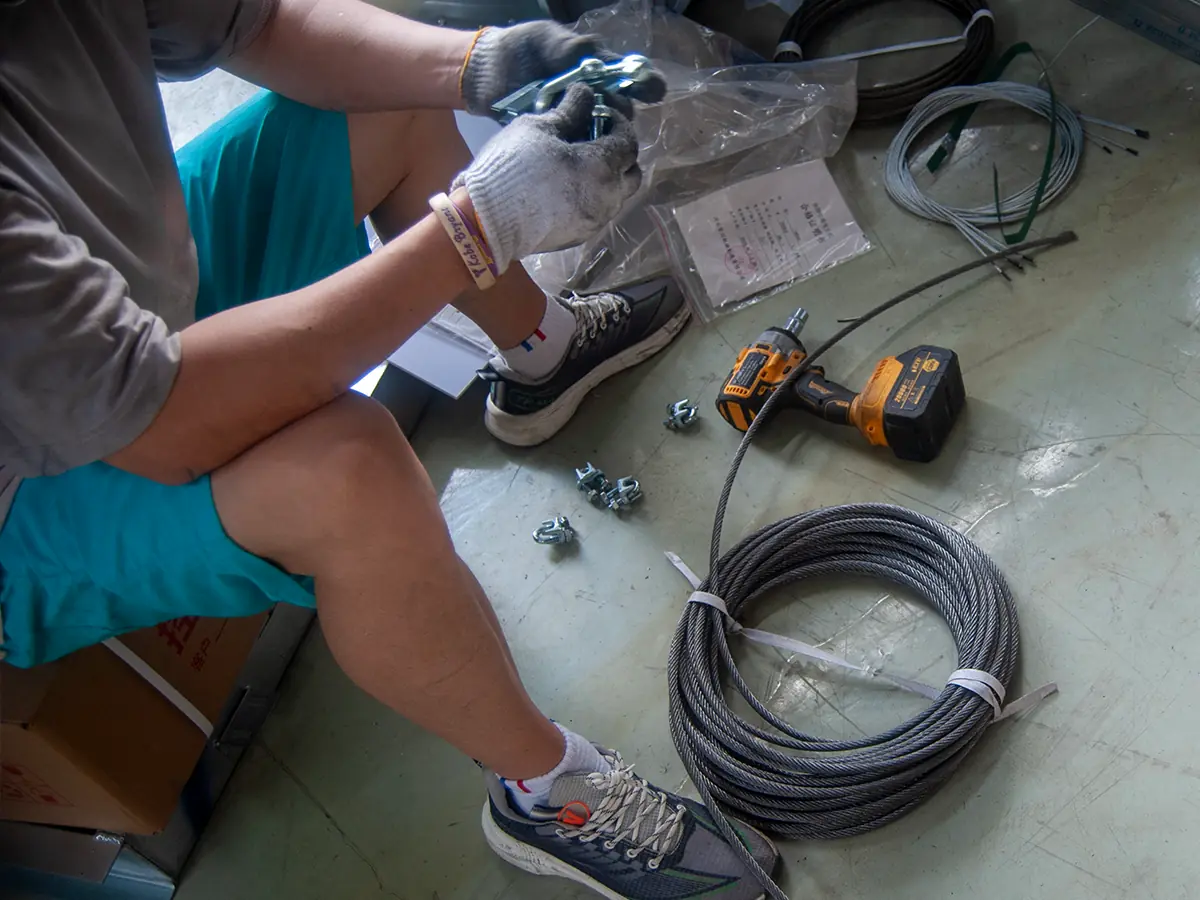
A steel wire rope runs from the car, over a sheave mounted at the top of the shaft, and down to the counterweight. Pulling the rope on the car side raises the car; pulling on the counterweight side lowers it. A fixed sheave only changes the direction of the force, so a pure rope-pull manual dumbwaiter gives you no mechanical advantage at all – you are lifting whatever imbalance exists with your arms.
That is why rope-pull units stay small and why most manufacturers move to a geared winch as soon as the load goes past about 50 kg. The mechanics of the rope path are the same ones described in how a dumbwaiter works, minus the motor.
The counterweight
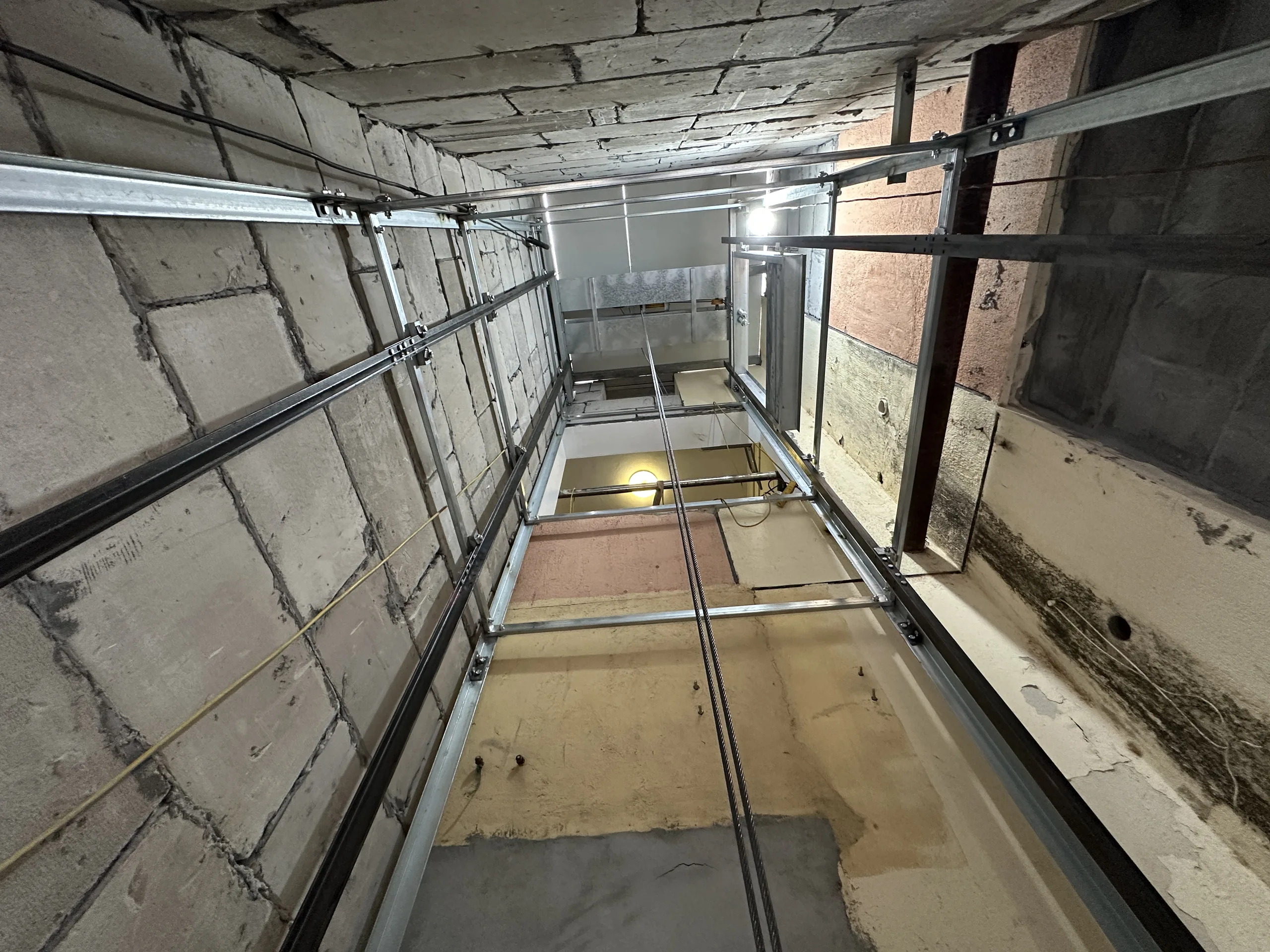
The counterweight is what makes the unit usable. It is set to roughly the weight of the empty car plus half the rated load, so at half load the system is close to balanced and the operator only has to overcome friction, rope stiffness and inertia.
Load the car fully and the imbalance the operator feels is about half the rated load; empty the car and it pulls the other way. That is the whole reason a 100 kg manual dumbwaiter can be moved by one person while a 100 kg dead weight on a rope cannot. On a powered unit the same counterweight exists, but the motor absorbs the imbalance instead of your shoulder.
The brake and the landing lock
Two separate devices keep a manual dumbwaiter from running away. The brake – usually a ratchet and pawl on the winch, or a friction brake on the sheave – holds the car wherever the operator stops pulling, and is designed so that releasing the rope does not release the load.
The landing lock is a mechanical latch that keeps the car at the landing while it is being loaded, and keeps the landing door shut when the car is elsewhere. Both are inspected, both wear, and both are the parts most likely to be missing or improvised on a cheap unit. Ask for photographs of the actual brake on the actual unit, not a catalogue drawing.
Rope-Pull, Hand-Crank and Semi-Manual: Three Different Machines
The phrase “manual dumbwaiter” is used for three designs that behave quite differently, and sellers rarely make the distinction. Ask which one you are being quoted.
Rope-pull systems
A rope or a continuous belt runs over the sheave and the operator pulls it hand over hand. There is no gearing, so the force required equals the imbalance. These are the cheapest and the oldest design, still found in heritage buildings, churches and small guesthouses. Practical ceiling is around 50 kg and two floors. Anything above that and a single operator cannot control the descent safely.
Winch-and-crank systems
A hand-cranked winch with a gear ratio multiplies the operator’s force, so the same person can move 100 kg or more – slowly. The crank usually carries the brake, and many designs include a second, lower gear for lowering. This is the version most factories build when a buyer asks for a manual dumbwaiter today. It costs more than a rope-pull unit because the winch, the gearing and the brake are real machined components, and it needs a slightly larger shaft head for the winch frame.
Semi-manual and counterweight-only units
A third category is worth knowing about because it gets sold as manual: a car balanced so precisely that an operator can move it with a light pull, sometimes with a small brake handle rather than a winch. These work only within a very narrow load band. Put a full tray on one side of the balance point and the car either won’t rise or won’t stop. If a supplier describes a manual dumbwaiter as “almost effortless”, ask what happens at 100% rated load.
What You Can Actually Lift by Hand
Rated load on a manual dumbwaiter is not a structural limit – the car and the rails could carry far more. It is an ergonomic limit, set by what one person can start, stop and hold on a slope of rope.
| Rated load | Force the operator feels (approx.) | Realistic use |
|---|---|---|
| Up to 50 kg | Light, one hand | Documents, mail, linen bags, single trays |
| 50-75 kg | Moderate, needs body weight | Two or three trays, small crates, pharmacy stock |
| 75-100 kg | Heavy, geared winch required | Full service trays, archive boxes, grocery crates |
| Over 100 kg | Not sustainable for staff | Use a powered traction dumbwaiter instead |
Three practical notes that the table cannot show. First, the force depends on the imbalance, so a well-balanced one at half load feels lighter than a badly balanced one at a quarter load. Second, the hardest moment is not lifting – it is stopping a descending car, and that is where operators lose control.
Third, if the same person has to do it forty times during a dinner service, the rated load is irrelevant because fatigue sets in long before the limit. For commercial kitchens running a full service, the load question usually settles itself in favour of a powered unit; the capacity tables in dumbwaiter restaurant load capacity show why.
Travel, Speed and the Constraints Nobody Mentions
Two numbers decide whether a manual dumbwaiter is workable: how far the car travels and how often. Both are limited by the operator, not by the machine.
| Constraint | Manual dumbwaiter | What it means on site |
|---|---|---|
| Travel height | Practically 2-4 floors, ~10 m | Above that, rope stretch and control effort grow faster than the benefit |
| Speed | 0.1-0.2 m/s | One floor takes 15-30 seconds of continuous pulling |
| Trips per hour | 10-15 comfortable, 20 maximum | Enough for a guesthouse, not for a 120-cover restaurant |
| Operators | One, trained | Shared units get overloaded when nobody owns the machine |
| Shaft size | Similar to a powered unit | Manual saves the machine room, not the shaft |
| Overhead clearance | Slightly more than a powered unit | The sheave and winch frame sit above the car |
The constraint buyers miss most often is the shaft. Removing the motor does not remove the hoistway: a manual dumbwaiter still needs a plumb shaft, guide rails, landing doors at every floor and a pit. The dimensions in a dumbwaiter dimensions and shaft guide apply almost unchanged.
Where manual does help is headroom – a hand winch and a small sheave need less space at the top than a traction machine and its deflection sheave, which is why some tight retrofits end up manual for reasons that have nothing to do with power. If the ceiling is the binding constraint rather than the electricity supply, a low headroom dumbwaiter is usually the better route.
Where a Manual Dumbwaiter Still Makes Sense
There are six situations where a manual dumbwaiter is not a compromise but the correct specification. They share one property: low frequency, high value per trip. If your use case is not on this list, be sceptical.
| Situation | Why manual wins | What to watch |
|---|---|---|
| No mains power at the shaft | No wiring, no breaker, no inspection | Confirm the building has no future power plan |
| Frequent or unpredictable outages | Keeps working when the grid does not | Trained operators only |
| Heritage or protected building | No electrical alteration to historic fabric | Listed-building consent still applies |
| Very low frequency use | A few trips a day, or a few a week | Under 20 trips per hour, ideally far under |
| Hazardous or wet environment | No electrical components in the shaft | Local rules on equipment in such areas |
| Fixed, tight budget | Removes machine, drive and cabinet cost | Does not remove shaft or door cost |
Two of these deserve a note. The first is frequency: one that sees five trips a day for twenty years is a good investment, and the same machine in a busy restaurant becomes a grievance in a fortnight. The second is the assumption that “no power” is permanent – if the site is a new build in a district where the supply is coming next year, it is a decision you will want to reverse, and reversing it means replacing the drive, the cabinet and the wiring. If the temptation is to skip the machine and build it yourself, the permit and certification limits are set out in what a DIY dumbwaiter can and cannot be.
Where a Manual Dumbwaiter Is the Wrong Answer
If the unit has to move a trolley every few minutes during service, a manual dumbwaiter will be bypassed by staff within a month. That is not a theory; it is the most common reason a manual unit ends up idle while people carry trays up the stairs next to it.
| Situation | Why manual fails | Better specification |
|---|---|---|
| Busy restaurant or hotel kitchen | 40-100 trips a day, staff fatigue | Powered traction dumbwaiter |
| Loads above 100 kg | Not controllable by one person | 200-300 kg traction unit |
| More than four floors | Travel time and rope stretch | Traction unit with VFD |
| Accessibility requirement | Manual dumbwaiter cannot carry people | Accessible goods lift or platform lift |
| Needs electrical door interlocks | No circuit exists to interlock | Powered unit with interlocked doors |
| Fire alarm integration required | No control system to signal | Powered unit with a control cabinet |
The last two rows are the ones that surprise buyers, because they are legal rather than practical. Modern dumbwaiter installations are commonly required to have landing doors that cannot open unless the car is at that floor, enforced electrically. A manual dumbwaiter can only offer a mechanical latch. Whether that is accepted depends entirely on your local authority, and no supplier in another country can answer it for you. Ask the question before you order, not after the unit lands.
The Cost Structure: Where Manual Saves and Where It Does Not
A manual dumbwaiter is cheaper than a traction dumbwaiter for one reason: fewer bought-in components. Everything else in the quote is the same, which caps the saving well below what most buyers expect.
| Cost element | Manual dumbwaiter | Traction dumbwaiter |
|---|---|---|
| Car, sling and guide rails | Same | Same |
| Shaft enclosure and landing doors | Same | Same |
| Drive | Winch or sheave only | Traction machine, 25-40% of hardware cost |
| Control cabinet and wiring | None | Included |
| Electrical supply and protection | None | Cable, breaker, earthing |
| Installation labour | Slightly lower | Includes electrical work |
| Ongoing inspection | Mechanical only | Mechanical and electrical |
Read the table from the top: the first two rows are the bulk of what you pay for, and they do not change. What changes is the third row downwards. On a small single-phase unit the drive and controls can be a third of the hardware price; on a large three-phase unit they are a smaller fraction, so the manual version saves proportionally less.
For the absolute numbers behind these ratios, the dumbwaiter price guide breaks the same structure down line by line, and dumbwaiter installation requirements covers the site work that manual does not avoid. Getting a real quote for a manual dumbwaiter therefore means sending the same five inputs you would send for a powered one – load, floors, shaft dimensions, door positions and destination.
Safety, Standards and What Inspectors Ask For
Removing the motor does not remove the machine from the rulebook. It is still lifting equipment, and in most markets it is regulated as such.

In the United States and Canada, dumbwaiters fall under the ASME A17.1 elevator and escalator safety code, which covers construction, door locking and inspection regardless of how the car is driven – the code series is listed at ASME codes and standards.
In the European Union, a dumbwaiter is machinery supplied under the Machinery Directive, and goods-only lifts have their own harmonised standards; the directive text is published by EU-OSHA, and a manual dumbwaiter still needs a declaration of conformity and a CE mark to be placed on the market. In the United Kingdom, lifting equipment used at work falls under LOLER, which requires a thorough examination by a competent person at defined intervals – see the HSE guidance on LOLER.
What inspectors actually look at on a manual unit is short and specific: the condition of the rope and its terminations, the function of the brake under load, the alignment and engagement of every landing lock, and the presence of a rated-load plate inside the car. All four are mechanical, all four wear, and all four are cheap to maintain when someone is looking.
The maintenance items that kill manual units are the same ones that kill powered units – a rope that was never inspected and a lock that was never adjusted. A dumbwaiter maintenance schedule for a manual unit can drop the electrical section entirely and keep the mechanical one intact. Detailed specification wording for the mechanical safety devices belongs in the dumbwaiter specification document so it is on the record before the unit ships.
Buying Checklist: Eight Questions Before You Order
Ask these eight questions in writing. A supplier who answers all eight is worth quoting; a supplier who answers three is telling you something.
- Which manual type is this – rope-pull, geared winch or counterweight-only? The answer changes the price, the effort and the shaft head.
- What is the rated load, and what force does the operator feel at that load on the worst floor? Ask for the number, not “easy”.
- How many trips per hour and per day do you consider acceptable for this manual dumbwaiter? Any answer over 20 trips per hour is marketing.
- Show me the brake and the landing lock on the actual unit. Photographs of the delivered hardware, not drawings.
- How is the rope terminated, and how often should it be replaced? Terminations are where manual units fail.
- What does my local authority require for door locking? If the supplier claims no requirement anywhere, they are guessing.
- What documents ship with the unit? Rated-load plate, drawing, test record, declaration of conformity where applicable.
- What happens if I later need to power it? Ask what retrofit involves, because some shafts cannot take a traction machine afterwards.

A factory that builds both manual and traction units will tell you honestly when manual is the wrong choice, because they can sell you either. That is the most useful signal in the whole conversation. ServLifts builds dumbwaiters in Wujiang, Suzhou and quotes both drive types; if you send the five inputs, the answer usually comes back within a working day – start at contact ServLifts, or read the manufacturing side in dumbwaiter manufacturer in China.
Manual Dumbwaiter FAQ
Can a manual dumbwaiter carry people? No. It is a goods-only lift, and a hand-operated one has no motor brake, no overspeed governor and no electrical door interlock. It is never converted for passengers.
How much weight can a manual dumbwaiter lift? Most units are rated 50-100 kg (110-220 lb). Above 100 kg the effort required from one operator stops being sustainable, and a powered traction unit becomes the practical specification.
Does a manual dumbwaiter need electricity at all? No. It needs no power supply, no control cabinet and no wiring, which is the main reason it is chosen in off-grid, heritage and outage-prone buildings. Lighting inside the shaft, if fitted, is the only electrical item.
How many floors can a manual dumbwaiter serve? Two to four floors, roughly 10 m of travel. Beyond that, rope stretch and the time spent pulling make the machine unpleasant to use, and the case for a traction dumbwaiter becomes overwhelming.
Is a manual dumbwaiter cheaper than an electric one? Cheaper, but by less than most buyers expect. The shaft, doors, car and rails cost the same; the saving comes from the drive, the control cabinet and the electrical installation, which is roughly a third of hardware cost on a small unit.
Next Step
If your project has power, daily traffic and more than 100 kg to move, the honest answer is a traction dumbwaiter and this page has done its job by telling you so. If it has none of those, send the load, the floors, the shaft dimensions, the door positions and the destination address – that is enough to price a manual dumbwaiter properly, and enough to say plainly whether you should buy one.
[…] a clean installation from an expensive retrofit. Where mains power at the shaft is not available, a manual dumbwaiter takes the circuit out of the specification […]
[…] existe une cinquième famille, plus rare et souvent oubliée : le monte-plats manuel à treuil (en anglais), sans alimentation électrique, réservé aux charges faibles et aux bâtiments où […]
[…] At the lightest end of the market there is also a manual option. A hand-operated or light-duty dumbwaiter costs less than any powered unit, and for a home moving groceries and luggage a few times a day it can be enough. The trade-off is honest: no electric drive means no automated cycle, and any later upgrade to powered operation costs more than specifying it from the start. How hand-crank models are built and what they cost to run is set out in our manual dumbwaiter guide. […]
[…] Two things follow from building both drive types. We can tell you when a manual unit is the wrong choice for your building, even when it is ours — a 100 kg ceiling on a hand machine is an ergonomic limit, not a structural one. And we can tell you when a dumbwaiter for sale is the wrong product entirely, which is what the section above is for. The manual line is described separately in manual dumbwaiter. […]