Welcome to ServLifts Official Website

Low Headroom Dumbwaiter: 5 Best Ways to Fit a Short Shaft

What this page covers:
- What low headroom actually means
- Five numbers decide whether a low headroom dumbwaiter fits
- Option 1: bottom-drive for a low headroom dumbwaiter
- Option 2: no pit or shallow pit on a low headroom dumbwaiter
- Option 3: narrow jamb and folding doors
- Option 4: a self-supporting low headroom dumbwaiter frame
- Option 5: drop one car size
- What each low headroom dumbwaiter option costs
- How to measure, and when only civil work will fix it
- Low headroom dumbwaiter: questions buyers ask
A low headroom dumbwaiter is a service lift specified around the space above the top landing rather than around the car. Standard traction units need 2,600–3,000 mm of headroom; buildings often offer less. Five changes solve it: bottom-drive, no-pit or shallow-pit layout, narrow jamb doors, a self-supporting frame, or one car size smaller.
Most buyers meet this problem after the shaft is built. The building gives what it gives, and the question stops being what you want and becomes what still fits. This page sets out the five workable answers in order of how much building work each one needs, then the measurements that decide between them.
Dimensions quoted are ranges ServLifts builds to, not a single order. Where a limit depends on the building, the page says so rather than quoting a number that would only be true for one site.
What Low Headroom Actually Means
Headroom is the clear distance from the top finished floor to the lowest obstruction above it. It is not the shaft height, it is not the floor-to-floor height, and it is not the pit. Those four numbers get confused constantly, usually on a drawing where only one of them was marked.
A standard traction low headroom dumbwaiter layout puts the machine, the drive sheave and the overrun space above the top landing. That assembly is what the 2,600–3,000 mm covers. Take the machine out of that zone and most of the number disappears with it, which is why every option on this page starts by moving equipment rather than by shrinking the car.
The obstruction is the part that trips people up. It is almost never the slab. It is a beam nobody flagged, a duct run crossing the shaft head, a roof slope on a top floor, or a water tank on a converted building.
Measure from the finished floor, not the structural one. A 50 mm screed and tile build-up is 50 mm of headroom you no longer have, and it is the single most common reason a measured 2,700 mm becomes a problem at installation.
Five Numbers Decide Whether a Low Headroom Dumbwaiter Fits
Five measurements settle a low headroom dumbwaiter specification before price is discussed. Four are dimensional, one is electrical. Each has a standard value, a workable reduced value, and a point past which the machine cannot follow.
| Measurement | Standard build | Reduced | What happens below that |
|---|---|---|---|
| Headroom above top floor | 2,600–3,000 mm | Reduced with bottom-drive or machine-in-shaft | Machine has nowhere to sit; unit must be relocated or the roof structure changed |
| Pit depth | 300–500 mm | Reduced with machine-in-shaft layout | Buffer and stop wiring will not fit; car cannot reach the bottom landing |
| Shaft clear width | Car + 320–400 mm | Car + 260 mm with narrow jamb doors | Car drops one size, or the wall has to be cut |
| Supply | 220 V single or 380 V three-phase | Re-rated motor and drive | Delivery slips; motor and drive need re-engineering |
| Stops and travel | 2–6 stops | Up to 8 with three-phase traction | Drive type changes; counterweight run needs shaft height |
Order matters on a low headroom dumbwaiter. Headroom and pit are fixed by the building and expensive to change. Car size is the cheapest thing to change and the last thing that should be changed, because a car that will not take the trolley has solved nothing. Work down the table from the fixed items to the flexible ones.
Supply is worth checking early on a low headroom dumbwaiter, for a reason that has nothing to do with the machine. A building wired at 415 V or 60 Hz needs the motor and drive re-rated, and that is a manufacturing change rather than a paperwork change. Photographing the distribution board at the quotation stage costs a minute and saves a month.
Option 1: Bottom-Drive for a Low Headroom Dumbwaiter
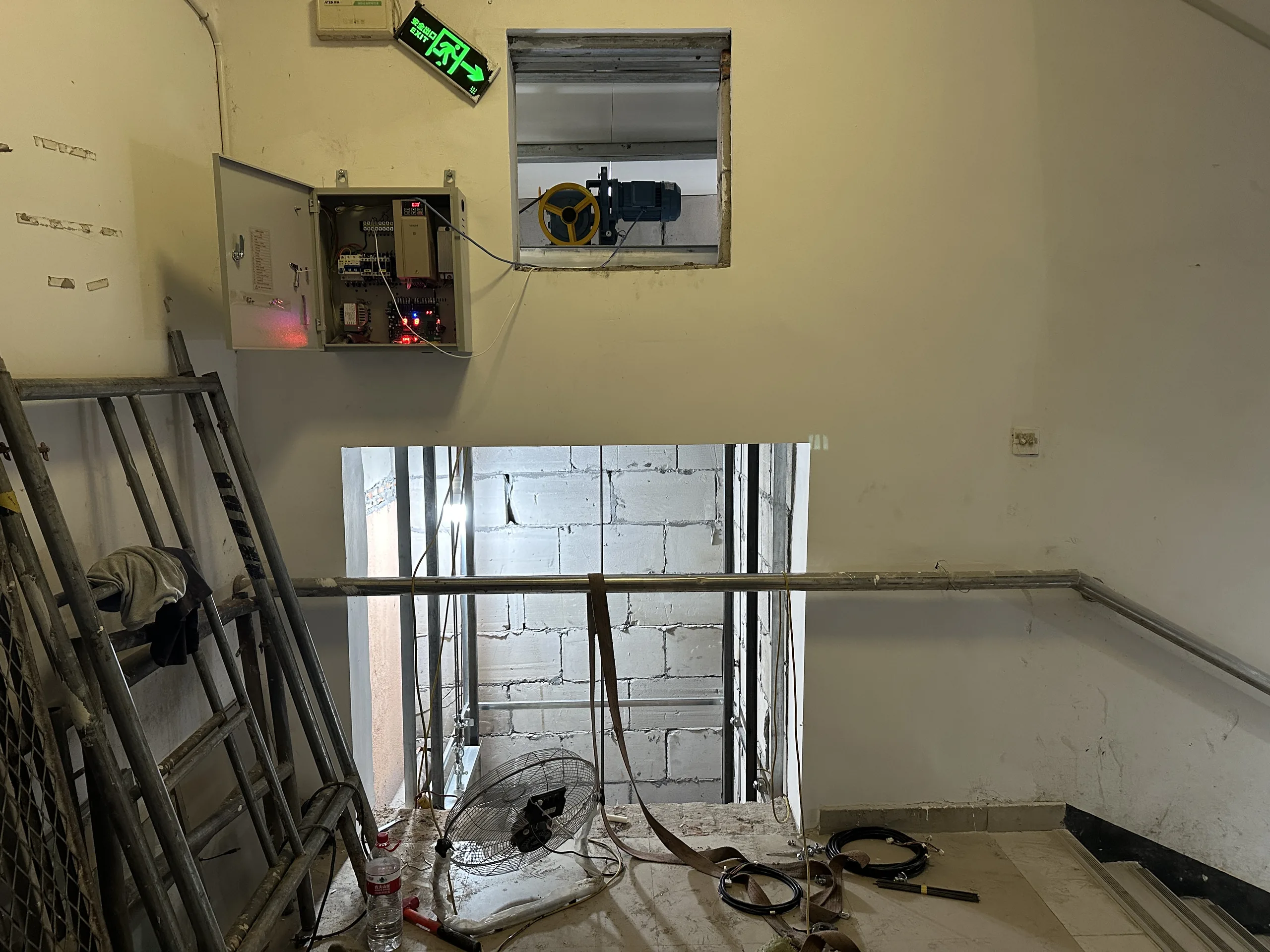
Bottom-drive moves the traction machine and its sheave from above the top landing to the base of the shaft, usually under or beside the car at the lowest floor. The overhead zone then contains only the car, the guide rails and the ropes, so the headroom figure falls sharply.
Bottom-drive is the first low headroom dumbwaiter option because it changes the least about the building. No wall is cut, no floor is strengthened, and the shaft footprint stays the same. For a top floor under a pitched roof, or a converted building where the ceiling void was never designed around lift equipment, it is usually the only answer that keeps the project inside the existing structure.
The cost is paid at the bottom, not the top. A bottom-drive low headroom dumbwaiter needs a machine position at the lowest landing, which normally means a service access door under the loading sill and a sill height of roughly 900 mm to clear it. Maintenance access moves to the ground floor as well. Neither is a problem in a kitchen or a back-of-house corridor, and both are problems in a finished lobby.

One specification point on a low headroom dumbwaiter gets missed: bottom-drive changes the rope run and the counterweight path. A shaft that worked with a top-drive unit is not automatically suitable, so the general arrangement drawing has to be reissued rather than edited. Ask for the new drawing before the opening is cut.
Option 2: No Pit or Shallow Pit on a Low Headroom Dumbwaiter
Whether a low headroom dumbwaiter needs a pit depends on how it is loaded, not on the drive. A unit loaded at waist height has usable space below the car, because the car floor never has to reach the building floor. A unit loaded flush with the floor does not, so the buffer and the stop wiring have to go underneath it.
A standard low headroom dumbwaiter build uses a pit of 300–500 mm. That figure covers the buffer, the stop wiring and the approach to the bottom landing. Machine-in-shaft layouts reduce it further by moving components out of the pit and into the shaft wall zone, and some configurations run with a modified pit rather than a conventional one.
| Layout | Typical pit | Loading height | Where it suits |
|---|---|---|---|
| Standard traction | 300–500 mm | Waist height or floor level | New shafts, ground-floor plant rooms |
| Machine-in-shaft | Reduced, set per drawing | Waist height | Retrofits where the slab cannot be broken |
| No pit, modified base | Set per site survey | Waist height only | Basement or slab-on-grade floors that cannot be cut |
Nobody should promise a zero-pit low headroom dumbwaiter from a photograph. The slab, the waterproofing and the drainage all matter, and a basement floor is a different proposition from a first-floor kitchen. What can be said is that a pit is not always required, and that the decision is made from a site survey rather than from a catalogue.
Option 3: Narrow Jamb and Folding Doors
Door gear on a low headroom dumbwaiter consumes shaft width in a way that is easy to underestimate. A swing door needs the leaf to rotate clear of the opening, so the reveal and the wall thickness both have to accommodate that movement. A folding door collapses within the shaft envelope instead, which is why it appears so often on narrow retrofit work.
Two separate dimensions on a low headroom dumbwaiter get conflated here. The clear door opening is what the tray or trolley passes through. The shaft clear width is what the car fits inside. A low headroom dumbwaiter with a generous car and a mean door opening is a machine that fits the shaft and cannot be loaded, and that mistake is only found on the first delivery.
| Door type | Space it needs | Where it helps | Trade-off |
|---|---|---|---|
| Bi-parting | Two leaves slide into the wall or shaft | Wide openings, frequent traffic | Needs side room in the wall |
| Swing | Leaf rotates clear of the opening | Simple walls, low cost | Consumes usable floor space at the landing |
| Folding | Leaf folds inside the shaft envelope | Narrow shafts, tight landings | More moving parts to maintain |
For a restaurant tray and a hotel linen trolley on a low headroom dumbwaiter, the clear opening matters more than the car height. An 800 mm opening takes a standard archive box or a loaded tray; going to 1,000 mm rarely earns its cost because the trolley, not the box, was the real constraint. Measure the thing that will actually go through the door.
Option 4: A Self-Supporting Low Headroom Dumbwaiter Frame
A self-supporting frame carries its own loads and does not rely on a load-bearing shaft wall. On a low headroom dumbwaiter retrofit this is what makes the other options possible, because it lets a shaft be built to the dimensions the machine needs instead of to the dimensions the building happens to offer.
A self-supporting frame also removes the argument about cutting into existing structure. A light steel frame can sit inside a room, in a service riser, or against a wall that must not be pierced, and the fire-rated enclosure becomes part of the frame package rather than a separate trade. On upper floors, a frame that does not load the slab is often the difference between approval and refusal.
The cost of a self-supporting low headroom dumbwaiter is floor area. A frame takes up room at every landing that a wall-hung shaft would not, and the enclosure has to be finished. For a building that has the room but not the structure, that trade is straightforward. For one that has neither, the next option is the only one left.
Option 5: Drop One Car Size
Dropping a car size is the last low headroom dumbwaiter option, because it attacks the payload rather than the constraint. It is also the option most often chosen first, because it is the only one that does not require anyone to move a machine or build anything.
The four car sizes ServLifts builds are 600×600×800 mm, 700×700×1000 mm, 800×800×1200 mm and 1000×1000×1200 mm, with rated loads from 50 to 300 kg. The 700×700×1000 mm unit is usually the sweet spot for a constrained low headroom dumbwaiter: it takes a full tray and a bussing cart while asking for roughly 200 mm less shaft width than the 800 mm car.
Before accepting a smaller car, put the largest item you will ever send up on the floor and measure it. A linen trolley is around 1,200 mm long; it will not fit an 800 mm car except diagonally, and diagonally is not a loading method. Full published sizes are in the dumbwaiter dimensions guide.
What Each Low Headroom Dumbwaiter Option Costs
The five low headroom dumbwaiter options are not ranked by price. They are ranked by how much of the building each one touches, because on a retrofit the building work is usually the largest single line and the least predictable one.
| Option | What it saves | What it costs | Schedule effect |
|---|---|---|---|
| Bottom-drive | Most of the overhead clearance | Machine position at the lowest landing, sill around 900 mm | New GA drawing; no extra site work |
| No pit / shallow pit | The pit excavation | Site survey, modified base detail | Survey before order; small site delay |
| Narrow jamb / folding door | Shaft width, landing space | More moving parts, different maintenance | Standard lead time |
| Self-supporting frame | Dependence on a load-bearing wall | Floor area at every landing, enclosure finishing | Frame fabricated with the unit |
| One car size down | Shaft width and depth | Payload and trolley fit | Standard lead time, cheapest option |
Two low headroom dumbwaiter items sit outside the table and both are real. The first is the shaft itself: the civil work has to be finished before the site installation window opens, and on a retrofit that work is often on the critical path. The second is access: a unit in a crate cannot be carried up a stair that has not been finished, and port storage is charged by the day. Budget structure rather than site work is covered in the dumbwaiter price guide, and installation labour in the installation cost breakdown.
How to Measure, and When Only Civil Work Will Fix It
Three rules cover most of the measurement risk on a low headroom dumbwaiter. Measure the clear opening at three heights and take the smallest. Measure the pit at the four corners rather than the centre. Measure headroom to the lowest obstruction, from the finished floor. Each rule exists because of a specific failure that repeats on site after site.
The three-heights rule matters because shafts are not square. A brick shaft can lose 40 mm between the bottom and the top, and the car has to pass through the tightest point. The four-corners rule matters because slabs are poured slightly out of level and the centre is reliably the highest reading. The finished-floor rule matters because screed and tile are added after the survey.
Then there is the low headroom dumbwaiter arithmetic nobody publishes. Planning guidance says to allow 15–20 cm of shaft beyond the car. That figure is a first estimate, and it is the reason so many projects order one size too large. A low headroom dumbwaiter shaft has to absorb three things on each side:
| Component | Per side | Why |
|---|---|---|
| Guide rail body | About 70 mm | T70 or T89 rail, depending on load and speed |
| Rail brackets and packing | 40–60 mm | Brackets stand off the wall and are packed to plumb |
| Installation clearance | 50–70 mm | Room to align, shim and tighten at installation |
| Total per side | About 160–200 mm | Both sides: 320–400 mm in total |
That is the whole low headroom dumbwaiter shaft explanation. A 600 mm car plus 320–400 mm across two sides lands at 920–1,000 mm. A 800 mm car lands at 1,120–1,200 mm and in practice is specified at 1,200–1,300 mm once door gear is included. A 1000 mm car runs at about 1,450 mm. Those numbers match the four project types set out in the dumbwaiter installation site profiles.
Measurement will not save every low headroom dumbwaiter building. Four conditions put the project beyond what any machine change can fix: a shaft that is 100 mm or more too narrow on the clear dimension, a headroom shortfall of 400 mm or more once a bottom-drive layout has been considered, a slab that cannot be broken for a pit on a floor-loading design, and no continuous vertical route at all. In those four cases the answer is civil work or a different location, and the earlier that is said the cheaper it is.
The governing low headroom dumbwaiter rules are local, usually a parent standard from the ASME codes and standards family amended for the jurisdiction. Machine guarding and access around the equipment follow general workplace rules such as OSHA 1910.212, and shaft planning is treated alongside the other building systems in the Whole Building Design Guide. None of them changes because the shaft is short, which is why a reduced-clearance unit is an engineering exercise rather than a compliance shortcut.
For the wider decision sequence, the dumbwaiter installation guide covers site preparation and the specification page covers the technical schedule. If the question is which type of unit suits the building rather than how to fit it, start from the types of dumbwaiter lifts and what a dumbwaiter elevator is.
Low Headroom Dumbwaiter: Questions Buyers Ask
Five low headroom dumbwaiter questions come up on almost every reduced-clearance enquiry. The answers below use the same ranges as the rest of this page, so they can be checked against a site survey rather than taken on trust.
Can a low headroom dumbwaiter fit under 2,600 mm?
Sometimes. A standard traction layout needs 2,600–3,000 mm above the top floor. Below that figure the machine has to leave the overhead zone, which means a bottom-drive or machine-in-shaft arrangement. How far below 2,600 mm a specific building can go is decided by the shaft survey and the general arrangement drawing, not by a catalogue limit.
Does a low headroom dumbwaiter cost more than a standard one?
The machine usually does, because a bottom-drive or machine-in-shaft layout is a less common build. The project sometimes costs less overall, because avoiding structural work above the top landing often saves more than the machine premium adds. Compare the two totals, not the two unit prices.
Can it be installed with no pit at all?
A unit loaded at waist height can run with a reduced or modified pit rather than a conventional 300–500 mm excavation, because the space below the car holds equipment instead of buffer travel. A floor-level loading unit cannot, because the car has to reach the building floor. Basement slabs, waterproofing and drainage all have to be surveyed before anyone commits.
What is the smallest shaft for a 600 mm car?
About 900–1,000 mm clear, depending on rail size and door type. The car is 600 mm; the rest is guide rail, brackets and installation clearance at roughly 160–200 mm per side. A 750 mm shaft will not take a 600 mm car, whatever a planning guide suggests.
How long does a low headroom retrofit take?
Manufacturing runs 4–8 weeks, sea freight 2–3 weeks and site work 1–2 weeks. The shaft and the power have to be finished before the site window opens, which means the civil work runs inside the manufacturing window. A container that lands while the opening is still being cut is a container paying port storage.
The short version. A low headroom dumbwaiter is a machine specified around the space above the top landing. Move the machine down, remove the pit, narrow the door gear, build the shaft the machine needs, or drop one car size, in that order. Measure to the finished floor and the lowest obstruction, allow 160–200 mm per side rather than 75 mm, and the answer will be a drawing instead of a range.
ServLifts builds these in Wujiang, Suzhou, China: traction drive, 50–300 kg rated load, CE, with bottom-drive and machine-in-shaft layouts available for constrained buildings. Send the shaft measurements and a photograph taken from the bottom landing looking up, and the reply will tell you which of the five options your building can take. Start with the contact page, or see how to choose a dumbwaiter for a restaurant or hotel if the building is still at design stage.
[…] depth, pit depth and headroom above the top floor. When headroom is the figure that fails, the low headroom dumbwaiter options are the place to start. The electrical fact is whether the building can give you a single-phase […]
[…] If your building has no pit at all, mention it to the manufacturer — some designs can run with a shallow or modified pit arrangement. Overhead needs the same check: when the space above the top floor is short, ask about low headroom layouts. […]
[…] your manufacturer before starting any construction work. If that headroom is not available, these five layouts for a short shaft cover the […]
[…] es el límite real. Si el local tiene un techo bajo sobre el hueco, revisa antes la guía de montaplatos de baja altura libre, porque ese límite decide el proyecto […]
[…] This is also the building type where dumbwaiter applications most often mean retrofit, because the enclosure has to fit an existing core. Where headroom above the top landing is short, the configuration changes rather than the building: a low-headroom arrangement is covered in low headroom dumbwaiter. […]