Welcome to ServLifts Official Website

Types of Elevators: Complete Classification & Buyer’s Guide (2026)

Complete Guide to All Types of Elevators (2026)
Table of Contents
- How to Choose the Right Type
- 1. Passenger Elevator
- 2. Panoramic Elevator
- 3. Hospital Elevator
- 4. Freight Elevator
- 5. Car Elevator
- 6. Escalator
- 7. Moving Walk
- 8. Dumbwaiter
- Which Type of Elevator Do You Need?
Elevators are essential vertical transport equipment in modern buildings. There are 8 main types of elevators, classified by function and application: passenger elevators, panoramic elevators, hospital elevators, freight elevators, car elevators, escalators, moving walks, and dumbwaiters. This guide covers all types of elevators – what each one does, where it is used, what it costs and how to choose between them. For historical context on elevator evolution, see this Wikipedia overview of elevator technology.
Why this list matters to buyers: most projects only need one of the eight. If your requirement is moving food, documents or small cargo in a restaurant, hotel, hospital or office – rather than carrying people – the answer is almost always type 8, the dumbwaiter. ServLifts manufactures traction dumbwaiters and food lifts for exactly that market, and the sections below explain how the other seven types differ from it.
| No. | Elevator Type | Primary Use Scenarios | Key Features | Mainstream Providers |
| 1 | Passenger Elevator | High-rise residential, commercial office buildings, public buildings | Safe, stable, efficientpersonnel transportation | OTIS KONE |
| 2 | Panoramic Elevator | Hotels, shopping malls,observation decks, high-end residences | Transparent glass car,landscape viewing + transport | Hitachi FUJITEC Aritco |
| 3 | Hospital Elevator | Medical institutions,health & wellness centers | Patient & stretcher transport,medical-grade hygiene | Schindler Mitsubishi |
| 4 | Freight Elevator | Industrial factories, warehouses,logistics parks, supermarkets | Heavy-duty, high-strength steel,cargo-only, no passengers | Thyssen Krupp |
| 5 | Car Elevator | Parking garages, auto showrooms,4S stores, service centers | Large-load, anti-slip,vehicle-dedicated transport | OTIS KONE |
| 6 | Escalator | Shopping malls, subways, airports,high-speed rail stations, exhibitions | Continuous circulating steps,ultra-high traffic efficiency | Schindler OTIS |
| 7 | Moving Walk | Airports, convention centers,large supermarkets, metro stations | Flat inclined platform,walkable with luggage carts | KONE ThyssenKrupp |
| 8 | Dumbwaiter | Restaurants, hotels, hospitals,libraries, archives | Compact size, tiny footprint,low energy, food/cargo only | OTIS Hitachi ServLifts |
This reference guide covers all major types of elevators used in commercial and residential buildings worldwide.
Cost levels quoted in the sections below are relative tiers, not quotations – the real price of any of the eight types of elevators depends on shaft dimensions, load rating, travel height, code requirements and finish.
Understanding the different types of elevators helps building owners, architects, and contractors choose the right vertical transport solution for their specific needs.
Why Classify by Types of Elevators
Knowing the types of elevators available is essential for making informed purchasing decisions. Each type of elevator serves a different purpose.
Passenger elevators move people efficiently between floors. Panoramic elevators add visual appeal. Hospital elevators accommodate stretchers and medical equipment. Freight elevators handle heavy cargo. Car elevators transport vehicles. Escalators and moving walks move high volumes of pedestrians. Dumbwaiters are compact types of elevators designed for food and small cargo in restaurants and hotels.
How to Choose Among Different Types of Elevators
The best type of elevator for your project depends on four things: who or what has to move (people, vehicles or cargo), how many floors and how much traffic, how much shaft and floor space is available, and budget plus lead time. For most commercial kitchen and restaurant applications, the dumbwaiter is the most practical type of elevators choice, as confirmed by ASME A17.1 safety code classifications for service lifts.
A decision order that works for most projects:
- People, more than three floors – passenger elevator (type 1) or panoramic (type 2).
- Vehicles – car elevator (type 5).
- Heavy palletised cargo with forklift access – freight elevator (type 4).
- Stretchers and medical equipment – hospital elevator (type 3).
- Food, dishes, documents or small parcels up to 250 kg – dumbwaiter (type 8). This is the lowest-cost and fastest-to-install category of the eight types of elevators, which is why it dominates hospitality projects.
If you are weighing the dumbwaiter option, start with the dumbwaiter selection guide, then look at the naming difference between a food lift, service lift and dumbwaiter. To discuss which type fits your building, contact ServLifts.
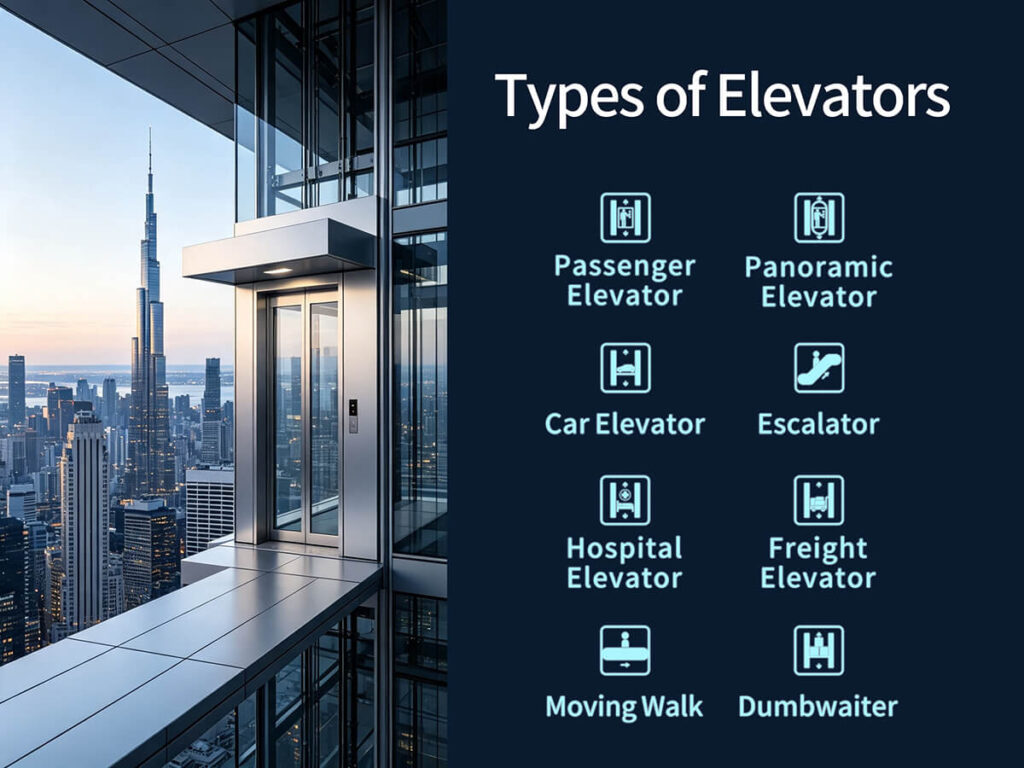
As the core vertical transportation supporting equipment for modern buildings, elevators are widely used in residential, commercial, medical, industrial, transportation hub and other scenarios. Divided by functional attributes, load parameters and application scenarios, elevators can be classified into the following eight categories:
1. Passenger Elevator
Introduction
As the most widely used vertical special manned equipment in the construction field, passenger elevators are extensively applied in high-rise residential buildings, commercial office buildings, urban commercial complexes and public office buildings. Centering on safe, stable and efficient personnel transportation, they are equipped with mature traction drive systems, intelligent variable frequency control systems and multiple safety protection modules.
Featuring accurate leveling, low noise and vibration, stable operation and controllable energy consumption, they can adapt to different floor heights, passenger capacities and passenger flow loads, serving as essential basic supporting facilities for modern civil and commercial buildings. Passenger elevator design and safety are governed by international standards including ISO/TC 178 for lifts, escalators and moving walks.
Who Supplies It & What It Costs
Best for: high-rise residential towers, offices, hotels and public buildings where people are the payload.
Cost level: the highest of the eight per unit – the shaft, machine room, rescue provision and code compliance dominate the price, not the car itself.
Lead time: the longest of the eight, because shaft construction, power supply and inspection must be completed first.
1. OTIS (Internationally Renowned Brand)
As the pioneer of the global elevator industry, OTIS has over 120 years of R&D and manufacturing experience, with business covering more than 200 countries and regions worldwide. It maintains over 2.5 million elevators and escalators in global maintenance, serving billions of passengers daily.
Its core Gen series elevators adopt self-developed composite steel belt gearless technology, reducing energy consumption by more than 30% compared with traditional equipment.
Equipped with an intelligent IoT monitoring system for early fault warning and real-time status monitoring, it ranks top in the industry in operational safety and stability, and is widely used in global landmark buildings such as the Oriental Pearl Tower and the Eiffel Tower.
2. KONE (Internationally Renowned Brand)
As a leading global elevator enterprise founded in Finland, KONE has over 115 years of industry experience and core patent advantages in energy-saving technology, high-speed elevator R&D and space optimization, holding more than 3,000 industry patents.
Its original permanent magnet synchronous traction technology greatly simplifies the machine room structure, reduces equipment occupation, improves operational efficiency and lowers operating noise, delivering an extremely smooth riding experience. With strong local adaptation capabilities, its products fully meet the full-scene manned needs of super high-rise landmarks, high-end residences and large commercial complexes, with projects deployed in 70+ countries worldwide.
2. Panoramic Elevator
Introduction
A panoramic elevator is a special elevator upgraded on the basis of conventional passenger elevators, featuring a large-area high-strength transparent glass car that integrates vertical passenger transportation and landscape viewing functions. It has higher standards for glass strength, fuselage stability, operation smoothness and appearance design.
Mainly applied in urban landmark buildings, high-end hotels, cultural tourism scenic spots and large shopping malls, it not only meets personnel transportation needs, but also serves as a visual highlight of buildings, improving the overall spatial texture and ornamental value.
Who Supplies It & What It Costs
Best for: hotels, malls, observation decks and showrooms where the lift is part of the visual design.
Cost level: a premium tier – structural glazing, the glass car and bespoke finishes push it above a standard passenger elevator of the same capacity.
Lead time: longer than a standard passenger elevator, because the glass and car are usually made to order.
1. Hitachi (Internationally Renowned Brand)
Hitachi panoramic elevators are famous for their high appearance and extremely stable operation quality, with a mature full-scene appearance customization system adaptable to various architectural styles such as modern, minimalist, luxury and Chinese style. Equipped with a high-precision variable frequency speed regulation system, it starts and stops smoothly without stagnation or vibration noise, and adopts high-strength explosion-proof tempered panoramic glass with high safety factor.
With in-depth research and development in elevator noise reduction and shockproof technology, it is highly adaptable to high-end commercial and cultural tourism scenarios and is a mainstream choice for high-end panoramic elevators.
2. FUJITEC (Internationally Renowned Brand)
FUJITEC is a world-renowned comprehensive elevator and escalator brand, with panoramic elevators as one of its core advantageous product lines. Its self-developed permanent magnet synchronous drive system realizes low-noise, low-vibration and energy-saving long-term operation. The car features a simple and elegant design and supports personalized customization such as special-shaped curved surfaces and oversized glass.
Certified by multiple international safety standards, its products feature strict craftsmanship and stable quality, having served benchmark projects including Tokyo Azabudai Hills, Beijing China World Trade Center and Shanghai Peninsula Hotel, with leading market reputation and quality recognition.
3. Aritco (Niche Cost-Effective International Brand)
Aritco is a high-end niche elevator brand from Sweden, specializing in panoramic elevators and residential landscape elevators. Famous for Scandinavian minimalist design, strict European craftsmanship and high space adaptability, it focuses on the R&D and production of small and medium-sized panoramic elevators. Its products adopt EU-standard double-layer laminated explosion-proof glass with excellent light transmission, aging resistance and high safety.
The lightweight reinforced fuselage ensures stable and silent operation without jitter. Supporting personalized customization of size, lighting and color, it adapts to light luxury hotels, cultural tourism homestays, small commercial landmarks and high-end villas. With outstanding cost performance compared with top international brands, it is widely used in Europe, Southeast Asia and other regions.
3. Hospital Elevator
Introduction
A hospital elevator is a special elevator exclusively designed for medical institutions and health and wellness centers. Different from ordinary passenger elevators, it is specially adapted for patient transportation, medical staff commuting, stretcher and medical equipment transportation, and medical material delivery. It features an oversized car, heavy load capacity, extremely stable start and stop, silent and vibration-free operation and precise leveling.
Meanwhile, it is equipped with exclusive functions such as antibacterial car, one-key emergency call, automatic fault leveling and emergency rescue, strictly meeting the core operational requirements of cleanliness, safety, stability and efficiency in medical scenarios.
Who Supplies It & What It Costs
Best for: hospitals, clinics and care facilities moving stretchers, beds and medical equipment.
Cost level: a high tier – an oversized car, medical-grade surfaces and emergency-rescue features raise the specification well above a passenger elevator.
Lead time: long, and normally tied to the construction programme of the building.
1. Schindler (Internationally Renowned Brand)
Founded in 1874, Swiss Schindler is a global high-end elevator benchmark enterprise, with hospital elevators as its core advantageous product line. Optimized exclusively for medical scenarios, its drive and control system ensures bump-free and vibration-free start and stop throughout the operation, avoiding patient discomfort during the transportation of critically ill and postoperative patients.
Equipped with an intelligent medical exclusive scheduling system, it features fast response, short waiting time and perfect emergency rescue mechanism. The antibacterial and dustproof car adapts to the clean environment of hospitals, widely deployed in tertiary hospitals and high-end health and wellness institutions worldwide.
2. Shanghai Mitsubishi (Internationally Renowned Brand)
With decades of deep cultivation in the Chinese market, Shanghai Mitsubishi has rich local adaptation and project implementation experience, serving as a mainstream cooperative brand for domestic public hospitals and grassroots medical institutions.
Its hospital elevators feature large space, heavy load, high precision and low failure rate, with cars easily accommodating medical stretchers, surgical trolleys and large medical equipment, and ultra-small leveling error adapting to high-precision medical scenario requirements. It has a nationwide after-sales maintenance network with 24-hour emergency response, convenient equipment operation and maintenance, and stable quality verified by numerous medical projects.
4. Freight Elevator
Introduction
A freight elevator is a heavy-duty special equipment exclusively for vertical cargo transportation, strictly prohibited from carrying passengers. It is mainly used in industrial factories, warehousing and logistics parks, large supermarket warehouses and industrial parks.
Built with high-strength steel structure, it features large load capacity, large car size, high wear resistance, impact resistance and collision resistance, suitable for high-frequency transportation of heavy equipment, bulk goods and batch materials. Equipped with multiple safety protection devices such as overload protection, fall prevention, emergency braking and limit protection, it can stably bear long-term heavy-load operation and ensure safe and efficient industrial transportation.
Who Supplies It & What It Costs
Best for: factories, warehouses and logistics parks moving palletised or bulk cargo, often with forklift access.
Cost level: a mid-to-high tier driven by load rating and platform size rather than finish.
Lead time: depends on the load rating and on whether a new shaft or pit has to be built.
1. ThyssenKrupp (Internationally Renowned Brand)
Relying on German precision manufacturing technology, ThyssenKrupp holds absolute technical advantages in industrial heavy-duty elevators, with freight elevators as its core benchmark products. The whole machine adopts thickened high-strength steel structure with high load-bearing limit and excellent wear and impact resistance, supporting 24-hour uninterrupted high-frequency heavy-load operation, perfectly adapting to high-load scenarios such as large factories, logistics hubs and heavy industrial bases.
Equipped with intelligent fault self-inspection, overload early warning and emergency braking systems, it has a complete safety protection system, long service life and leading industrial stability in the industry.
5. Car Elevator
Introduction
A car elevator is a large-load special elevator exclusively designed for vertical motor vehicle transportation. Different from ordinary freight elevators, it features a spacious car and larger load tonnage, with targeted optimized anti-slip, anti-collision and alignment functions.
Mainly applied in commercial three-dimensional garages, high-end residential communities, auto 4S stores, auto exhibition halls and large commercial complex garages, it can safely and stably transport private cars and small commercial vehicles without occupying traditional ramp space, greatly improving the space utilization and traffic efficiency of building garages.
Who Supplies It & What It Costs
Best for: mechanised parking, showrooms, service centres and residential garages.
Cost level: the highest tier of all, because of the enormous dead load – steel structure, pit depth and drive sizing dominate the budget.
Lead time: long, and usually the last item installed in a car park project.
1. OTIS (Internationally Renowned Brand)
With a century of technical accumulation, OTIS car elevators have exclusively optimized drive systems and fuselage structures for heavy-load vehicle transportation, maintaining stable start and stop without bumping or slipping under heavy-load operation with ultra-high operation accuracy. The car adopts high-strength anti-slip patterned floor and all-round anti-collision protection design with complete protection configurations, supporting the transportation of various household and commercial vehicles.
It ranks top in the industry in safety factor and service life, widely used in high-end commercial garages and urban landmark supporting projects worldwide.
2. KONE (Internationally Renowned Brand)
KONE car elevators focus on intelligent energy saving, stable heavy load and efficient operation and maintenance. Equipped with a large-load permanent magnet synchronous drive system, it delivers sufficient power with low energy consumption, supporting long-term high-frequency vehicle transportation operation. It is equipped with an exclusive vehicle induction recognition system, intelligent anti-pinch and anti-collision device and automatic precise alignment function for convenient and safe vehicle access.
With leading industry intelligence, its products adapt to full scenarios such as high-end communities, large commercial garages and professional auto venues with excellent comprehensive usage experience.
6. Escalator
Introduction
An escalator is a continuous circulating manned conveying equipment that realizes uninterrupted personnel transportation through circulating steps with ultra-high traffic efficiency. Mainly installed in high-traffic scenarios such as shopping malls, subways, high-speed railway stations, airports, exhibition halls and large public venues, it features large bearing capacity, continuous and stable operation and adaptability to large passenger flow impact.
Equipped with multiple safety devices including anti-slip steps, emergency braking, anti-pinch protection and overspeed protection, it can efficiently divert concentrated passenger flow and serve as the core passenger flow conveying equipment for public buildings.
Who Supplies It & What It Costs
Best for: malls, metro stations, airports and exhibition halls with continuous footfall.
Cost level: a mid-to-high tier, priced per unit plus a long installation window; the truss and balustrade drive the cost rather than the steps.
Lead time: long, and installation normally needs a planned closure of the area.
1. Schindler (Internationally Renowned Brand)
Schindler is a leading global enterprise in the escalator industry, ranking first in the global market share of high-end public scenario escalators. Equipped with an exclusive intelligent variable frequency drive system, its escalators operate smoothly with ultra-low noise. The high-strength wear-resistant steps can withstand long-term impact of ultra-large passenger flow with excellent durability.
The multiple intelligent safety protection system can respond to sudden faults in milliseconds with accurate and stable emergency braking and ultra-low equipment failure rate, widely deployed in major global transportation hubs, high-end commercial complexes and large public venues.
2. OTIS (Internationally Renowned Brand)
OTIS escalators feature mature technology and rigorous scientific structural design, with stable safety and performance verified by a century of market iteration. Adopting thickened wear-resistant steps, anti-slip handrails and reinforced fuselage structure, it adapts to long-term high-frequency and high-traffic operation scenarios with excellent energy-saving performance and low long-term energy consumption costs.
With a perfect global after-sales maintenance system for convenient equipment inspection and repair, it is one of the preferred brands for large-scale public infrastructure projects at home and abroad.
7. Moving Walk
Introduction
Also known as a horizontal escalator, the moving walk is a horizontal or slightly inclined continuous personnel conveying equipment with a flat and wide step-free platform, allowing pedestrians to walk and push luggage carts, shopping carts and baggage trolleys.
Mainly applied in long-distance passage scenarios such as airport terminals, large convention and exhibition centers, supermarkets and high-speed railway stations, it operates smoothly and evenly with high safety and no jitter, effectively shortening pedestrian passage distance and improving overall passenger flow transportation efficiency.
Who Supplies It & What It Costs
Best for: airports, convention centres, metro interchanges and large supermarkets over long horizontal distances.
Cost level: a mid-to-high tier that scales directly with run length.
Lead time: long, and site preparation is a major part of the programme.
1. KONE (Internationally Renowned Brand)
KONE moving walks are industry benchmark products featuring stable silence, long-term durability and intelligent energy saving. Adopting widened and thickened anti-slip flat platforms with strong bearing capacity, it adapts to the passage of large luggage and batch trolleys. The stable drive system supports 24-hour uninterrupted continuous operation.
Equipped with an intelligent passenger flow induction speed regulation system, it automatically adjusts the operating speed according to real-time passenger flow, greatly reducing no-load energy consumption with outstanding energy-saving effects, widely deployed in major international airports and large transportation hubs worldwide.
2. ThyssenKrupp (Internationally Renowned Brand)
ThyssenKrupp moving walks inherit German precision craftsmanship with a solid and sturdy overall structure, excellent wear resistance, aging resistance and ultra-long service life. It operates evenly and smoothly without jitter or abnormal noise, with targeted optimized safety designs of anti-slip, anti-tripping and anti-jamming to fully protect pedestrian passage safety.
With strict production standards and perfect quality control system, it maintains extremely stable long-term operation, adapting to high-end public scenarios with large passenger flow, long distance and all-weather operation.
8. Dumbwaiter
Introduction
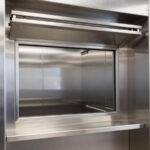
Also known as food elevator, service elevator or small cargo elevator, the dumbwaiter is a small special freight elevator strictly prohibited from carrying personnel in accordance with national regulations. It features small size, tiny floor occupation, flexible installation, low energy consumption and simple operation.
Mainly applicable to star hotels, catering restaurants, staff canteens, commercial office buildings and community properties, it is used to transport meals, tableware, documents, small materials and consumable accessories, efficiently solving the problem of vertical transportation of small items and greatly improving the operational efficiency of venues. Because the duty cycle is short and the loads are light, a dumbwaiter needs far less maintenance than a passenger elevator – the dumbwaiter maintenance guide covers the full service schedule.
Who Supplies It & What It Costs
Best for: restaurants, hotels, hospitals, offices, retail units and libraries moving food, dishes, documents or small parcels between floors.
Cost level: the lowest of the eight types of elevators – a compact traction unit, a small shaft and no passenger-rated safety systems. For a per-floor and per-capacity breakdown see the dumbwaiter price guide.
Lead time: standard units ship in 15-25 working days.
Typical capacity: 100-250 kg, in window-type, floor-type and chain-type configurations. ServLifts builds these at its own factory – see the China dumbwaiter factory page.
1. OTIS (Internationally Renowned Brand)
OTIS dumbwaiters inherit the brand’s century-old core safety technology with compact and exquisite fuselage, adaptable to various narrow installation spaces. It operates accurately and stably with excellent silent effect, no start-stop stagnation or noise. Equipped with multiple safety protection functions such as intelligent overload protection, anti-jamming, automatic fault shutdown and emergency braking, it has an ultra-high safety factor.
Featuring exquisite craftsmanship, stable and durable quality and perfect intelligent configurations, it is the preferred dumbwaiter brand for high-end hotels and star-level catering scenarios.
2. Hitachi (Internationally Renowned Brand)
Hitachi dumbwaiters feature precision craftsmanship, ultra-low energy consumption and long-term stable operation. The compact fuselage adapts to various special-shaped and narrow shaft installation scenarios. Adopting variable frequency speed regulation technology, it starts and stops gently and evenly without bumping or abnormal noise, with ultra-low daily operation energy consumption, convenient operation and maintenance and ultra-low failure rate.
With stable quality and outstanding market reputation, it is widely used in high-end catering, commercial buildings and clubs.
3. ServLifts (Niche Cost-Effective Brand)
ServLifts is a professional high-quality niche brand focusing on the R&D, production and supporting services of dumbwaiters. Its factory is located in Suzhou, China’s national core elevator industrial base, relying on a complete elevator industrial chain to provide mature production technology and strict quality control system.
It provides full-range dumbwaiters including window-type, floor-type and chain-type, supporting customized load capacity from 100kg to 250kg and personalized size adjustment. All products comply with EU CE safety standards with reliable and compliant quality. Standard products can be delivered within 15-25 working days, with 12-month full-machine warranty, lifelong remote technical support, sufficient spare parts inventory and efficient delivery.
New customers can enjoy exclusive first-order discounts, delivering far better cost performance than similar imported and domestic mainstream brands, making it a high-quality choice for commercial and catering dumbwaiters.
Browse the full ServLifts dumbwaiter range or read more about the dumbwaiter manufacturer in China behind it.
In summary, the eight categories of elevators fully cover the vertical transportation needs of all building scenarios, with significant differences in performance, applicable scenarios and brand positioning. In the selection process, users can match the optimal elevator solution according to project scenarios, load requirements and budget standards, combining the stable quality of top international brands and the high cost performance of overseas niche brands.
This selection method balances safety, practicality and economy, and fully meets the supporting construction needs of various architectural engineering projects.
Which Type of Elevator Do You Need?
Which type of elevator is best for a restaurant? For restaurants, cafes, hotels and catering kitchens the dumbwaiter (type 8) is almost always the right answer. It moves food, dishes and supplies between floors without the shaft, machine room and cost of a passenger elevator, and it is the only type in this list designed specifically for kitchens.
Is a dumbwaiter a type of elevator? Yes. Technically a dumbwaiter is a small freight elevator for goods only. It falls under service-lift standards such as EN 81-3, is listed under ASME A17.1 in North America, and is classified as one of the eight types of elevators by function.
Can a dumbwaiter carry people? No. A dumbwaiter is strictly goods-only and must never carry passengers. Where people need to travel between floors you need a passenger elevator or a small home lift instead.
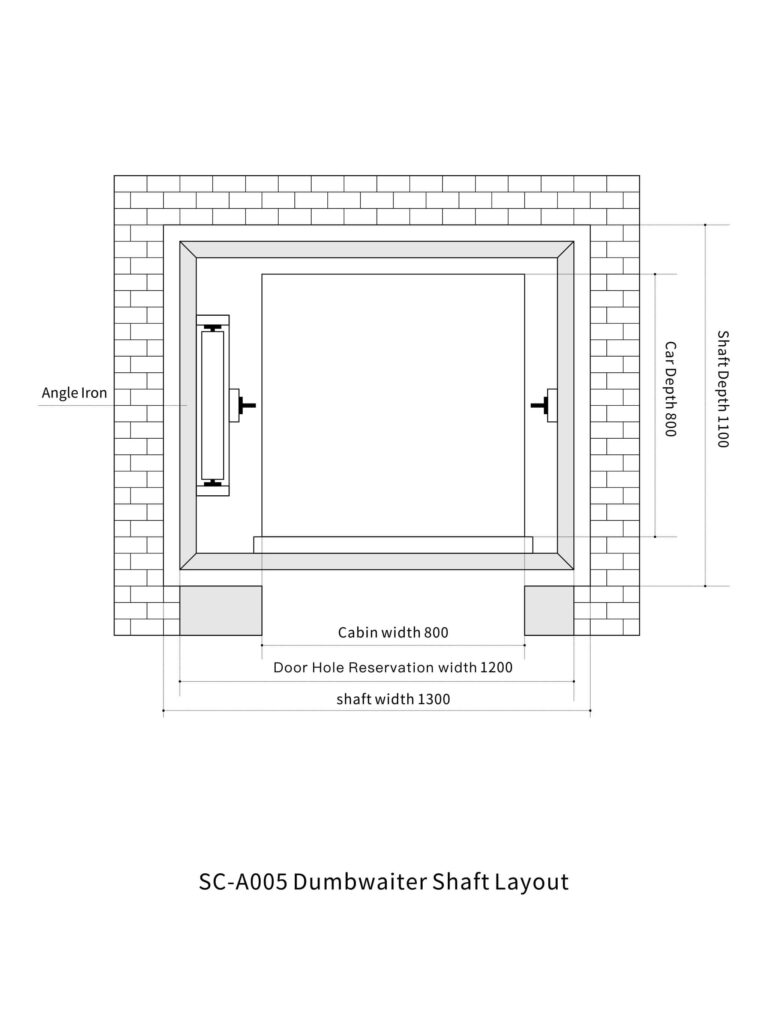
How much space does a dumbwaiter need compared with other types of elevators? Far less – a standard unit fits in a shaft of roughly 1 m x 1 m and takes no machine room above. The dumbwaiter dimensions guide lists shaft, car and opening sizes for every capacity.
Choosing among the eight types of elevators depends on your building requirements, budget, and intended use. For commercial kitchens and restaurants, the dumbwaiter is the most practical type of elevator for transporting food and supplies between floors. If you want to know why hospitality buyers increasingly choose a specialist supplier rather than a major brand, read why a dumbwaiter does not have to come from a big elevator company. Contact ServLifts for guidance on selecting the right dumbwaiter for your business.
[…] are still comparing lift categories rather than dumbwaiter types, start with our overview of the main types of elevators. Working with a professional dumbwaiter specialist can streamline quotation, design and […]
[…] installation footprint. If you want the full classification of every type of elevator, see our types of elevators […]
[…] documents, and a buyer who uses the “wrong” term locally looks like an outsider. Our guide to the eight types of elevator shows how much of the wider lifting vocabulary is regional in exactly the same […]
[…] confusion that partly comes from how loosely the category is described elsewhere in the trade (see how dumbwaiters sit inside the wider elevator classification). That is not correct. EU dumbwaiter regulations are not a single rulebook; they are a routing […]
[…] distinta. Si quieres la clasificación completa de todos los tipos de elevadores, consulta nuestra guía de tipos de elevadores (en […]