Welcome to ServLifts Official Website

Industrial Dumbwaiter: Best 300 kg Factory Lift Guide

Table of Contents
- Quick Answer: What an Industrial Dumbwaiter Is and Is Not
- Where an Industrial Dumbwaiter Lift Earns Its Place
- Load, Size and Speed Limits: 300 kg, 1.0 m2, 1 m/s
- Industrial Dumbwaiter Lift Specifications You Can Order Today
- How to Size an Industrial Dumbwaiter Lift for a Real Workflow
- Traction, Hydraulic or Screw: What Suits a Factory Floor
- Where the Boundary With a Goods Lift Sits
- Regulations: Machinery Directive, EN 81-30 and EN 81-31
- Shaft, Pit and Headroom in an Existing Factory Building
- Cost, Lead Time and What Moves the Price
- Buyer Checklist: 7 Things to Verify Before You Order
- Frequently Asked Questions
- Next Step
An industrial dumbwaiter is a permanently installed, non-passenger goods lift that moves loads of up to 300 kg between two and six defined floors, inside a shaft built too small for a person to enter. It is rope, positive or hydraulically driven, it needs no lift attendant, and it is far cheaper to run than a goods lift of the same travel. What it cannot do is carry people, carry a palletised ton, or be built out of a doorway that a person can walk through.
This guide is written for plant engineers, facility managers and importers who need to move small, heavy, awkward items vertically without installing a full goods lift. It sets out the hard limits an industrial dumbwaiter lift has to work inside, the specifications available from a factory in China today, the regulations that decide which product you are legally buying, and the seven checks that separate a working installation from an expensive one.
Quick Answer: What an Industrial Dumbwaiter Is and Is Not
An industrial dumbwaiter is the smallest class of lifting equipment that a factory, warehouse or food plant can install. It is defined by its carrier, not by its application: the car is deliberately made too small and too shallow for a person to enter, and that single design fact is what keeps the unit under the machinery rules rather than the lift rules.
- It is: a fixed, guided, powered lifting appliance serving defined landing levels, rated up to 300 kg, for goods only.
- It is not: a passenger lift, a wheelchair platform, a pallet lift, or a way to move a person between floors under any circumstances.
- It is usually: rope-driven (traction), with a steel car or a stainless steel car, a landing door or shutter at every stop, and call and send stations at each level.
- It is often confused with: a small freight elevator. The two overlap in load, and they diverge completely in law, price and installation cost.
The practical consequence of the definition is that an industrial dumbwaiter can be installed in a building core that has no space for a goods lift: a corner of a mezzanine, a cupboard between two production halls, or an external steel tower bolted to the wall. Factory-direct units of this class, built in Suzhou, China, are shipped with CE marking, a declaration of conformity and a free CAD shaft drawing, with standard lead time of 15 to 25 working days.
Where an Industrial Dumbwaiter Lift Earns Its Place
An industrial dumbwaiter lift pays for itself wherever a small load has to move up or down repeatedly and no one is willing to walk it. The pattern is always the same: a load that is heavy enough to hurt a person but too small to justify a goods lift, moving a distance that is one floor too many.
Moving parts and tooling between production floors
On multi-level manufacturing sites, an industrial dumbwaiter carries jigs, moulds, dies, sample batches and spares between a ground-floor store and an upper assembly floor. Loads are typically in the 50 to 200 kg band, arrive on a small trolley or in a tote, and are needed within minutes rather than on a schedule. An industrial dumbwaiter removes the trip without consuming floor space on either level.
Warehouse, dispatch and packing mezzanines
In distribution and packing operations the vertical move is between a mezzanine pick face and the ground-floor dispatch lane. An industrial dumbwaiter lift shortens that loop, keeps people off stairs with loads in their hands, and does it without a shaft that eats a pallet position on each level.
| Industrial setting | Typical load | Why an industrial dumbwaiter fits |
|---|---|---|
| Machining and fabrication shops | 30 to 150 kg | Tools, fixtures and cut stock move in small batches between floors |
| Assembly plants | 50 to 250 kg | Sub-assemblies and kitted parts travel one or two levels to the line |
| Warehouse mezzanines | 50 to 300 kg | Picked totes and cartons move down to packing without a pallet truck |
| Food and beverage plants | 50 to 250 kg | Ingredients, samples and trays move in washable stainless cars |
| Pharmaceutical and lab buildings | 20 to 100 kg | Samples and consumables move in a closed, lockable carrier |
| Print, textile and packaging plants | 100 to 300 kg | Rolls, reels and stacks are heavy but compact |
| Vehicle and equipment workshops | 50 to 200 kg | Parts, batteries and tooling move to a first-floor store |
The common thread is that none of these flows needs a person in the car, none needs more than 300 kg, and all of them are worse served by carrying the load up a staircase. Where a load does grow past that ceiling, the decision that matters is the one between an industrial dumbwaiter and a small freight elevator, not the one between two suppliers of the same machine.
In most markets the manual alternative is regulated work as well. General duties such as the OSHA materials handling standard exist because lifting and carrying by hand is one of the largest single sources of injury in industrial buildings. An industrial dumbwaiter removes the lift itself rather than training people to perform it more carefully.
Load, Size and Speed Limits: 300 kg, 1.0 m2, 1 m/s
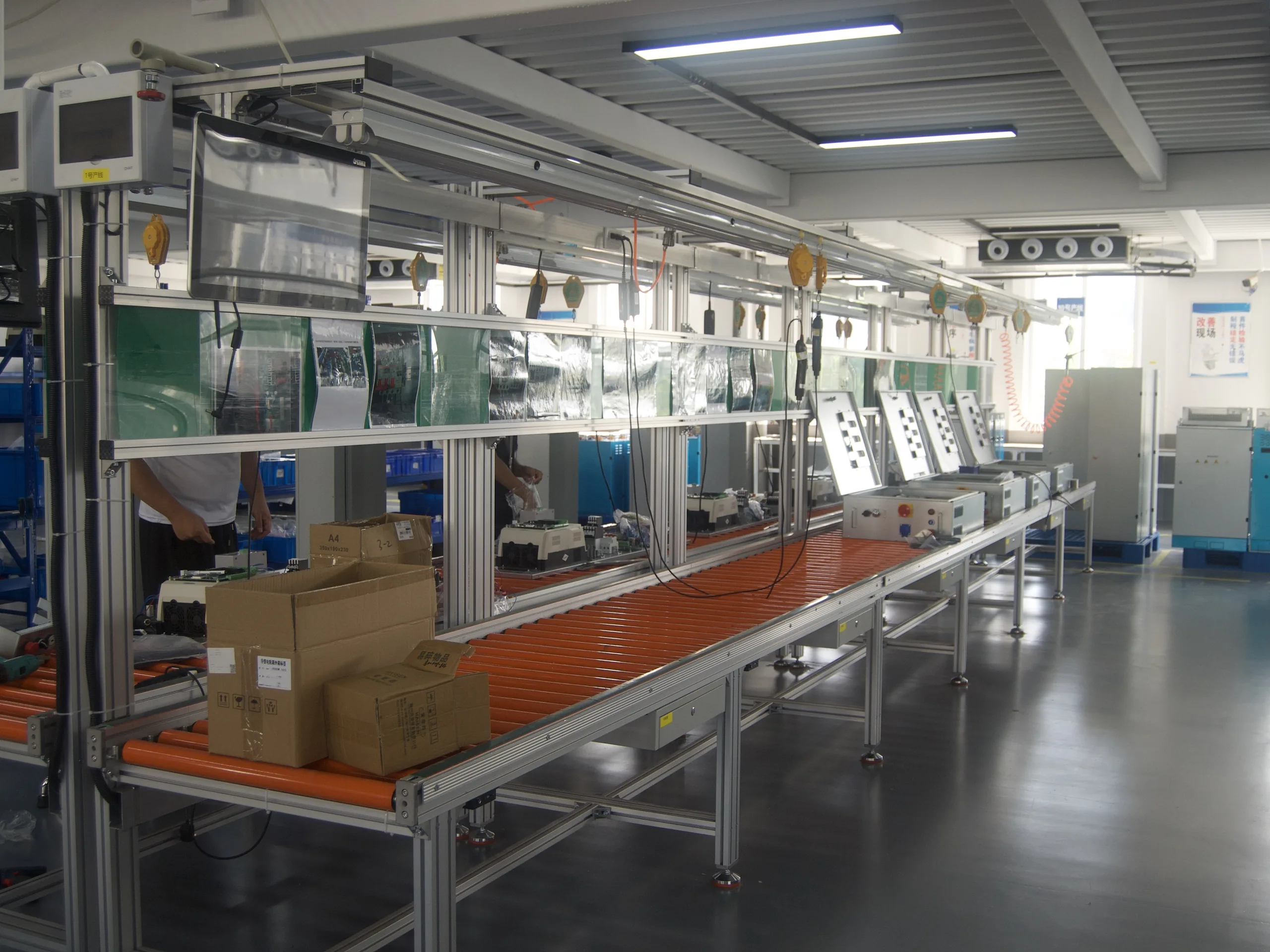
The limits of an industrial dumbwaiter are set by standard, not by preference. Under EN 81-30:2025 the carrier is capped on four dimensions at once, and a design that breaks any one of them leaves the industrial dumbwaiter category entirely.
| Parameter | EN 81-30:2025 limit | What it means on a real site |
|---|---|---|
| Rated load | Not more than 300 kg | A 200 kg tote is comfortable; a 500 kg pallet is out of scope |
| Car floor area | Not more than 1.0 m2 | Roughly one square metre of usable floor in the car |
| Car depth | Not more than 1.0 m | Deep trolleys have to be reconsidered or loaded outside the car |
| Car height | Not more than 1.20 m | Tall carts will not fit; shelves suit this class better |
| Rated speed | Up to 1 m/s | Fast enough for two to six landings, not a substitute for a lift |
| Guide rail inclination | Not more than 15 degrees from vertical | An inclined industrial dumbwaiter is a different machine class |
Two operational limits matter as much as the standard for an industrial dumbwaiter. First, the car is inaccessible to persons by design, and EN 81-30:2025 treats that inaccessibility as the safety case; a unit that a person can physically step into is not covered by this standard at all. Second, standard load ratings in production today are 50 kg, 100 kg, 200 kg, 250 kg and 300 kg, with custom ratings available inside the same ceiling. Standard travel is two to six floors, and more stops can be engineered where the building height allows.
The consequence is a workflow rule rather than a technical one. If a load needs two people to lift it onto a shelf, an industrial dumbwaiter can move it. If a load needs a pallet truck, a fork position or a ride-along operator, it has already outgrown the class. Car sizes and the clearances they need are set out in the dumbwaiter dimensions guide, which is best read alongside the standard rather than instead of it.
Industrial Dumbwaiter Lift Specifications You Can Order Today
The specification below is the standard configuration produced for export, and it is the fastest way to check whether an industrial dumbwaiter lift covers an intended duty before a supplier is contacted.
| Specification | Standard range | Notes for specifiers |
|---|---|---|
| Rated load | 50 / 100 / 200 / 250 / 300 kg | Custom ratings available at or below 300 kg |
| Floors served | 2 to 6 standard | More landings engineered on request |
| Car sizes | 60x60x80 cm up to 100x100x120 cm | The largest sits at the standard ceiling of 1.0 m2, 1.0 m and 1.20 m |
| Drive | Traction, rope-driven | Positive and hydraulic options for specific sites |
| Power supply | 220 V single phase or 380 V three phase | Confirm at order; the voltage follows the destination country |
| Car finish | Stainless steel 304 or 316 | 316 for wet, salted or acidic environments |
| Control | Controller with call and send station per landing | Interlocked doors, travel limits and overload protection included |
| Documentation | CE marking, declaration of conformity, free CAD shaft drawing | The drawing is issued before civil work starts |
| Delivery terms | FOB, CIF or DDP | Shipped from Shanghai or Ningbo |
| Lead time | 15 to 25 working days | 25 to 45 working days for custom builds or peak season |
| Warranty | 12 months on the whole machine | Spare parts are dispatched within 3 working days |
Dimensions of an industrial dumbwaiter are quoted as width x depth x height of the car, and they drive the shaft size, not the other way round. A shaft drawing produced from the car size is the document a contractor needs, which is why a free CAD shaft drawing issued before the order is a working advantage rather than a marketing line. Sites that need a low headroom arrangement, a through-loading car or a two-door configuration should raise it at quotation stage, because those choices change the shaft, not just the car.
How to Size an Industrial Dumbwaiter Lift for a Real Workflow
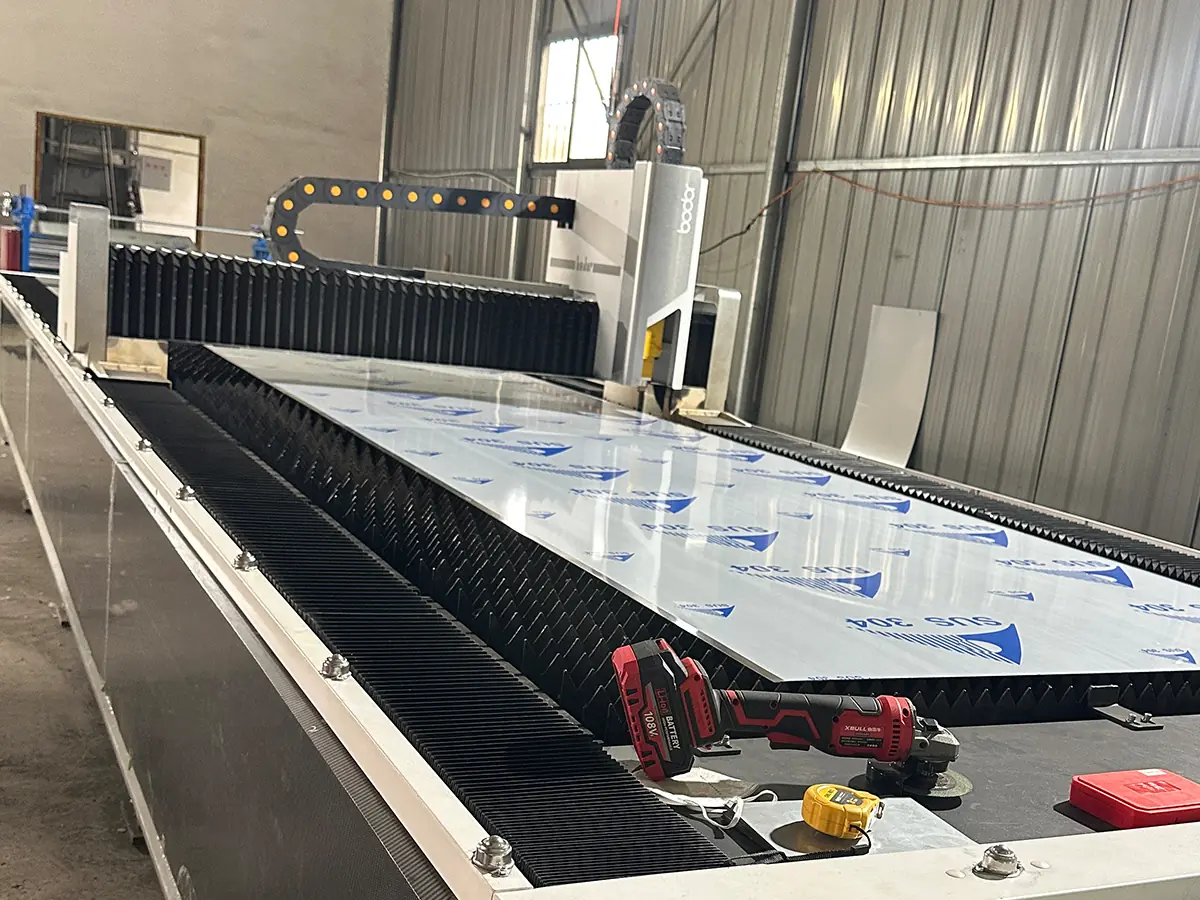
Sizing an industrial dumbwaiter lift is a sequence of six measurements, and doing them in order prevents the most expensive mistake in this category: ordering a car that cannot take the loads the plant actually produces. The sequence is the one used in the dumbwaiter selection guide, applied here to loads that are heavier and more repetitive than a kitchen tray.
- Weigh the real load, not the average load. Weigh the heaviest tote, tray or fixture that will ever enter the car, add any packaging, and round up. The rating you order is the number you will live with for fifteen years.
- Measure the footprint and height of the container. A 1200 mm deep trolley will not fit a 1000 mm deep car. The car dimensions follow the container, and EN 81-30:2025 caps the car at 1.0 m2, 1.0 m deep and 1.20 m high.
- Count the landings and the floor-to-floor heights. Standard travel is two to six floors. Each landing needs a door or shutter, a call or send station, and the same clear opening.
- Check pit and headroom on site. Measure the available vertical space at the bottom and top landing before the car is chosen. Low headroom arrangements exist, but they must be designed in from the start.
- Decide how the load enters. A trolley rolled in needs a doorway and a floor finish that lets it roll; a hand-loaded car needs a comfortable working height.
- Fix the electrical supply. The unit runs on 220 V single phase or 380 V three phase, and it needs one isolator at the machine position, not a socket at every landing.
A reversed approach is the most common source of rework: buying a car size for an industrial dumbwaiter first and then discovering that the plant’s standard tote does not fit. The cheapest correction is a shaft drawing produced against the real container, reviewed by the site contractor, and signed off before the pit is formed.
Traction, Hydraulic or Screw: What Suits a Factory Floor
Drive choice for an industrial dumbwaiter is a site decision, not a price decision. Each drive type changes the shaft, the pit, the headroom and the maintenance regime, and each one has a travel band where it is clearly the better answer.
| Drive | Best travel band | Site implications |
|---|---|---|
| Traction, rope-driven | Two to six floors | Lowest running cost at speed, needs headroom for the machine, no oil |
| Hydraulic | Two to three floors, heavier cars | Small headroom, larger footprint for the power unit, oil management |
| Positive or screw drive | Low travel, simple duty | Compact and simple, lower speed, rarely chosen above 300 kg |
If travel is two to six floors and the load is at or below 300 kg, then traction is normally the better choice, because the running cost per cycle is lower and no hydraulic oil has to be stored, monitored or replaced. If headroom is the binding constraint and the travel is short, a hydraulic industrial dumbwaiter solves a site problem that traction cannot, and paying for that solution is rational. The mistake is choosing hydraulic for a six-floor factory because the quotation looked simpler.
Where the Boundary With a Goods Lift Sits
The boundary between an industrial dumbwaiter and a goods lift is drawn in law, and it is crossed the moment a unit either exceeds 300 kg or becomes accessible to a person. Both conditions change the applicable standard, the conformity route, the inspection regime and the installation cost.
| Attribute | Industrial dumbwaiter | Accessible goods lift | Passenger lift |
|---|---|---|---|
| Rated load | Up to 300 kg | Above 300 kg | Persons and goods |
| Can a person enter the car | No, by design | Yes | Yes |
| Reference standard | EN 81-30:2025 | EN 81-31:2024 | EN 81-20 and EN 81-50 |
| EU legal basis | Machinery Directive 2006/42/EC | Machinery Directive 2006/42/EC | Lifts Directive 2014/33/EU |
| Typical shaft footprint | Under 1.5 m2 | Several square metres | Several square metres |
| Installation impact | Low, often a shaft in the core or an external tower | High, civil structure and pit | Highest |
Read the table as a decision rule. If the load stays at or below 300 kg and nobody can physically step into the carrier, the correct product is an industrial dumbwaiter under EN 81-30:2025 and the Machinery Directive. If either condition fails, the correct product is a goods lift, which in Europe means EN 81-31:2024 for accessible goods-only lifts, and the project has moved into a much larger budget bracket.
Regulations: Machinery Directive, EN 81-30 and EN 81-31
An industrial dumbwaiter is machinery, not a lift, in the eyes of European law, and that distinction decides which paperwork a buyer should expect to receive.
The codes a buyer is most likely to be asked about are collected in the dumbwaiter regulations reference. The summary below keeps to the clauses that decide which product class a project falls into.
In the European Union, an industrial dumbwaiter is a non-passenger service lift covered by the Machinery Directive 2006/42/EC, and the harmonised standard that gives the design presumption of conformity is EN 81-30:2025, published in December 2025 as part of the EN 81 series for lifts carrying goods only. It replaces EN 81-3:2000+A1:2008, which had governed this product class for two decades. Accessible goods-only lifts above the 300 kg and 1.0 m2 envelope are covered by EN 81-31:2024 instead, and passenger-carrying units fall under the Lifts Directive 2014/33/EU, a different legal instrument with a different conformity route.
| Market | Legal instrument | Standard for this product class | What the buyer should hold |
|---|---|---|---|
| European Union | Machinery Directive 2006/42/EC until 19 January 2027 | EN 81-30:2025 | CE marking and a declaration of conformity naming the standard |
| European Union, from 20 January 2027 | Machinery Regulation (EU) 2023/1230 | EN 81-30:2025 | Technical file, declaration of conformity, digital documentation accepted |
| United Kingdom | Supply of Machinery (Safety) Regulations 2008, UKCA or CE marking; use: PUWER 1998 and LOLER 1998 | BS EN 81-30:2025 | Declaration of conformity plus thorough examination records |
| United States and Canada | State and provincial adoption of the safety code | ASME A17.1 / CSA B44 | Code compliance documentation and local acceptance inspection |
| Other export markets | National adoption of EN or ASME families | EN 81-30 or ASME A17.1 | Standard reference stated on the declaration of conformity |
The transition date is the single most useful fact in this section for anyone placing an order in 2026. Machinery Directive 2006/42/EC remains the applicable law until 19 January 2027, and Regulation (EU) 2023/1230 applies on a mandatory basis from 20 January 2027, with no dual-application window for units placed on the market after that date. A modern industrial dumbwaiter order should therefore arrive with design verification records and a declaration of conformity that states the standard reference, and a file that is already structured for the documentation duties the Regulation introduces.
The technical changes in EN 81-30:2025 are concrete rather than cosmetic. Electrical safety moved to Performance Levels under EN ISO 13849-1 with explicit EMC requirements; door locking added electrical safety devices, a minimum engagement depth of 7 mm and impact testing; rope terminals must reach 80 per cent of minimum breaking force; hydraulic circuits restrict compression fittings and require oil temperature monitoring. Buyers do not need to verify those clauses personally, but the standard reference on the paperwork tells them which generation of design they are being sold.
Shaft, Pit and Headroom in an Existing Factory Building
An industrial dumbwaiter is one of the few vertical transport products that can usually be retrofitted into a building that was never designed for one. That flexibility comes from its small car, and it still requires three site conditions to be satisfied before the order is placed.
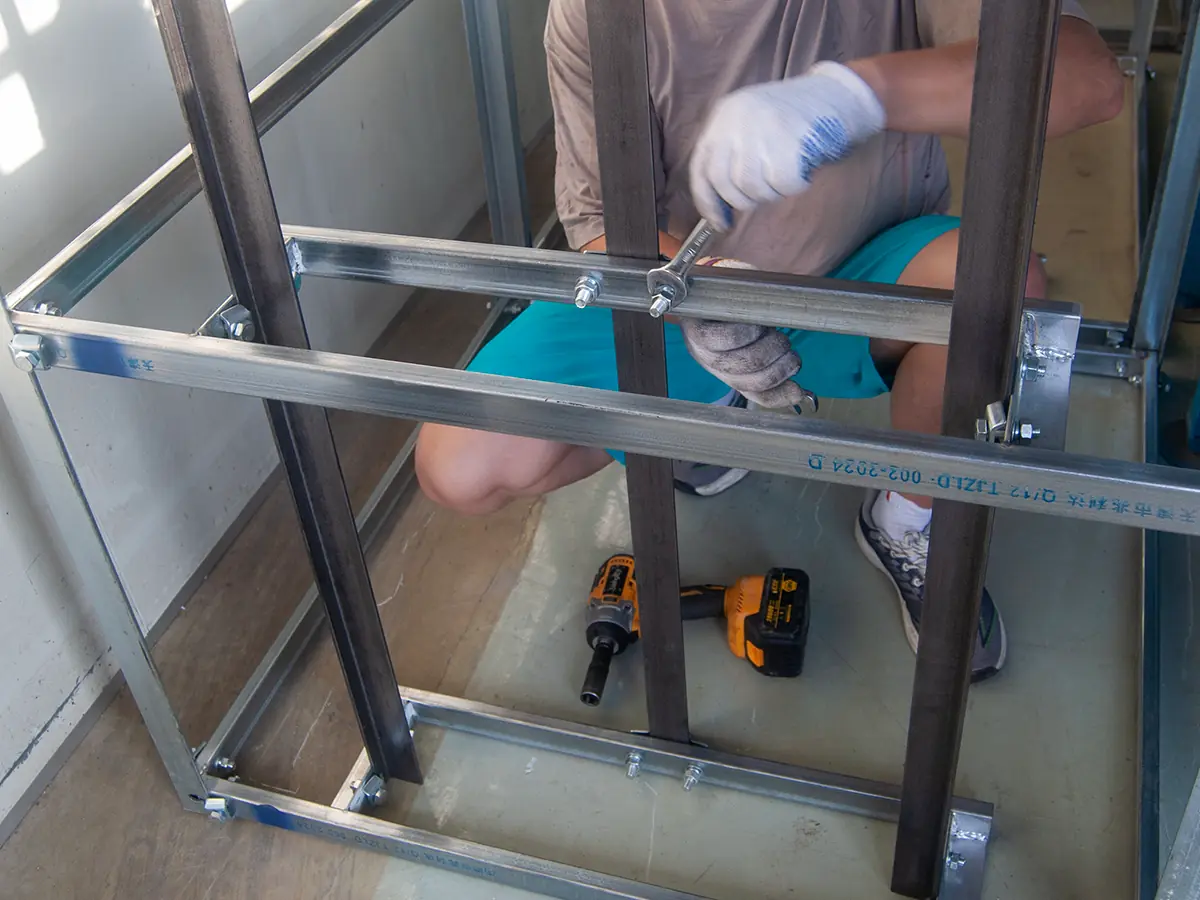
The shaft can be masonry, a bolted steel frame, or an external tower fixed to the building. The site sequence that keeps those three options open is set out in the dumbwaiter installation guide. Because the car of an industrial dumbwaiter is small, the shaft can be placed in a service core, a cupboard or a corner of a production hall, and an external shaft avoids touching the internal layout altogether. A low headroom arrangement is available for buildings with limited space above the top landing, and it must be identified at the specification stage rather than on site.
Pit and headroom are usually the two constraints that decide whether an industrial dumbwaiter is feasible. The available depth below the bottom landing and the clear height above the top landing determine whether the unit can be standard or has to be engineered, and both are measured, not estimated. Where neither is available, the project should be re-examined as a different product class before any deposit is paid.
Power and control for an industrial dumbwaiter are simple by lift standards: one supply of 220 V single phase or 380 V three phase, and call or send stations at every landing. The load test, the CE file and the free CAD shaft drawing are issued by the factory, and the drawing is the document that lets a local contractor build the shaft to the right clear dimensions the first time. A plant that hands that drawing to its builder before forming the pit typically avoids the two most expensive retrofit errors: a shaft that is too shallow for the car and a headroom that is too low for the machine.
Cost, Lead Time and What Moves the Price
Cost of an industrial dumbwaiter is driven by load rating, number of landings, car dimensions, finish and how much of the shaft structure is supplied with the machine. Comparing quotations without normalising those five variables is the usual reason two prices for the same duty look impossibly far apart.
The supply route matters as much as the specification, and it can be read as a ladder. A factory-direct supplier sits at the bottom of the price range; a trading company adds a margin for sourcing; a regional distributor adds stock, local service and import costs; a major lift brand adds brand, certification overheads and project management. The ladder does not say which rung is correct for a project. Standard shaft, complete documentation and a confirmed spare-parts route favour the factory-direct rung, while a site that needs a local engineer on a service contract may reasonably pay for the distributor rung.
Lead time follows the same logic. Standard industrial dumbwaiter units ship in 15 to 25 working days from order confirmation, and custom builds or peak season can extend that to 25 to 45 working days. Spare parts are held in stock and dispatch within 3 working days. Freight runs from Shanghai or Ningbo under FOB, CIF or DDP terms, and the whole lift travels packed in moisture-proof and shock-proof wooden cases. Buyers should treat the shipping term as a cost decision with a documentation consequence, because DDP door-to-door duty-paid moves the import formalities to the seller while FOB leaves them with the buyer.
The full cost of ownership is a separate calculation from the purchase price, and it is covered in detail in the guide to installation cost and in the analysis of dumbwaiter running cost.
Buyer Checklist: 7 Things to Verify Before You Order
Seven checks separate a supplier who can deliver an industrial dumbwaiter that passes inspection from one who can only deliver a quotation. Each has a document trail, and each is verifiable before a deposit is paid.
| Check | How to verify it | Warning sign |
|---|---|---|
| Standard reference on the declaration of conformity | Ask for the declaration and read the clause that names the harmonised standard | The standard is not named, or an old edition such as EN 81-3 is still quoted |
| Design verification records | Ask what the manufacturer retains against the design and for how long | Only a certificate is offered, with no design file behind it |
| Load test records | Ask for the test report format used at final inspection | Load testing is described only in words |
| Drawings before the order | Request a CAD shaft drawing against your real car size | Drawings are offered only after the deposit |
| Spare parts route | Ask which parts are held in stock and what the dispatch promise is | No stated dispatch time, or parts quoted per request only |
| Voltage and supply configuration | Confirm 220 V single phase or 380 V three phase against the site supply | The voltage is left blank until shipping |
| Clear definition of what is not included | Compare the exclusion list against the site scope | No exclusion list at all |
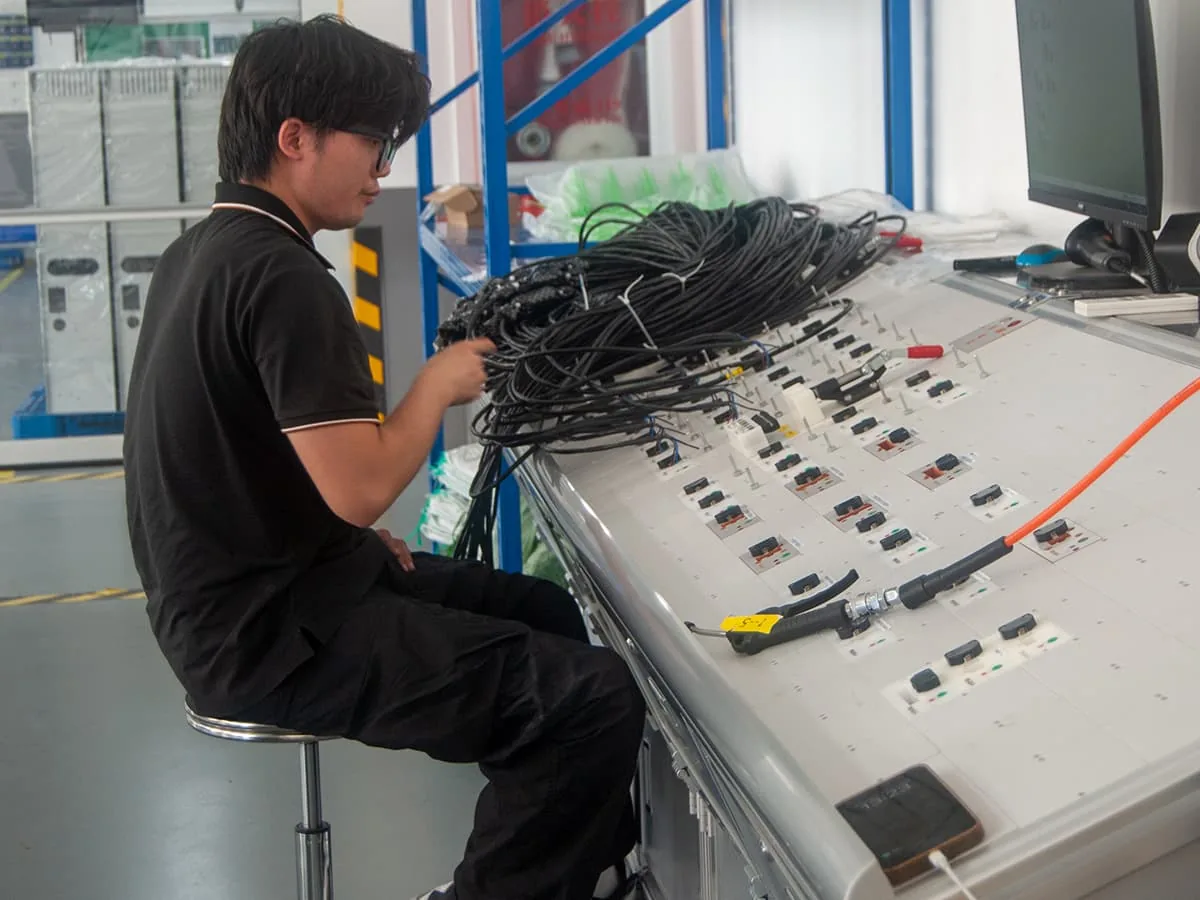
For importer-specific checks, including the documents a customs broker will ask for and how to compare two suppliers quoting the same duty, see the supplier verification guide and the notes on importing a dumbwaiter from China. Buyers who want to apply the same list to the place where units are actually assembled will find it in the china dumbwaiter factory notes.
Frequently Asked Questions
What is the maximum load for an industrial dumbwaiter?
The rated load is capped at 300 kg by EN 81-30:2025, and standard production ratings are 50 kg, 100 kg, 200 kg, 250 kg and 300 kg. Custom ratings are available at or below the 300 kg ceiling. A load above 300 kg, or a person able to enter the car, moves the project into the accessible goods lift class under EN 81-31:2024.
Can people ride an industrial dumbwaiter?
No. An industrial dumbwaiter is a non-passenger appliance by design, and its right to exist under the machinery rules depends on the carrier being inaccessible to persons. An operator who rides one removes the legal basis for the CE marking, voids the insurance position of the site, and creates the single most serious safety exposure in this product class.
How many floors can an industrial dumbwaiter lift serve?
Standard travel is two to six floors, and additional landings can be engineered where building height allows. Rated speed is up to 1 m/s, which keeps journey time short across the standard range. For a project above six landings, the shaft, the drive and the documentation all need to be reviewed as a bespoke design, not as a standard unit.
Does an industrial dumbwaiter need a machine room?
No separate machine room is needed. The drive sits in the shaft head or in a compact machinery space, and a low headroom arrangement is available where the building has limited space above the top landing. Each landing still needs a door or shutter, a call or send station, and the same clear opening as the others.
What lead time should I plan for?
Standard industrial dumbwaiter units ship in 15 to 25 working days from order confirmation. Custom builds and peak season can extend that to 25 to 45 working days. Spare parts are held in stock and dispatch within 3 working days, and freight runs from Shanghai or Ningbo under FOB, CIF or DDP terms.
Next Step
ServLifts manufactures industrial dumbwaiter lifts in Wujiang, Suzhou, in China’s Yangtze River Delta, and supplies them factory-direct with CE marking, a declaration of conformity and a free CAD shaft drawing. Standard loads are 50 kg to 300 kg, standard travel is two to six floors, and both 220 V and 380 V builds are available.
Send the load weight, the container footprint, the number of landings and the floor-to-floor heights, and the next document you receive will be a shaft drawing and a quotation against your own duty. Where the duty turns out to be above 300 kg or accessible to a person, that will be stated at the quotation stage rather than discovered after the order, because the correct product would then be a goods lift and not an industrial dumbwaiter. Contact the factory team at ServLifts to start that review.