Welcome to ServLifts Official Website

Dumbwaiter Noise: How Loud It Really Is, and How to Bring It Down
Dumbwaiter noise explained: what a food lift really sounds like in a hotel, restaurant or home, six sources, and why the same machine reads 55 or 85 dB(A).

A dumbwaiter is quiet by the standards of machinery and loud by the standards of a bedroom. That gap is where complaints come from, and it is not closed by asking a supplier for a lower decibel figure. Dumbwaiter noise is produced by six different parts of the machine, measured at a point nobody has agreed on, and judged against a limit that no lift standard writes down.
This guide covers all three: where the sound comes from, why the same unit reads 55 dB in one building and 85 dB in another, and what to put in the order so noise does not become a dispute after handover. If you are still fixing shaft size and power supply, the dumbwaiter installation guide covers that first.
- Quick Answer: How Loud a Dumbwaiter Actually Is
- Why Dumbwaiter Noise Is a Project Problem, Not a Code Problem
- The Six Sources of Dumbwaiter Noise
- Why the Same Machine Reads 55 dB Here and 85 dB There
- Low Frequency: What a dB(A) Reading Hides
- Traction or Hydraulic: Which Drive Sets the Floor
- Where the Machine Sits Decides Who Hears It
- Seven Decisions That Lower Noise Before the Unit Is Built
- How to Measure Dumbwaiter Noise on Site
- What to Write Into the Order
- Frequently Asked Questions
- Next Step
Quick Answer: How Loud a Dumbwaiter Actually Is
A two- to four-stop traction dumbwaiter rated 100 to 250 kg typically produces 55 to 75 dB(A) at one metre from the traction machine inside the machine space, and 30 to 45 dB(A) in the room on the other side of the shaft wall. Both numbers describe the same machine on the same day. The first is what a supplier quotes; the second is what decides whether the project succeeds.
Three figures frame the problem. The WHO night guideline for bedrooms is 40 dB Lnight outdoors, about the level of a quiet library. A landing door closing is a short event well above that. And the European lift safety standard sets no noise limit at all — a unit can pass every test in it and still keep a guest awake.
So there is no compliance answer to dumbwaiter noise. There is a project answer, and it has to be written down before the equipment is ordered.
Why Dumbwaiter Noise Is a Project Problem, Not a Code Problem
Buyers often assume a CE-marked dumbwaiter has been checked against a noise limit. It has not. EN 81-20:2020, the harmonised safety standard for lifts under the EU Lift Directive, states in its scope that noise and vibration are not dealt with, because they are not found at levels that could be considered harmful with regard to safe use and maintenance. Both the published EN 81-20 standard and the Lift Directive 2014/33/EU are concerned with safety, not acoustics.
That is a division of responsibility, not a loophole: the standard keeps the machine from hurting anyone, and the building keeps it from annoying anyone. In practice four documents set the number you have to meet:
- The lease or hotel operating agreement — brand standards for a four-star property name a maximum background level in guest rooms, and equipment above it is a defect, not a nuisance.
- The local building code or noise ordinance — many jurisdictions limit equipment noise in habitable rooms, separately from lift law.
- The acoustic specification — where an acoustician is engaged, the dumbwaiter sits inside a room-by-room allowance shared with HVAC.
- Nothing at all — on a small restaurant or villa project the limit is whoever sleeps beside the shaft.
The last case is the most common in our markets and the one where a written number matters most. “Quiet operation” means nothing at handover; a clause naming a measurement point and a value can be tested in ten minutes.
The Six Sources of Dumbwaiter Noise
Dumbwaiter noise is not one sound but six, with different frequencies and travel paths. Fixing the loudest is often not what fixes the complaint. The table is the map; the sections after it are what each source needs.
| Source | Typical level | Dominant frequency | How it reaches people | Who complains |
| Traction machine and gearbox | 55–80 dB(A) at 1 m in the machine space | Low, 31.5–250 Hz | Machine base into the slab, re-radiated below | The floor under the machine |
| Guide rails and shoes | 65–80 dB(A) inside the shaft | Mid to high, impact at joints | Rail brackets into the shaft wall, floor by floor | Every room on the shaft wall |
| Ropes, sheaves, counterweight | 60–75 dB(A) inside the shaft | Mid, with rope harmonics | Sheave into the machine beam; rope slap in the shaft | Top floors and the machine space |
| Landing doors and operator | 55–70 dB(A) at 1 m outside the landing | Mid to high, short events | Directly into the corridor or kitchen | The room beside the landing |
| Control panel and drive | 50–65 dB(A) at 1 m from the panel | Fan broadband plus 100 Hz hum | Airborne from the panel, plus wall fixing | Whoever works beside the panel |
| Structure-borne re-radiation | 25–45 dB(A) inside the adjacent room | Very low, 31.5–125 Hz | Walls and floors acting as loudspeakers | The room nobody considered |
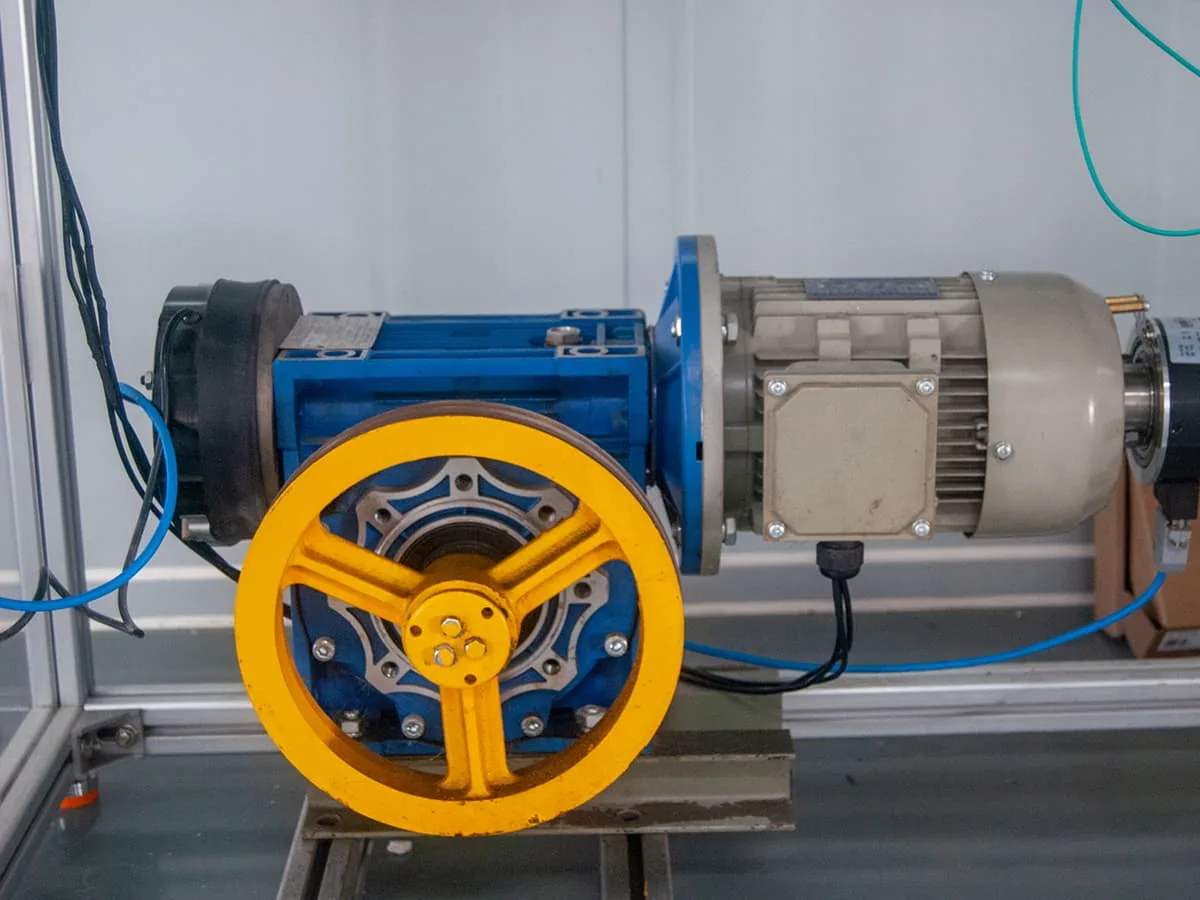
Source 1: The Traction Machine and Gearbox
The machine is where noise conversations start and where most go wrong. Its output is dominated by low frequency: motor rotation, gear mesh and brake action all sit between roughly 31.5 and 250 Hz. That band is the hardest to stop with mass, the hardest to absorb with foam, and the easiest to carry through a concrete slab.
Two machine characteristics move the level more than any site treatment: whether there is a gearbox at all, and if there is, how accurately it is cut. A gearless permanent-magnet machine removes the mesh tone entirely. Where a gearbox exists, a ground worm pair runs measurably quieter than a hobbed one — a difference bought at the factory, not fixed on site. Our range uses 0.75 kW to 1.5 kW traction machines by load and travel, so if noise is scored in your project, say so at quotation stage: machine selection is the one decision here that cannot be revisited after the unit ships.
Source 2: Guide Rails and Rail Joints
Rail noise is the most under-diagnosed cause of dumbwaiter noise complaints, because it does not sound like machinery. It sounds like a scrape or a knock at the same point in the travel every time, and it is worst where two rail sections meet. An undressed joint gives the guide shoe a step to hit, and every hit is an impulse injected into the bracket, the wall, and the room behind it.
Two fixes carry most of the benefit: grinding each joint flush at installation, and putting an elastomeric pad between bracket and wall so the impulse is not transmitted rigidly. This is also why rail noise grows over years rather than appearing at handover — as shoe clearance opens with wear, the shoe rattles instead of sliding. The dumbwaiter maintenance guide treats shoe clearance as a noise item, not only a wear item.
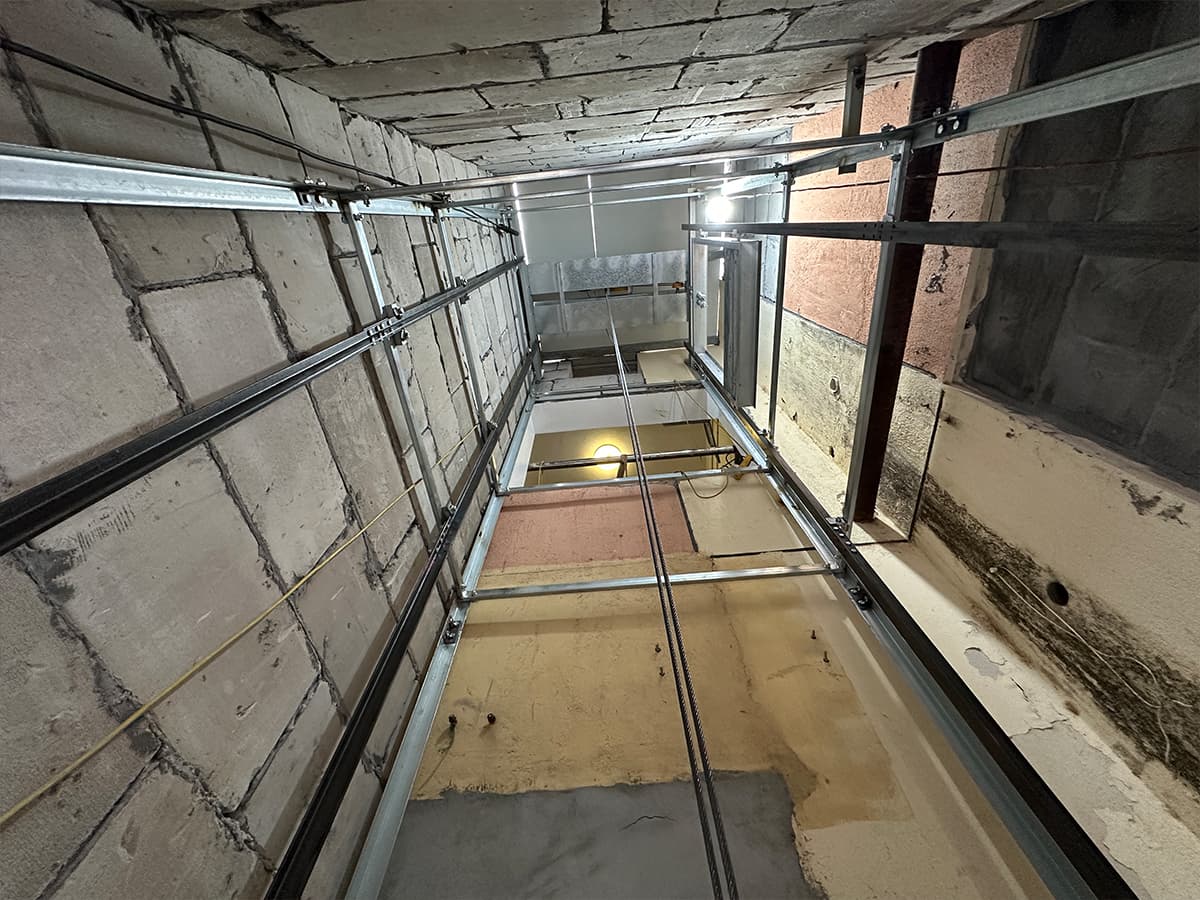
Source 3: Ropes, Sheaves and the Counterweight
Rope systems make two distinct sounds: a steady mid-frequency hum from sheave and rope contact that rises with speed, and rope slap where a rope vibrates against its neighbour or the shaft. Slap usually signals uneven tension rather than a defective rope. Because the sheave is bolted to the machine beam, rope noise and machine noise share an exit path — which is why balancing tension at commissioning is the cheapest intervention in this article. It costs an hour and removes a class of noise that no wall insulation will fix, because the source is inside the shaft.
Source 4: Landing Doors and the Door Operator
Door noise is short, repetitive and close to people, which makes it the most complained-about source per decibel. A door that closes with a bang at 02:00 in a hotel corridor is remembered longer than a machine that hums all day in a plant room nobody visits. Three things drive it: the operator and its belt or chain, the track and rollers, and the final closing action. A cushioned final travel often removes the impact with a single setting rather than a different product.
Source 5: The Control Panel and the Drive
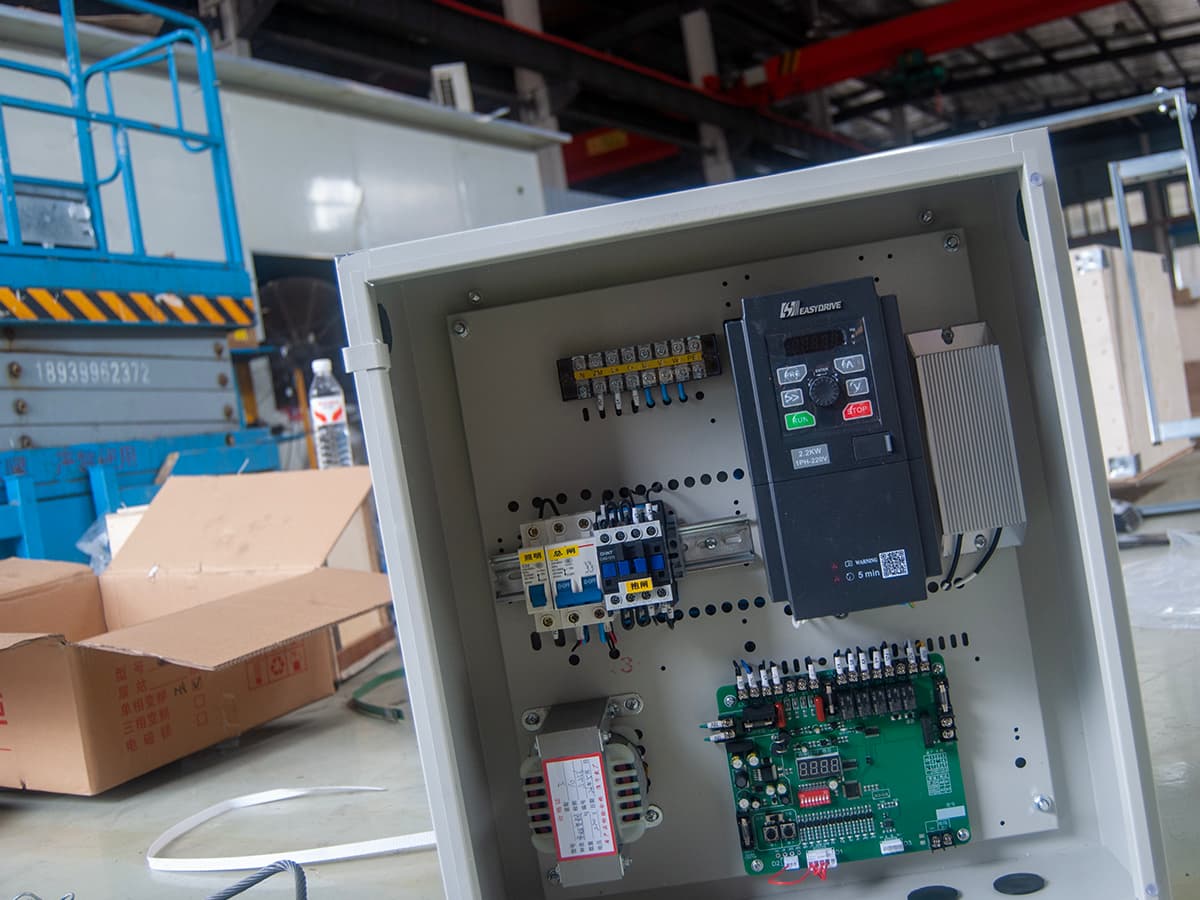
The panel contributes two noises that get confused. Fan and contactor noise is broadband and modest. The high-pitched whine from the motor comes from the variable frequency drive’s switching, and it is often blamed on the machine when the fix is a drive parameter. The drive synthesises its waveform by switching at a carrier frequency that excites the motor laminations; raising it moves the tone out of the most audible range but increases switching losses and can raise bearing currents. It is a deliberate trade-off, not a free win. The dumbwaiter control system guide covers the panel specification in full.
Source 6: Structure-Borne Paths Nobody Checks
The sixth source is not a component; it is the building acting as a loudspeaker. Vibration entering a slab or wall re-radiates as sound on the far side, and because the surface is large and the frequency low, the dumbwaiter noise seems to come from everywhere and cannot be located. Two identical machines in two identical buildings can therefore produce completely different complaints. The difference is the path: a machine bolted to a slab, a bracket cast into a wall, a conduit through a bedroom wall without a flexible sleeve. Each is a bridge, and each has to be broken at the source end rather than papered over at the receiving end.
Why the Same Machine Reads 55 dB Here and 85 dB There
When two suppliers quote 55 dB and 85 dB for comparable machines, both may be telling the truth. A dumbwaiter noise figure is meaningless without context, and quotations rarely include any of it:
- Distance and position — a compact source falls about 6 dB for every doubling of distance in a free field. One metre and four metres are not the same measurement.
- Operating state — starting, running at rated speed, decelerating and braking all differ; a start-up transient can sit 10 dB above steady running for a second or two.
- Background level — a machine measured beside a running compressor is being measured against a mask, not in silence.
- Room acoustics — a small tiled machine space reflects sound back onto the microphone; a large absorptive plant room does not.
- Weighting and averaging — dB(A) or dB(C), fast or slow, instantaneous or equivalent over a period. These are different numbers from the same event.
| Measurement point | What it tells you | Typical reading | Use it for |
| 1 m from the machine, in the machine space | Machine output before the building adds anything | 55–80 dB(A) | Comparing machines; factory acceptance |
| 1 m outside the landing door | Door and car noise where people stand | 55–70 dB(A) | Corridor and kitchen acceptability |
| Nearest occupied room, door and window closed | What the building finally delivers | 30–45 dB(A) | The only number that matters to a guest |
| Same room, at night, unit running | Low-frequency content the A-weighting hides | Measure dB(C) as well | Sleep disturbance complaints |
The conclusion is blunt: ask where the number was measured, and refuse a figure quoted without a point. A supplier who says “about 60 dB” and cannot say at what distance, in what state, with what weighting has given you a marketing number, not an engineering one.
Low Frequency: What a dB(A) Reading Hides
Almost every noise figure in this industry is A-weighted, and A-weighting deliberately discounts low frequency to imitate the ear at moderate levels. The discount is large. Per IEC 61672-1 the A-weighting correction is about −39 dB at 31.5 Hz, −30 dB at 50 Hz and −26 dB at 63 Hz, against −1.3 dB at 50 Hz for C-weighting.
Read that as a consequence. A machine whose energy sits at 50 Hz can measure 40 dB(A) in a bedroom and still be the reason somebody cannot sleep, because the energy is real and the meter has been told to ignore it. Low frequency also passes walls that stop speech cold: insulation giving 40 dB at 500 Hz may give 15 dB at 63 Hz, so the wall that makes conversation inaudible lets the hum through.
There is a field test that costs nothing extra. Measure dB(A) and dB(C) at the same point. If the C-weighted reading is more than 15 to 20 dB above the A-weighted one, the sound is low-frequency dominated and the complaint will be about pressure and vibration rather than audibility — a headache, a rattling cabinet door, a bed that seems to hum. Absorptive panels will not fix it; isolation at the source will.
Traction or Hydraulic: Which Drive Sets the Floor
The drive type changes the character of dumbwaiter noise more than any other single choice, and the two options fail in opposite ways. Traction runs continuously and quietly per unit of time; hydraulic runs briefly and loudly, then stops.
| Aspect | Traction | Hydraulic |
| Character of the sound | Steady low hum while the car moves | Pump and valve noise during the run, then silence |
| Where the source sits | Machine space or shaft top, close to the top floors | Power unit can sit away from the shaft |
| What goes wrong | Structure-borne low frequency from the machine base | Pump start impact and valve chatter through the pipework |
| When it is the better choice | Two to six stops, frequent use, hotel and restaurant service | Low rises, heavy cars, plant far from occupied rooms |
For most hotel and restaurant projects the answer is traction — not because it is quieter on paper, but because its noise is predictable and can be isolated at one known point. A hydraulic power unit is genuinely quiet if it sits in a basement plant room with isolated pipework, and genuinely bad if it ends up in a cupboard behind the bar. If the load is small enough that no drive is needed, the manual versus powered dumbwaiter comparison is the shorter route.
Where the Machine Sits Decides Who Hears It
The most consequential decision for dumbwaiter noise is made on the layout drawing, months before anyone discusses decibels: where the machine goes. Our machines can be supplied for a machine space or for shaft-top mounting, and the two put the noise in completely different places.
| Machine location | Nearest occupied space | What to build |
| Dedicated machine room above the shaft | The floor below the machine room, often a guest room or apartment | Isolated machine base, floating floor above a bedroom, sealed penetrations |
| Shaft-top mounting, no machine room | The top floor ceiling and the room beside the shaft head | Isolation inside the shaft head, acoustic lining at the shaft top, no rigid conduit into the room |
| Bottom-drive, machine in the shaft base | The lowest floor and rooms sharing the pit wall | Isolated base frame, dry pit, wall lining on the occupied side |
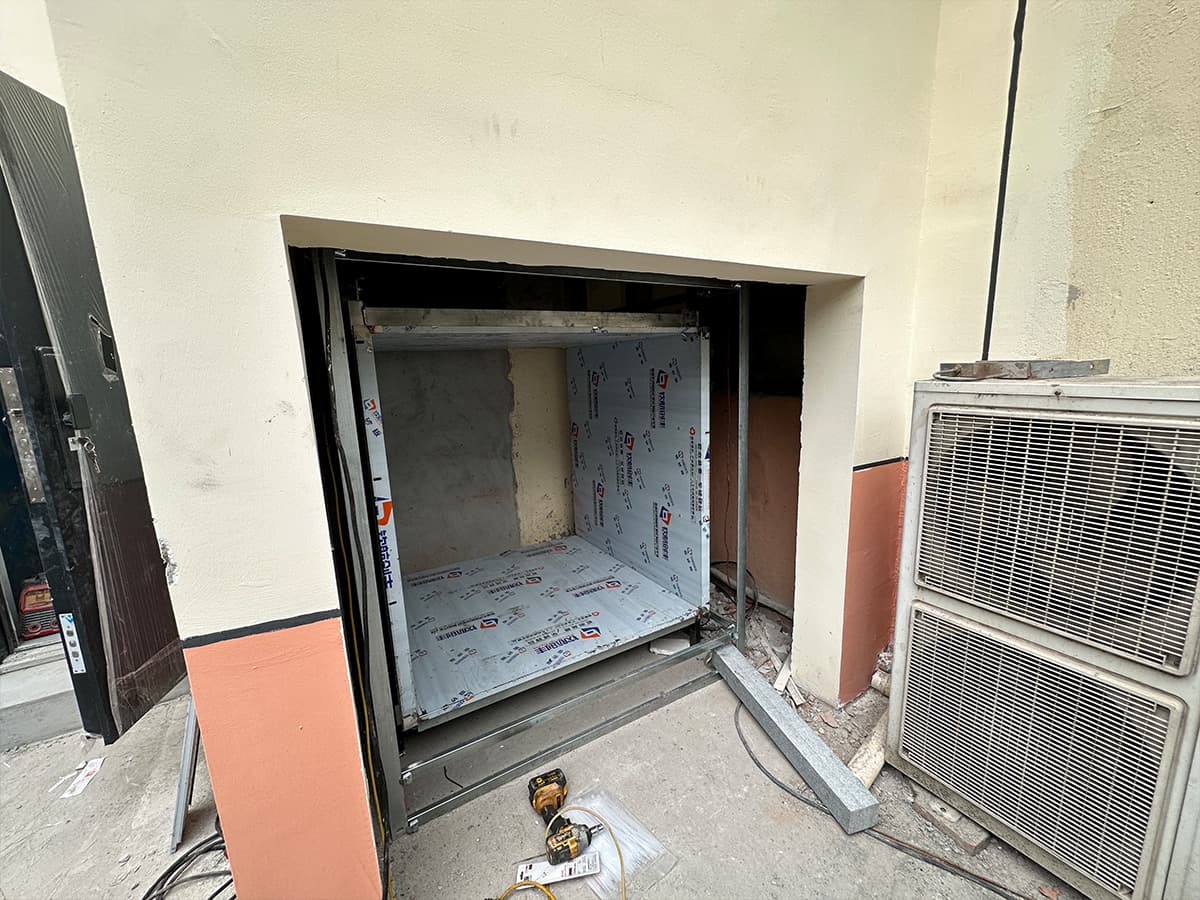
On a low-rise building with no headroom for a machine room, shaft-top mounting is the only option and the top floor automatically becomes the acoustically critical floor. That is the configuration covered by our low headroom dumbwaiter range, and it is where isolation detail matters most. The four typical site layouts show how much the space and power assumptions change between them.
Seven Decisions That Lower Noise Before the Unit Is Built
Everything here is cheaper before the equipment ships than after handover. The order is deliberate: the first two are made at the factory, the next three at installation, the last two in settings.
- Choose the machine for noise, not only for load. Where acoustics are scored, specify the machine type rather than accepting the default for that rating.
- Isolate the machine base. Elastomeric pads under the base frame are the minimum; a spring-and-inertia-block arrangement is what actually cuts low frequency, because it puts the system’s natural frequency below the excitation.
- Isolate the rail brackets. A pad between bracket and wall breaks the impulse path. Almost free at installation, expensive later.
- Dress the rail joints. Ten minutes per joint removes a recurring knock for the life of the unit.
- Balance rope tension. Uneven tension produces slap and a rhythmic beat that no wall treatment will absorb.
- Set the door to close softly. Cushioned final travel and an aligned track turn the loudest event in a hotel corridor into a non-event.
- Tune the drive. Carrier frequency, acceleration ramp and S-curve shaping all change what the motor emits. Adjust them against a measurement, not a preference.
Two items are deliberately absent: acoustic foam in the machine room and extra insulation on the occupied side. Both are the first things proposed and the last things that work on a low-frequency problem, because they treat the air path while the energy travels through the structure.
How to Measure Dumbwaiter Noise on Site
A defensible dumbwaiter noise measurement takes about ten minutes per point and needs no specialist — only a written procedure agreed before handover, so the result cannot be argued about afterwards.
- Measure background first. Unit stopped, everything else in the room as it normally is. Record it.
- Fix the point. One metre from the nearest surface of the machine at 1.5 m above the floor, or at the head of the bed in a guest room. Photograph it.
- Run a full cycle. Loaded car from the lowest to the highest landing and back. Record the maximum and the equivalent level, not one instantaneous reading.
- Record both weightings. dB(A) for the contractual number, dB(C) to reveal low frequency.
- Correct for background. If the unit raises the level by less than 3 dB above background, the measurement proves nothing and must be repeated.
Phone sound meter apps are fine for a quick check and unusable as acceptance evidence: a few dB at best, often no C-weighting, never calibrated. A Class 2 meter with a current certificate costs less than re-testing a disputed handover. Whatever the instrument, the result belongs on the same sheet as the safety checks — the dumbwaiter commissioning and handover process already has a place for recorded values, and noise is one more line.
What to Write Into the Order
This is the part that decides whether any of the above matters. A dumbwaiter noise requirement that is not in the order does not exist at handover, and one written as an adjective cannot be tested. Six lines are enough:
| Item | What to write | Why it matters |
| Measurement point | Distance, height and room for every test point | Without a point, any reading can be defended |
| Limit and weighting | A value in dB(A), plus dB(C) where low frequency is a risk | A single dB(A) figure hides the band that causes sleep complaints |
| Operating condition | Rated load, both directions, full travel, stated background | An unloaded test is quieter than a real one |
| Instrument | Class 2 or better, certificate current | Removes the argument about the meter |
| Who tests and when | Named party, before handover, result recorded | Retrofitting isolation after opening costs several times more |
| Remedy | What happens if the limit is missed, and who pays | The line that actually protects the buyer |
One caution: do not accept a limit the equipment cannot meet in the building you have. A supplier who signs up to 30 dB(A) in a room sharing a wall with a brick shaft is either measuring somewhere else or planning to argue later. A realistic clause names the machine-space figure the factory controls and the room figure the building controls, and says who owns each. We would rather quote the second number honestly than sign the first and lose the argument on site.
Frequently Asked Questions
How loud is a dumbwaiter in dB?
At one metre from the machine a typical traction dumbwaiter measures roughly 55 to 80 dB(A), depending on machine size, gearing and whether the reading is taken at start-up or at steady running. Inside the nearest occupied room it usually falls to 30 to 45 dB(A). Dumbwaiter noise figures quoted without a measurement point cannot be compared.
Can you hear a dumbwaiter through a wall?
Yes, and usually through the structure rather than the air. Low-frequency vibration from the machine and from rail joints enters the wall and floor and is re-radiated on the far side. That is why rooms which are acoustically fine for speech still transmit a hum, and why foam on the shaft wall rarely solves it.
Is a hydraulic dumbwaiter quieter than a traction one?
Not inherently. A hydraulic power unit is loud while it runs and silent when it stops, and it can be placed away from occupied rooms; traction is quieter moment to moment but its machine sits near the top floors. Dumbwaiter noise depends more on where the source is and how it is isolated than on drive type alone.
What is an acceptable noise level for a hotel or home?
A common design target for a guest room or bedroom at night is 30 to 35 dB(A), against a WHO outdoor night guideline of 40 dB Lnight. No lift standard sets a dumbwaiter noise limit, so the number comes from the lease, the brand standard or the acoustic specification — which is why it has to be written into the order. For a residential project the constraint is usually the room above or beside the shaft, which the residential dumbwaiter guide covers in more detail.
Can dumbwaiter noise be fixed after installation?
Partly. Rope tension, shoe clearance, rail joint dressing, door closing settings and drive parameters can all be corrected in service and often give a large improvement. Machine base isolation and rail bracket pads are much harder to add once the unit is built in, which is why they belong to the design stage. Service work on an existing unit is described in the hotel dumbwaiter guide and in the maintenance material supplied with each machine.
Do you supply a noise test report with the unit?
We record test results on the factory bench and supply them with the unit’s documents, alongside the data sheet and wiring diagram. Site measurements after installation depend on the building, so the acceptance figure is best agreed in the order as described above. For a heavier unit where the machine is a larger share of the noise, the industrial dumbwaiter guide sets out the load and speed limits that apply.
Next Step
If dumbwaiter noise is scored on your project, send us four numbers and one sentence: rated load, number of stops, where the machine will sit, what the nearest occupied room is — plus the limit you have to meet and who set it. With those we can say which machine suits, which isolation detail the layout needs, and whether the limit is realistic for the building.
ServLifts builds traction dumbwaiters from 50 to 250 kg in Wujiang, Suzhou, China, supplying the data sheet, wiring diagram, O&M manual and test records with every unit, plus free CAD sketches for 16 standard models. Where noise is part of the specification, send the four numbers through the contact page and we will return a machine recommendation with the isolation detail marked on your layout drawing.