Welcome to ServLifts Official Website

Dumbwaiter Submittal: The 12 Documents a Consultant Asks For
A dumbwaiter submittal lives or dies on twelve documents. What each one proves, who can issue it, and the three reasons consultants reject a package.

Table of Contents
A dumbwaiter submittal is the package a contractor hands to the consultant, architect or authority to prove that the machine being supplied meets the specification and the code. It is not a brochure, and it is not a quotation. It is evidence, in a fixed order, with a revision number on every sheet.
Most rejected dumbwaiter submittal packages do not fail because the machine is wrong. They fail because a document is missing, a drawing carries no project information, or a certificate names a product family instead of the actual unit. By the time the consultant writes “resubmit” the contractor has lost two weeks and, on a fast job, the production slot as well.
This guide walks through the twelve documents in the order a reviewer actually reads them, splits the package into what a factory can produce and what only a locally licensed party can, and gives a ten-day schedule for assembling it. Availability differs by model, by market and by year, so the honest rule comes first.
The short answer
A dumbwaiter submittal is a project-specific evidence package. Every document in it should carry three identifiers: the project name, the equipment tag or model, and a date or revision. If a sheet could be dropped into a different project without editing, it does not belong in a dumbwaiter submittal.
A dumbwaiter submittal normally runs to twelve items and between twenty and forty sheets. Four of those items are drawings, four are product evidence, two are legal declarations, and two belong to the contractor rather than the supplier. The Whole Building Design Guide’s submittal procedures describe the same cycle at building scale: the contractor prepares, the designer reviews, and resubmittal is a formal loop rather than an email exchange.
One caution before you use any supplier’s checklist, including this one. Which documents a factory can lawfully issue depends on the model, the destination market and the standard in force that year. Ask for the list in writing, with the model number on it, before you price the job. A supplier who answers “yes, all twelve” before reading your project has not read your project.
Why dumbwaiter submittals get rejected
Reviewers reject a dumbwaiter submittal on paperwork, not on engineering. Four patterns cover most of it.
1. A generic package passed off as project-specific. The data sheet is for a 100 kg unit, the project calls for 150 kg, and nothing on the sheet has been marked up. The reviewer cannot tell whether the supplier read the specification. Fix: a line-by-line compliance statement that quotes the specification clause and answers it.
2. A declaration where a certificate is required. A manufacturer’s declaration of conformity is a self-declaration. A notified-body certificate or a test report from an accredited laboratory is third-party evidence. In the EU the two documents serve different purposes and reviewers know the difference; submitting the declaration where the certificate was asked for is an automatic resubmit.
3. A drawing that does not match the site. The sheet shows three stops, the building has four. Or the shaft width on the drawing is the factory’s standard frame, not the shaft that was actually poured. This is the most expensive rejection because it usually means someone has to visit the site.
4. No revision control. Two versions of the same sheet in circulation, neither dated, one of them already superseded. On a project with an architect, an MEP consultant and a main contractor, this alone can stall the dumbwaiter submittal for a week while three parties argue about which drawing is current.
All four are cheap to prevent and expensive to fix. The rest of this guide is organised around preventing them.
Twelve documents every dumbwaiter submittal needs
A reviewer does not read a dumbwaiter submittal front to back. They check the transmittal, look for the specification response, then open the drawings, then look for the certificate. Building the dumbwaiter submittal in that order saves a resubmit cycle even when nothing is missing.
| # | Document | Normally produced by | What the reviewer checks |
|---|---|---|---|
| 1 | Submittal transmittal / cover sheet | Contractor | Spec section number, revision, list of contents, date |
| 2 | Specification compliance statement | Supplier, reviewed by contractor | Clause-by-clause response: comply, comply with comment, or exception |
| 3 | Product data sheet for the actual model | Supplier | Capacity, car size, speed, power, applicable standard |
| 4 | Layout / general arrangement drawing | Supplier | Project name, stops, dimensions, clearance to structure |
| 5 | Shaft interface and builder’s work drawing | Supplier, confirmed by contractor | Opening sizes, reaction loads, pit and overhead requirements |
| 6 | Electrical schematic and load schedule | Supplier | Voltage, phases, full-load current, breaker and cable sizing |
| 7 | Structural reaction note | Supplier data, local engineer signature | Point loads at machine and guide fixings |
| 8 | Certificate of conformity or test report | Supplier | Product identified by model, standard cited, issuer named |
| 9 | Factory test and inspection records | Supplier | Test date, serial number matching the shipped unit |
| 10 | Operation and maintenance manual, spare parts list | Supplier | Language, wear parts, service intervals |
| 11 | Warranty statement | Supplier | Term, scope, who performs the work, where |
| 12 | Permit application, registration or inspection request | Local licensed party | Whether the equipment can legally be installed and inspected |
Items 2, 3, 4 and 6 do most of the work. If a dumbwaiter submittal is going to be approved on the first pass, it is because those four answered the specification precisely and everything else was supporting evidence.
Item 12 is the one that surprises overseas buyers. What the local authority will actually inspect, and how often after handover, is set out in our dumbwaiter inspection schedule. The tests that have to be signed before that inspection can even be booked are on the commissioning test sheet. No factory outside your country can register equipment inside it. That step belongs to a local licensed installer or engineer, and it is the item most often missing when a dumbwaiter submittal is assembled entirely from supplier documents.
What a factory can issue, and what it cannot
The single most useful page in a dumbwaiter submittal is the responsibility split. It tells the contractor, in advance, which documents are coming from the supplier and which they have to commission locally. Getting this wrong is what turns a two-week approval into a six-week one.
| Document | Usual supplier position | Who else is involved | Note |
|---|---|---|---|
| Compliance statement | Issued, model-specific | Contractor signs the transmittal | Exceptions must be listed, not hidden |
| Layout drawing | Issued in PDF and DWG | Contractor confirms site dimensions | Two revisions usually included |
| Builder’s work drawing | Issued | Structural engineer reviews | Needs the actual shaft survey |
| Electrical schematic | Issued | MEP consultant reviews | Must match the site supply |
| Certificate / test report | Issued where the model is covered | Accredited body | Coverage is model-specific, not blanket |
| Structural calculation | Load data supplied | Local engineer signs | Signature must be locally registered |
| Stamped or sealed drawings | Not issued | Local licensed engineer | See the note below |
| Permit, registration, inspection | Not issued | Local installer or authority | Cannot be done from outside the country |
| Site-specific lift or rigging plan | Not issued | Installation contractor | Depends on site access, not on the machine |
| O&M manual in local language | English as standard | Translation reviewed locally | Other languages by arrangement |
Read that table as a starting position, not a guarantee. What any supplier can actually put in a specific dumbwaiter submittal depends on the model, the market and the state of the certification at the time of order. The correct move is to ask for the split in writing, against your model number, before the order is placed.
On stamping, be clear about the limit. A factory in China cannot stamp, seal, sign or register drawings for a building in Manila, Nairobi or Houston, and neither can a factory in Germany or the United States. Stamping is a local professional act performed by a locally licensed engineer who takes legal responsibility for the building. No legitimate overseas supplier can do it, and a supplier who claims they can is describing something else.
Three questions that settle it in one email
Ask these three, and the answer tells you what the dumbwaiter submittal will look like: Which of the twelve items will be issued with this model number? Which certificate covers this model, and who issued it? Which items are you not able to issue, and what do you recommend locally? A supplier who answers all three specifically is workable. One who answers all three vaguely is a resubmit waiting to happen.
Where the drawing set fits
Three different drawings get confused in almost every dumbwaiter submittal, and the confusion is expensive.
A submittal drawing proves that the machine fits the space and meets the specification. It is reviewed, marked up and returned. A production drawing is released to the workshop after approval and controls what gets built. An as-built records what was actually installed, and it is the only one of the three that is allowed to disagree with the other two.
Reviewers approve the first, and sites get built from the second. If the approval comment never reaches the production drawing, the machine arrives with the error the reviewer had already caught. That single failure mode accounts for a large share of on-site modifications.
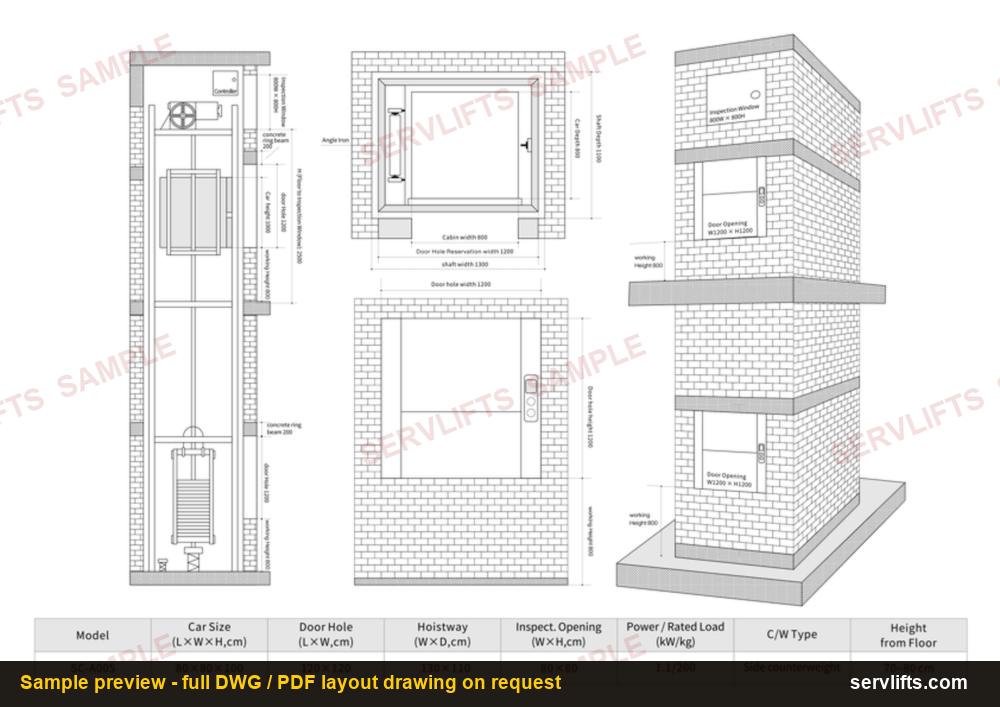
Our own drawing set is described on the dumbwaiter drawings page, which covers what each sheet is for and what information we need before drawing. For contractors who want to see the format before requesting anything, sixteen dimensioned sketches of standard models are available as free PDF downloads. Those sketches are a format reference, not a submittal: they carry no project title block and no signature.
Stamped, sealed, signed: what each word actually means
A stamp is the engineer’s registration mark, applied under local law. A seal is a physical or digital impression that usually accompanies the stamp. A signature is the individual’s acceptance of responsibility. In most jurisdictions all three come from the same licensed person, and that person must be registered where the building stands. A factory can supply the drawing that gets stamped. It cannot supply the stamp.
Compliance paperwork by market
Regulation content belongs on our dumbwaiter regulations page. What follows is narrower: for each market, which piece of paper a reviewer normally asks to see, and who can sign it.
| Market | Document usually requested | Who signs or issues it | Watch out for |
|---|---|---|---|
| European Union | Declaration of conformity citing the applicable directive, plus the test evidence behind it | Manufacturer, with notified-body involvement where the route requires it | The CE marking rules attach to the product, not to the project |
| United Kingdom | UKCA or accepted CE evidence, plus installation-stage inspection | Manufacturer and local inspecting body | Supply rules and installation duties are separate documents |
| United States | Code compliance statement against ASME A17.1, plus state or city permit drawings | Manufacturer for the statement, licensed installer for the permit | Local amendments override the model code |
| Gulf states | Conformity certificate and often an embassy or chamber legalisation | Manufacturer and a local agent | Legalisation takes time and is rarely on the supplier’s schedule |
| South and Southeast Asia | Manufacturer’s certificate plus a project-specific compliance letter | Manufacturer, countersigned locally | Requirements vary by city, not just by country |
| West and East Africa | Certificate of conformity, sometimes under a pre-shipment verification scheme | Manufacturer and the appointed inspection agent | Inspection is often a condition of customs clearance |
Treat the third column as the question to ask, not the answer to assume. On a specific project the reviewer may ask for a different document, and the fastest way to find out is to send the specification section to the supplier and ask which of the twelve dumbwaiter submittal items it triggers, using the same clause numbering as the specification checklist where one exists.
Language, format and file naming
Format errors in a dumbwaiter submittal do not usually cause rejection on their own, but they cause queries, and a query costs a week. Five rules remove most of them.
Send PDF for review, DWG on request. Reviewers mark up PDF. Installers and consultants sometimes need the DWG to overlay on their own drawings. Sending only DWG means the reviewer prints a raster; sending only PDF means the consultant redraws the interface. State both in the transmittal.
State the CAD version. A DWG saved in the newest release may not open on the consultant’s software. Naming the version in the transmittal removes a round trip.
Keep units explicit. Millimetres throughout, stated once on every sheet. Mixed units inside one dumbwaiter submittal are the fastest way to get a dimension queried.
Use one revision block, one date format. ISO dates (2026-11-16) rather than local formats, revision letters rather than “final” and “final2”.
Number the package against the specification. If the specification uses MasterFormat section numbering, put that number on the transmittal and on every attachment. The reviewer’s index and your package then line up without explanation.
A naming convention that survives review
One pattern, applied without exception, removes the “which version is this” argument: PROJECT-EQPT-SHEET-REV.pdf, for example MARINA-TOWER-DW-01-L01-REV.B.pdf. Equipment tag, sheet number, revision. When a reviewer asks for the latest builder’s work drawing, the file name answers before the email is opened.
The numbers a consultant checks first
A reviewer with twenty submittals to clear does not read the whole dumbwaiter submittal. They check a fixed set of numbers against the specification, and they check them in the same order every time. Getting these right is worth more than any amount of narrative.
| Item | Where it appears | Who confirms it | What goes wrong when it is wrong |
|---|---|---|---|
| Rated capacity | Data sheet, layout drawing, compliance statement | Supplier, checked against specification | Standard models run 50 kg to 250 kg; 300 kg is a custom build, not a catalogue item |
| Car clear dimensions | Layout drawing | Supplier | Trays or carts that no longer fit the opening |
| Shaft clear dimensions | Builder’s work drawing | Contractor, from site survey | Frame cannot be erected without cutting concrete |
| Pit depth and overhead | Builder’s work drawing | Contractor | Machine will not fit; low-headroom variant needed too late |
| Number of stops and travel | Layout drawing, data sheet | Contractor | Control system built for the wrong landing count |
| Door opening and handing | Layout drawing | Contractor | Landing opening clashes with a wall or a corridor turn |
| Power supply | Electrical schematic | MEP consultant | 380 V three-phase specified where only 220 V single-phase exists |
| Reaction loads | Structural note | Local engineer | Fixings specified into a slab that cannot take them |
The dimension figures themselves belong in the dumbwaiter dimensions guide, not here. What matters for the submittal is that every one of these eight numbers appears in at least two documents and agrees in both. A reviewer who finds a disagreement stops reading and returns the dumbwaiter submittal.
A ten-day dumbwaiter submittal timeline
Ten working days is realistic for a dumbwaiter submittal that includes one drawing revision and a compliance set. It assumes the project information was complete on day zero, which is the assumption that usually breaks.
- Day 0. Contractor sends the specification section, the shaft survey, the number of stops, the capacity and the destination market.
- Days 1 to 2. Supplier issues the data sheet, the compliance statement and a first layout drawing.
- Days 3 to 4. Contractor checks the drawing against the actual shaft. Local engineer reviews the builder’s work and structural items. This is the step that slips.
- Day 5. Revision B issued with the site corrections folded in.
- Days 6 to 7. Certificate, test records and O&M material assembled for the specific model and serial range.
- Day 8. Language check, format conversion, file naming, transmittal drafted.
- Day 9. Internal review against the specification clause by clause. Exceptions listed in writing.
- Day 10. Submitted.
Two clocks are worth keeping separate. The ten days above end at submission, not at approval; review time belongs to the consultant and cannot be compressed from the supplier side. And the production clock normally starts after approval, not before, which is why a slow submittal shows up later as a lead time problem rather than a paperwork problem. If the schedule is tight, the dumbwaiter submittal is the thing to accelerate.

Dumbwaiter submittal FAQ
Is a submittal the same as a shop drawing?
No. A dumbwaiter submittal is the package submitted for review and approval. A shop drawing is a fabrication drawing, produced after approval, that tells the workshop what to build. On small projects the same sheet sometimes serves both roles, which is exactly how approval comments get lost.
Can you stamp or seal drawings for my city?
No, and no supplier outside your jurisdiction can. Stamping is a local professional act performed by an engineer licensed where the building stands. What a factory can supply is the dimensioned drawing, the load data and the technical file that the local engineer reviews and stamps.
Do I get DWG, or only PDF?
PDF is the standard review format and is always the primary deliverable in a dumbwaiter submittal. DWG is normally available on request so consultants can overlay the layout on their own drawings. Confirm both in the transmittal, and state the CAD version.
How long does the package take?
About ten working days for a complete dumbwaiter submittal, when the project information is complete on day zero, including one revision round. The realistic variable is not the supplier’s drafting time, it is how long the site dimensions take to confirm.
What happens if the consultant rejects it?
Resubmit against the comments, not against the original package. Mark each comment, state what changed on which sheet and which revision, and list any comment you are not implementing with the reason. A resubmission that silently ignores one comment usually comes back a second time.
What to send us
If you want a dumbwaiter submittal checklist for a live project, send six things: number of stops, rated capacity, shaft clear dimensions from the site survey, the destination country and city, the specification section if you have one, and your submission deadline. With those, we can tell you in writing which of the twelve documents we can issue for that model and which ones have to come from your side.
That written split is the useful output, more than the documents themselves. It tells you before you commit whether the package is achievable on your schedule. Send the project details here and we will answer against your model number rather than in general terms.