Welcome to ServLifts Official Website

Dumbwaiter Stainless Steel: 304 vs 316 for Food Service

Table of Contents
- Quick Answer: Which Grade for Which Kitchen
- What “Food Grade” Actually Means for a Dumbwaiter
- 304 vs 316: The Composition That Decides the Answer
- Chlorides: The Reason Cars Rust in Clean Kitchens
- Thickness: Why the Car Floor Is Different From the Panels
- Welds and Surface Finish: Where Hygiene Is Won or Lost
- Design Details That Make a Car Easy to Clean
- Cleaning Chemicals: What to Use and What to Ban
- Food Contact Rules in the EU and the US
- Coastal and High-Humidity Sites
- Specifying Stainless Steel on the Order
- Frequently Asked Questions
- Next Step
Ask three suppliers what dumbwaiter stainless steel a car is made from and you will get three answers: “food grade”, “304”, or “the best”. None of them tells you what will happen to that car after five years of steam, sanitiser and salted food waste. Yet dumbwaiter stainless steel is the material decision that determines whether the equipment stays hygienic, stays presentable and stays legal in a food-handling environment.
If you are still deciding what the equipment is, start with what a dumbwaiter elevator is. This guide sets out the dumbwaiter stainless steel grades that are actually used, the thicknesses that make sense for a car that carries trays and trolleys, the weld and finish details that decide whether bacteria have somewhere to hide, and the cleaning chemicals that destroy stainless steel faster than any kitchen workload.
It is written for restaurant and hotel operators, food plant engineers and importers specifying equipment from a factory in China.
Quick Answer: Which Grade for Which Kitchen
For most commercial kitchens, 304 stainless steel is the correct grade for the car interior, doors, panels and shelves. It handles steam, food acids, alkaline cleaners and routine sanitising without trouble, and it is the grade used in the overwhelming majority of food lifts in service today.
Move up to 316 when any of these apply:
- The site is coastal or within a few kilometres of salt water.
- The car is cleaned daily with chlorinated sanitisers, or bleach is used routinely.
- The equipment sits in a hospital, dairy, brewery or food processing plant where aggressive wash-down chemicals are standard.
- The car handles salted or brined products — fish, pickles, cured meat — and is not rinsed and dried between shifts.
Grade is only half the dumbwaiter stainless steel specification. Three other decisions matter as much: the thickness of the floor and panels, whether the welds are pickled and passivated after fabrication, and what surface finish the car interior carries.
A 316 car with untreated welds will rust at the seams before a 304 car with treated welds does. That is the single most useful thing to understand about dumbwaiter stainless steel.
If you take one number away from this guide, make it the weld treatment. It costs very little at the factory and cannot be added once the unit is on site.
What “Food Grade” Actually Means for a Dumbwaiter
“Food grade” is not a grade of steel. It is a description of a material and a surface state that together meet the conditions for contact with food. A dumbwaiter stainless steel car can legitimately be called food grade when three things are true at once:
- The alloy resists the food and the cleaning regime it will meet — which is why 304 and 316 appear and 201 does not.
- The surface is smooth, non-porous and cleanable, with no cracks, open seams or unpolished weld beads where residue can collect.
- The material is corrosion resistant in its own right, so it does not release metal ions into food or shed particles over time.
Dumbwaiter stainless steel protects itself with a chromium oxide layer that re-forms instantly when the surface is scratched, provided there is enough chromium at the surface to do it. That is the whole mechanism.
Everything that damages a food-service dumbwaiter stainless steel car — rust at a weld, pitting under a shelf, a brown stain in a corner — comes down to that passive layer being starved of chromium or prevented from re-forming.
Two practical consequences follow for anyone specifying dumbwaiter stainless steel. First, mechanical damage matters less than chemical attack: a scratch on 304 in a dry kitchen is harmless, while a chloride film left overnight in a crevice will pit the same surface. Second, the weakest point is always the weld, because welding burns chromium and leaves a heat-tinted zone that has to be restored deliberately.
304 vs 316: The Composition That Decides the Answer
The difference between the two dumbwaiter stainless steel grades is small on a datasheet and decisive in service. The table below is the comparison to hold in mind when a quotation says “stainless”.
| Property | 304 (1.4301) | 316 (1.4401) | What it means in a kitchen |
|---|---|---|---|
| Chromium | 18 to 20 percent | 16 to 18 percent | Both form a passive layer; 304 has slightly more chromium |
| Nickel | 8 to 10.5 percent | 10 to 14 percent | Both stay austenitic and non-magnetic in the annealed condition |
| Molybdenum | None | 2 to 3 percent | The single reason 316 resists chlorides |
| Resistance to chloride pitting | Moderate | Good | Decides whether a car survives coastal air or daily bleach |
| Relative material cost | Base | Higher | Roughly a third more, and it should be quoted explicitly |
| Typical dumbwaiter use | Car, doors, panels, shelves in most kitchens | Coastal sites, hospitals, food plants, heavy sanitiser | Most projects do not need 316, but the ones that do cannot substitute |
| Magnetic after cold working | Yes, weakly | Yes, weakly | Not a defect; a magnet is not a grade test |
Two notes on dumbwaiter stainless steel grades. The molybdenum row is the whole story — if there is no chloride threat, 316 buys you nothing except a higher price. And the magnet question comes up on nearly every site visit: cold-formed corners become weakly magnetic even in genuine 304, so a magnet neither proves nor disproves the grade. If you need to verify dumbwaiter stainless steel, ask for the mill certificate rather than testing it with a magnet.
Chlorides: The Reason Cars Rust in Clean Kitchens
Chlorides are the most common cause of premature corrosion on dumbwaiter stainless steel, and they usually arrive from one of four places: salt used in cooking or de-icing, sodium hypochlorite bleach, chlorinated sanitisers, and hydrochloric-acid based descalers. All four attack 304, and all four attack 316 too if the concentration is high enough or the exposure is long enough.
The failure mechanism on dumbwaiter stainless steel is pitting rather than general corrosion. A chloride ion breaks down the passive layer of dumbwaiter stainless steel at a weak point, the exposed metal becomes an anode, and a small pit forms. Left alone, the pit deepens and eventually perforates the panel.
Between surfaces — under a weld bead, behind a folded shelf edge, in a bolted joint — the same chemistry runs faster because the pit mouth is starved of oxygen. This is crevice corrosion, and it is the reason dumbwaiter stainless steel failures so often start at a detail rather than in the middle of a flat panel.
The most important variable is not concentration but dwell time. A strong chloride solution that is rinsed off within minutes does far less damage than a weak one left to dry in a seam overnight. Concrete guidance:
- Rinse and dry after cleaning. Every time. A drying film of chlorinated water concentrates as it evaporates, and the concentration at the end is much higher than the concentration at the start.
- Do not leave salted food waste or brine in the car overnight in a unit that is not rinsed daily.
- Choose 316 in any kitchen that cleans with hypochlorite, or switch the sanitiser to a non-chlorinated product.
- Specify pickled and passivated welds so that the crevice at the weld toe is chemically restored rather than left as a hot spot.
Thickness: Why the Car Floor Is Different From the Panels
Thickness is where cheap quotations on dumbwaiter stainless steel are cut, and the failure is visible long before corrosion sets in: an oil-canned panel, a floor that flexes and drums under a trolley, a shelf edge that folds if a crate is dropped on it.
| Element | Sensible thickness | Why |
|---|---|---|
| Car floor | 1.5 to 2.0 mm | Point loads from trolley wheels and dropped crates |
| Car side panels | 1.2 to 1.5 mm | Stiffness against drumming and side impact |
| Car roof | 1.0 to 1.2 mm | Little load, but needs to resist cleaning brushes |
| Landing and car doors | 1.0 to 1.2 mm | Repetitive opening and closing, and hands on the surface |
| Shelves | 1.2 mm with a folded or formed edge | Edge stiffness, and avoiding a razor-thin edge to clean around |
| Structural frame | Carbon steel, painted, or 304 | Carries the load; food contact is not a consideration |
A 0.8 mm dumbwaiter stainless steel car floor is not a bargain. It flexes under a full tray, the spot welds eventually crack, and the resulting gap is impossible to clean and holds moisture.
If a quotation is silent on thickness, ask for it in millimetres, and ask which parts of the car are singled out for a heavier gauge. A manufacturer who builds food lifts every week will answer without hesitation.
Welds and Surface Finish: Where Hygiene Is Won or Lost
Welding destroys the passive layer of dumbwaiter stainless steel locally. The heat oxidises the surface, forms a chromium-depleted zone beside the weld, and leaves a coloured oxide film — the straw, blue and grey tinting that is visible around a bead. That film is not cosmetic. It is a chromium-poor layer that will rust first.
Two treatments restore the surface, and both should be specified:
- Pickling removes the oxide film and the chromium-depleted zone beneath it, using an acid paste or bath. This is what brings the weld back to the corrosion resistance of the parent metal.
- Passivation then allows a fresh chromium oxide layer to form. In practice the two are often done together with a pickling paste followed by rinsing.
A third point concerns contamination of dumbwaiter stainless steel. Grinding and brushing a weld with a disc that has previously been used on carbon steel embeds iron particles in the surface, and those particles rust. Any fabricator building dumbwaiter stainless steel cars should keep separate, dedicated stainless tools, and a buyer is entitled to ask.
Surface finish is the second half of dumbwaiter stainless steel cleanability:
| Finish | Appearance | Hygiene notes |
|---|---|---|
| 2B (cold rolled) | Matte grey, the mill default | Fine for panels and structure; less common for visible car interiors |
| No. 4 (brushed) | Linear satin grain | The usual choice for car interiors; the grain direction must be consistent and horizontal to shed water |
| No. 8 (mirror polish) | Reflective | Easiest to see residue on, and easiest to wipe; common in front-of-house installations |
| Bead blasted | Uniform matte | Attractive but creates a texture that traps fine residue; use only where cleaning is thorough |
Whichever finish is chosen on dumbwaiter stainless steel, the rule is the same: smoother is easier to clean, and a consistent grain beats a decorative one. A brushed car interior with the grain running vertically will hold a water film across the horizontal lines, while the same finish applied horizontally drains.
Design Details That Make a Car Easy to Clean
Most hygiene failures on a dumbwaiter stainless steel car are designed in at the drawing stage. The car that is hard to clean is hard to clean because of six specific details, and every one of them can be specified differently at no meaningful cost.
| Detail | Hard to clean | Better specification |
|---|---|---|
| Internal corners | Square butt joints | Radiused or formed corners with a continuous weld |
| Car floor drainage | Flat floor with no outlet | Slight fall to a plugged drain, or a removable floor tray |
| Shelf edges | Open folded edge with a crevice | Closed and sealed edge, or a fully formed tray |
| Fixings | Exposed slotted screws and trapped dirt | Welded studs, dome nuts, or sealed heads |
| Door track | Open channel at floor level | Covered track or a sill that can be lifted out |
| Car roof | Unsealed joint to the panels | Continuous welded roof, sealed penetrations for lights and cables |
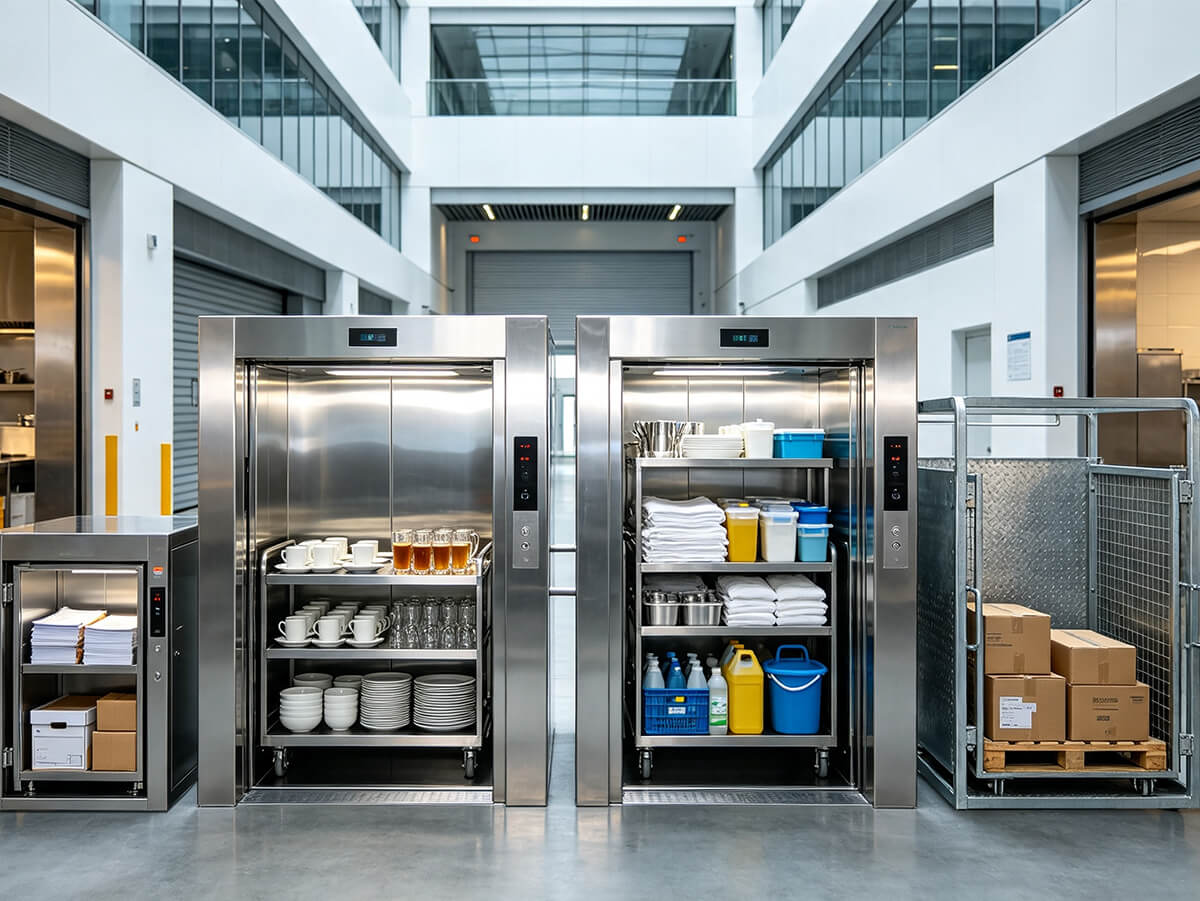
All six come down to the same principle: no crevices, no trapped water, no place where a cloth cannot reach. When you review a drawing, look for a cross-section rather than a front view. The front view shows the size of the car; the cross-section shows whether a health inspector will find anything to write down.
Cleaning Chemicals: What to Use and What to Ban
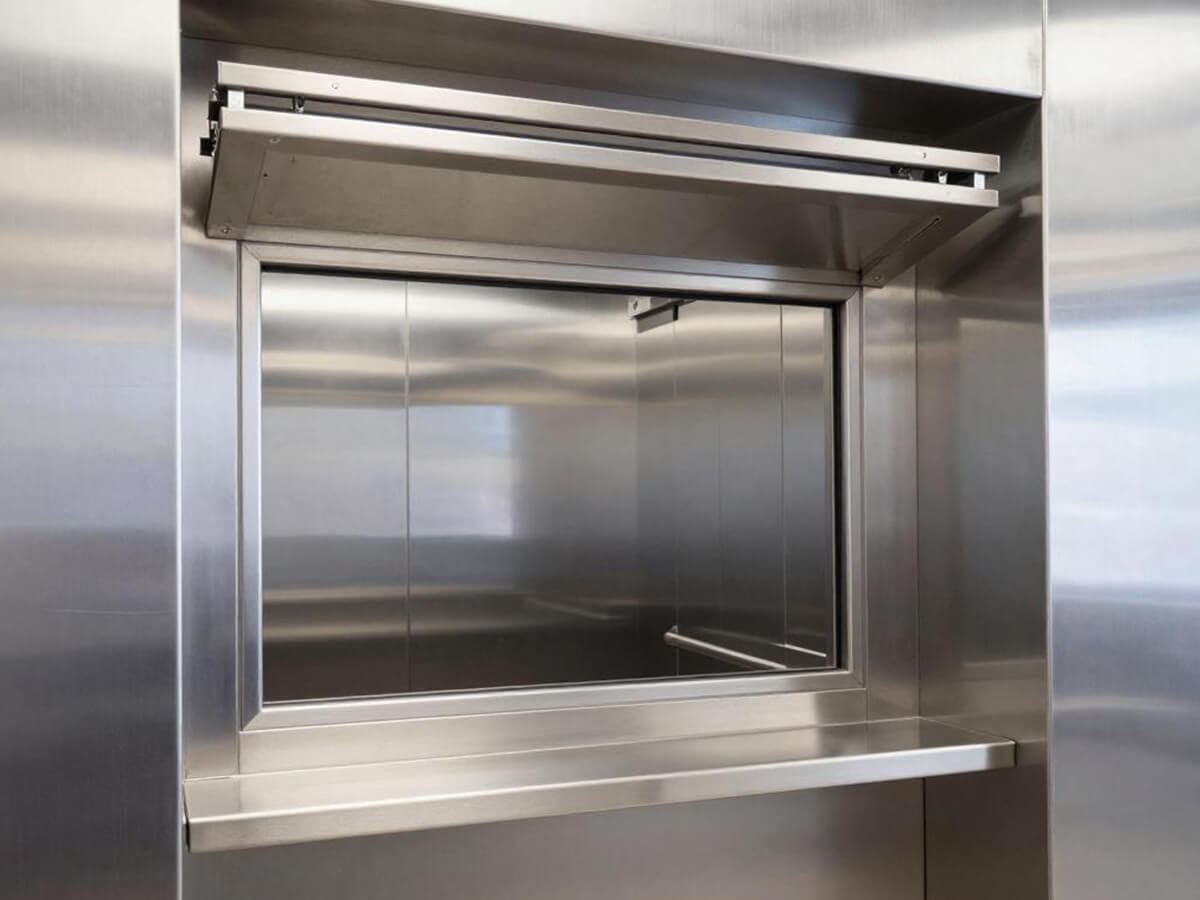
Cleaning is where dumbwaiter stainless steel is either preserved or destroyed, and the damage is usually done by a product chosen for convenience rather than chemistry.
- Use: neutral pH detergents, mild alkaline cleaners, and non-chlorinated sanitisers such as quaternary ammonium or peracetic acid products at their recommended dilution. NSF publishes the food equipment standards most sanitisers and surface materials are listed against.
- Use with care: chlorinated sanitisers and sodium hypochlorite. Acceptable on 316 at short contact times, always followed by a clean water rinse. On 304 they are a slow corrosion source.
- Never use: hydrochloric acid or strong acid descalers, steel wool, and abrasive pads intended for carbon steel. These either attack the passive layer chemically or contaminate the surface with iron.
- Never leave a wet car closed overnight after cleaning with a chlorinated product. Rinse, wipe, and leave the door ajar to dry.
Write the cleaning regime for the dumbwaiter stainless steel into the operating instructions and train the staff who will follow it. For the wider service routine, and for what the cleaning is protecting, see the restaurant dumbwaiter guide. The failure pattern is consistent across markets: the corrosion starts within a year of commissioning, in a car that is spotless, because a well-meaning cleaning routine is leaving chlorinated water in the corners. Cleaning instructions belong with the handover pack, and the dumbwaiter maintenance guide covers the rest of the routine.
Food Contact Rules in the EU and the US
A dumbwaiter is not a food processing machine, so the food-contact regime applies to the dumbwaiter stainless steel parts that touch food rather than to the whole installation. That distinction matters when a buyer asks for “FDA approved” or “EU compliant” documentation.
| Market | Framework | What it means in practice |
|---|---|---|
| European Union | Regulation (EC) No 1935/2004 on food contact materials | Materials in contact with food must not transfer constituents in quantities that endanger health or change the food. Applies to the car interior and any shelves or trays supplied |
| European Union | Regulation (EC) No 2023/2006 on good manufacturing practice | Requires a documented quality system for food contact materials, which is a supplier-side obligation |
| United States | FDA food contact substance framework, 21 CFR | Stainless steel grades used in food equipment are long-established as suitable; the practical requirement is a cleanable, corrosion-resistant surface |
| Both | Hygienic design guidance, including 3-A and EHEDG practice | Not law for a dumbwaiter, but the standard set out by bodies such as 3-A Sanitary Standards that food plants and auditors will measure the car against |
For the European side, the European Commission’s food contact materials pages set out the requirements the car interior falls under.
In practice a supplier can support this in three ways: a mill certificate identifying the grade, drawings that show the finish and weld treatment, and a written cleaning instruction sheet. If your site is audited — a dairy, a food factory, a hospital kitchen with an accreditation — ask for those three documents before the order, not after.
Buyers who need the wider compliance picture for a market should start with dumbwaiter regulations by country.
Coastal and High-Humidity Sites
A food lift on a coastal site lives in a salt-laden atmosphere even when the kitchen itself is perfectly clean, and the corrosion arrives on air rather than on food. Three adjustments are worth making, none of them expensive relative to a replacement car:
- Specify 316 for every part of the dumbwaiter stainless steel car that is visible or touched, including shelf edges and door returns, not just the flat panels.
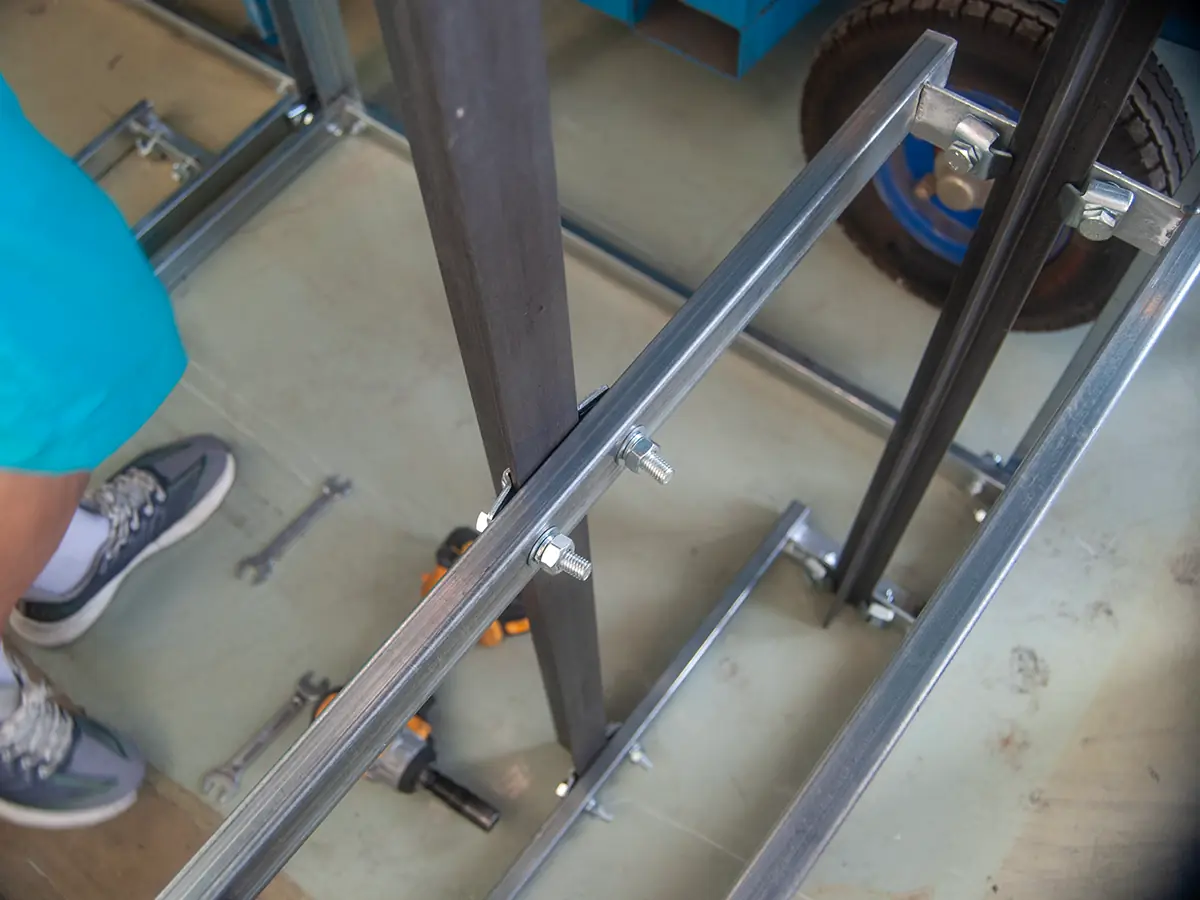
- Avoid mixed-metal contact. Where stainless steel is bolted to a carbon steel frame, the carbon steel becomes the anode and corrodes. Use isolating washers, or specify stainless fasteners and paint the frame properly.
- Rinse more often. On a coastal site, plain water rinsing and drying after every shift removes the salt film that would otherwise concentrate overnight.
Where the dumbwaiter stainless steel car is mounted in a genuinely open position — a rooftop service area or an open-sided loading location — stainless steel alone may not be the right answer, and a covered enclosure or a different material strategy is worth discussing with the manufacturer.
Specifying Stainless Steel on the Order
This is the list to put in the enquiry when specifying dumbwaiter stainless steel. Each item is cheap at the factory and impossible to fix afterwards. Buyers comparing whole projects rather than materials will want how to choose a dumbwaiter for a restaurant or hotel alongside the dumbwaiter price guide.
| # | Item | What to ask for |
|---|---|---|
| 1 | Grade | 304 or 316, stated explicitly, for car, doors, panels and shelves |
| 2 | Thickness | Floor, panels, roof and doors in millimetres, not “heavy gauge” |
| 3 | Weld treatment | Pickled and passivated after fabrication, stated on the drawing |
| 4 | Surface finish | 2B, No. 4 or No. 8, with grain direction on visible interior surfaces |
| 5 | Material certificate | Mill certificate for the sheet used in the car |
| 6 | Cleaning instructions | A written sheet listing approved and prohibited chemicals |
| 7 | Drainage detail | Fall to a plugged drain, or a liftable floor tray |
| 8 | Fasteners | Stainless, with isolating washers where they meet carbon steel |
Send these with the load, the number of stops and the car dimensions, and the resulting unit will be specified rather than assembled. On the commercial side of the same decision — how many units a site needs and where they go — see commercial dumbwaiter lift applications.
Where the car size and shaft envelope are still open, the reference for those numbers is our dumbwaiter dimensions guide. For the load side of the same decision, see dumbwaiter restaurant load capacity.

Frequently Asked Questions
Is 304 stainless steel food safe?
Yes. 304 is the standard grade for food service equipment, including dumbwaiter stainless steel car interiors, doors and shelves in most commercial kitchens. What makes a surface food safe is the combination of a corrosion-resistant alloy, a smooth cleanable finish, and welds that have been pickled and passivated. Grade alone is not enough.
Do I need 316 for a restaurant?
Usually not. A restaurant kitchen that cleans with neutral or alkaline detergents and rinses properly is well served by 304. Choose 316 where the site is coastal, where chlorinated sanitisers are used daily, or where salted and brined products are handled without a rinse between shifts.
Why did my stainless steel car rust at the welds?
Because the dumbwaiter stainless steel weld was not pickled and passivated. Welding leaves a chromium-depleted zone and an oxide film beside the bead, and that zone rusts long before the surrounding panel does. The fix is at the factory: acid-pickle the weld, rinse, and let the passive layer re-form. It cannot be added retrospectively.
Can I use bleach to clean a food lift?
Diluted sodium hypochlorite can be used on dumbwaiter stainless steel in grade 316 with a short contact time and a clean water rinse afterwards. It should not be used routinely on 304, and it should never be left to dry on the surface. The drying film concentrates the chloride exactly where the damage begins.
How thick should the car floor be?
Between 1.5 and 2.0 mm for a commercial dumbwaiter stainless steel car that will be loaded with trolleys or crates. Below that the floor flexes, the fixings work loose and the resulting gaps are impossible to clean. Ask for the figure in millimetres and get it on the drawing.
Next Step
Dumbwaiter stainless steel is the part of a food lift that is easiest to get right and hardest to fix. Specify the grade for the environment, not for the brochure; insist on pickled and passivated welds; put the thickness on the drawing; and hand a written cleaning sheet to the people who will use the car every day.
Those four decisions cover almost everything that goes wrong with dumbwaiter stainless steel in service.
ServLifts builds non-passenger dumbwaiters from 100 kg to 250 kg in Wujiang, Suzhou, China, in 304 or 316 stainless steel, with pickled and passivated welds, the finish recorded on the approved drawing, and cleaning instructions in the handover pack. Tell us where the unit will be installed and what will be cleaned with, and we will confirm the grade before you commit: contact ServLifts.
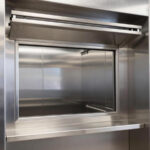
[…] materials and fire rating: Stainless steel doors are standard for food service applications. In commercial buildings, doors must be fire-rated […]
[…] Finish preference: painted steel or stainless steel […]
[…] chemicals also reach the car itself, the grade of steel matters as much as the connectors, as our stainless steel for food service guide explains. The dumbwaiter maintenance guide covers the routine that stops the last two causes […]
[…] The dumbwaiter dimensions and shaft guide sets out clear openings for common car sizes, and the stainless steel choice guide covers 304 against 316 for kitchen environments. Projects that need remote monitoring or […]