Welcome to ServLifts Official Website

Dumbwaiter Control System: What to Specify Before You Order

Table of Contents
- Quick Answer: What a Dumbwaiter Control System Includes
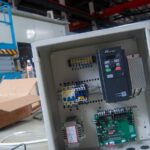
- What Actually Sits Inside the Panel
- Control Voltage: Why 24 V DC, Not 220 V
- 220 V Single-Phase or 380 V Three-Phase?
- 50 Hz vs 60 Hz: The Export Detail That Delays Projects
- Call Buttons, Floor Display and Intercom
- The Door Interlock and the Safety Circuit
- Enclosure Rating and Where the Panel Should Live
- Cable Separation and Electromagnetic Compatibility
- What to Send Before We Build the Panel
- Common Control Faults and What They Mean
- Spare Parts to Keep With the Control System
- Frequently Asked Questions
- Next Step
A dumbwaiter control system is the part of the equipment most buyers leave to the supplier and then argue about three months later. The car, the shaft and the doors are visible in the quotation. The panel, the drive settings and the safety circuit are not, and that is exactly where export projects lose time: a panel built for 380 V three-phase arrives at a site wired for 220 V single-phase, or a VFD parameterised for 50 Hz is dropped into a 60 Hz market and the car runs 20 percent fast.
If you are new to the product, start with what a dumbwaiter elevator is; this guide assumes you have already settled that question. It covers what a dumbwaiter control system contains, which four numbers you have to confirm before the panel is built, how the control voltage and the safety circuit work together, and what to check when the car stops between floors.
It is written for importers, distributors and project engineers ordering non-passenger food lifts, service lifts and small freight dumbwaiters from a factory in China, and for the electricians who will wire the dumbwaiter control system once it lands.
Everything here is practical, and none of it is marketing. If you only read one section of this dumbwaiter control system guide, read the nine-point list you send to the factory before the panel goes into production.
Quick Answer: What a Dumbwaiter Control System Includes
A dumbwaiter control system is the complete electrical assembly that decides where the car goes, how fast it travels and when it is allowed to move at all. It consists of four groups:
- Power group — incoming supply, main breaker, contactor, overload relay, and the variable-frequency drive (VFD) that feeds the traction motor.
- Logic group — the controller that sequences floor calls, stops, levelling and door release. On modern units this is a small PLC or a dedicated lift controller board.
- Interface group — call buttons on each landing, the car operating station, the floor indicator, and the intercom or bell.
- Safety group — door interlock contacts, terminal limit switches, slack-rope or broken-rope switch, emergency stop, and the brake release circuit.
For an export order, four numbers decide whether the panel will work on arrival. Confirm all four before production, not after:
- Supply voltage and phase at the site — 220 V single-phase or 380 V three-phase.
- Frequency — 50 Hz or 60 Hz.
- Control voltage — usually 24 V DC for the safety and signalling circuits.
- Enclosure rating — normally IP54 or better, and higher in wet or wash-down zones.
Get those four right and the dumbwaiter control system is a commissioning exercise of an afternoon. Get one wrong and you are air-freighting a panel or a motor.
What Actually Sits Inside the Panel
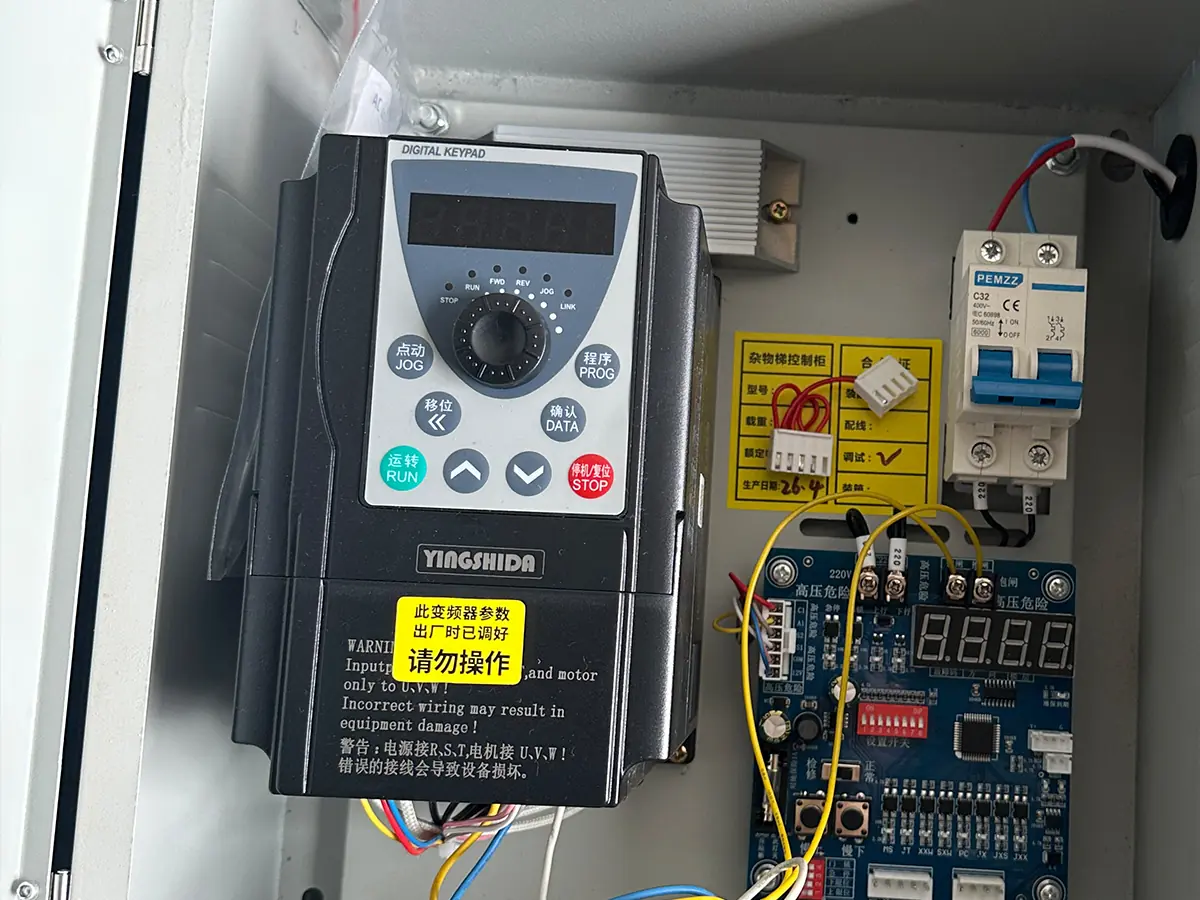
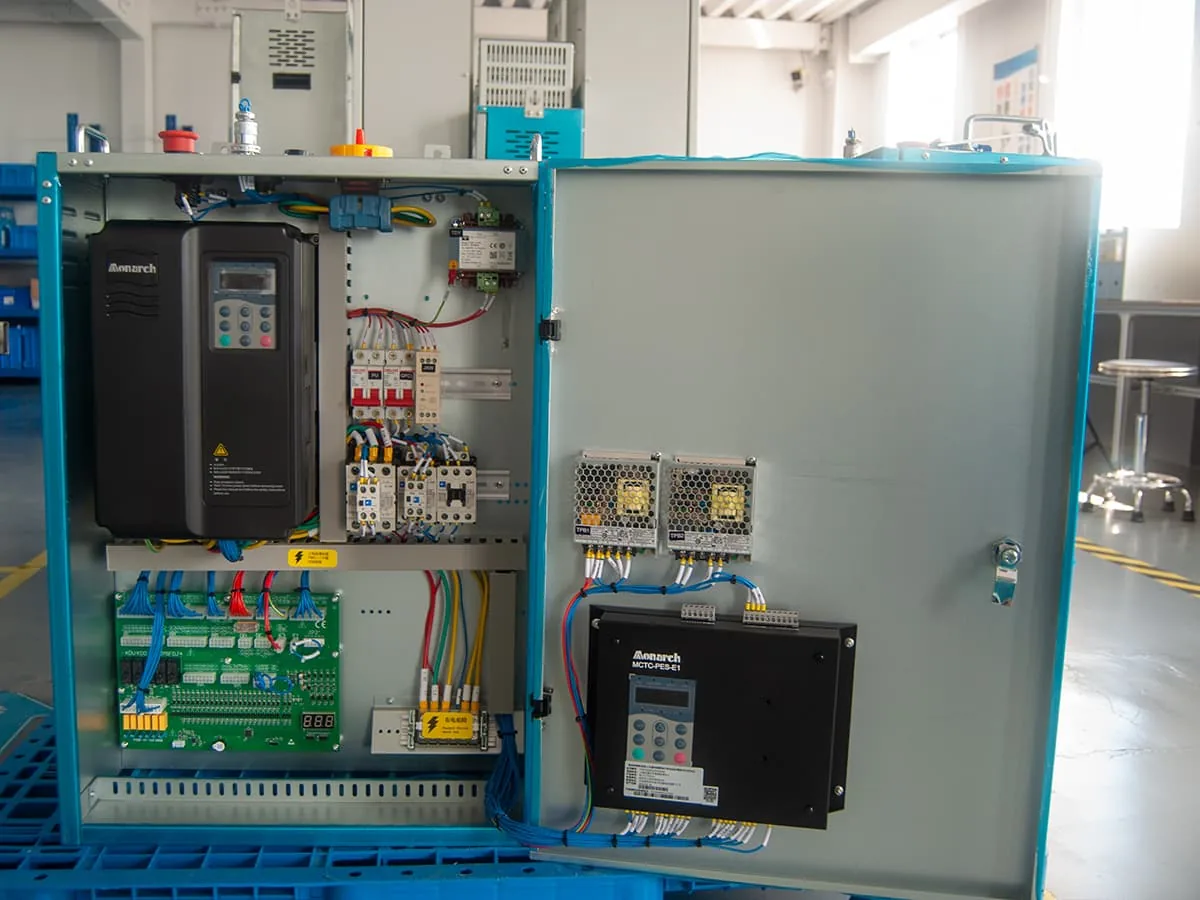
Buyers often ask for “a control panel” without knowing what is in it, which makes it impossible to compare two quotations. The table below lists what a standard traction dumbwaiter control system contains and the question you should ask about each item.
| Component | What it does | What to confirm |
|---|---|---|
| Enclosure and door | Houses and protects everything else | IP rating, material, lockable door, cable entry type |
| Main breaker | Isolates the whole unit | Rating matched to motor kW and site supply |
| Contactor and overload relay | Switches motor power and trips on overload | Duty rating, adjustable overload range |
| Variable-frequency drive (VFD) | Accelerates, decelerates and levels the car | Input phase, Hz range, parameter set for your market |
| PLC or controller board | Sequences calls, stops and door release | Spare inputs/outputs if floors may be added later |
| 24 V DC power supply | Feeds control, interlocks and signalling | Surge protection, spare capacity |
| Door interlock contact block | Proves the landing door is closed and locked | Number of independent contacts |
| Limit switches | Stop travel at the top and bottom terminal floors | Mechanical or inductive, and whether they are duplicated |
| Slack-rope switch | Stops the car if suspension tension is lost | Fitted as standard or optional |
| Emergency stop and alarm | Cuts power independently and calls for help | Location of the stop buttons, alarm type |
Two of these deserve a comment. First, the VFD is not optional on a commercial dumbwaiter control system, because it is what makes smooth levelling and a low starting current possible; a direct-on-line starter will trip a domestic supply.
Second, the controller board is the only part you cannot buy locally in most markets, so it belongs on the spare parts list from day one. The standard panel is described on our dumbwaiter control cabinet product page.
Control Voltage: Why 24 V DC, Not 220 V
The control voltage of a dumbwaiter control system is almost always 24 V DC, stepped down from the main supply by a small power supply inside the panel. There are three reasons, and they matter more on a kitchen wall than on a factory floor.
- Touch safety. Every call button, interlock contact and limit switch is touched or serviced by people who are not electricians. At 24 V DC a damaged cable or a wet push button is an inconvenience; at 220 V it is a hazard.
- Separation from the power circuit. Keeping the logic and safety circuits on a separate low-voltage rail means a fault on the motor side cannot feed back into the signalling wiring.
- Interlock reliability. Low-voltage, low-current contacts stay cleaner. Doors interlocks that switch 24 V DC at a few hundred milliamps last far longer than those switching mains current.
This is why the standard places the emergency stop in the power circuit and everything else in the control circuit. It is also why a competent person inspecting the unit will open the panel and look at the segregation: power wiring and control wiring should be physically separated with separate terminal rails, and the control rail should be clearly labelled.
Site wiring practice in the destination market matters as much as the panel itself; in the United Kingdom, the HSE guidance on electrical safety at work sets out what an installer is expected to verify.
The practical consequence for buyers is that the control voltage is not a choice you make — it is a specification you check. In a well-designed dumbwaiter control system the 24 V rail is the only voltage a service technician ever touches.
If a quotation offers a dumbwaiter control system with no low-voltage rail, ask what voltage the call buttons and interlocks run at. The answer tells you a lot about the design.
220 V Single-Phase or 380 V Three-Phase?
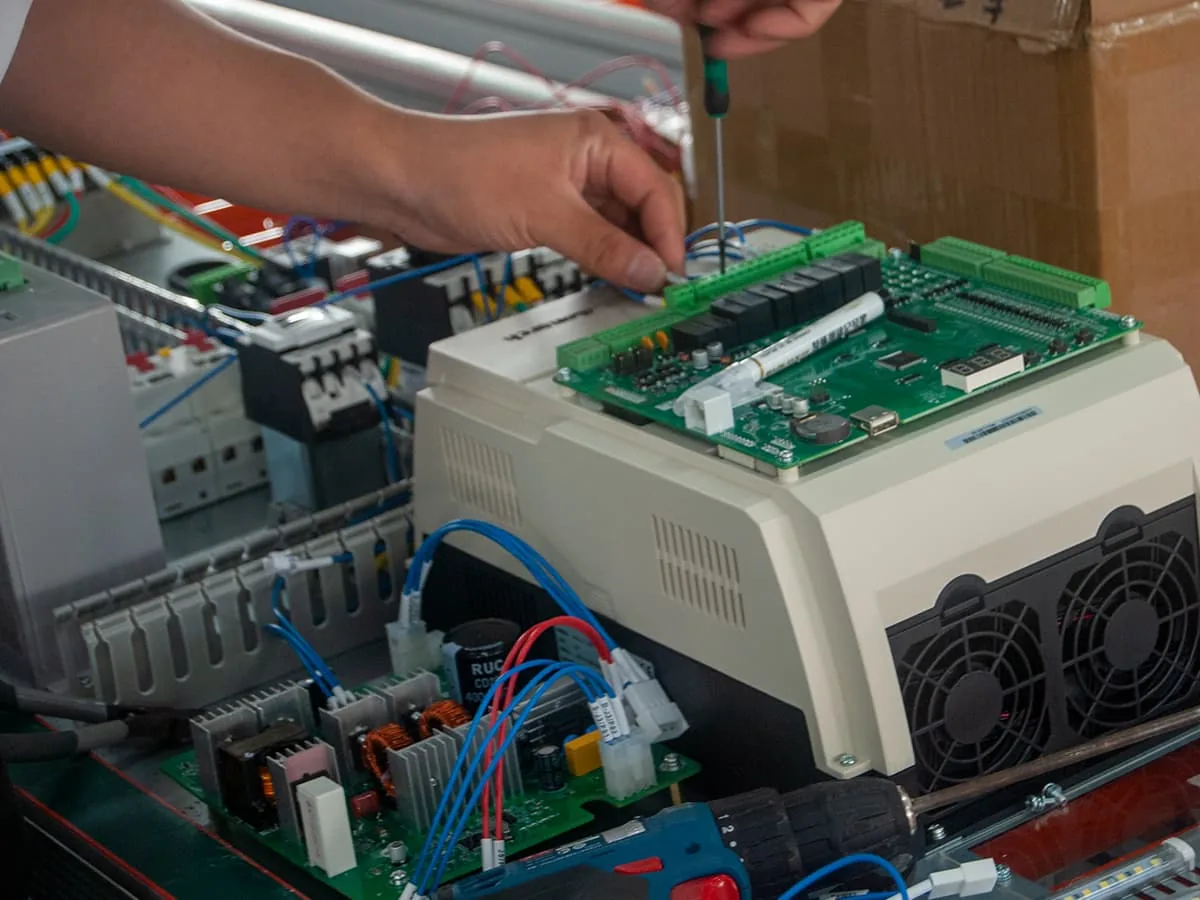
The supply question for a dumbwaiter control system splits into two: what the site has, and what the machine needs. For dumbwaiters up to about 200 kg with moderate duty, a single-phase supply is often enough because the drive is small and starts under VFD control. Above that, or at high trip counts, three-phase becomes the sensible answer.
| Application | Typical rating | Usual supply | Notes |
|---|---|---|---|
| Small cafe or clinic, 2 to 3 stops | 50 to 100 kg | 220 V single-phase | Light duty, short run times |
| Restaurant, 3 to 4 stops | 100 to 200 kg | 220 V single-phase or 380 V three-phase | Depends on trips per day and travel height |
| Hotel or hospital kitchen, 4 to 6 stops | 200 to 300 kg | 380 V three-phase | Higher duty, longer travel, heavier car |
| 60 Hz market, any size | 50 to 300 kg | Same voltages, different frequency | VFD parameters and motor selection change |
Two site rules apply to the dumbwaiter control system whatever the rating. The dumbwaiter must be on its own dedicated circuit, not shared with kitchen equipment, laundry machines or air conditioning, because a compressor starting elsewhere on the same circuit will disturb the drive. And the emergency stop must cut power independently of other building systems, which is a clause an inspector will check on the first visit.
If your building only has single-phase power and you need a larger unit, do not assume you need a panel upgrade. Single-phase options up to 200 kg exist. What changes is the drive rating and sometimes the motor frame, so the request has to reach the factory before the dumbwaiter control system is built, not after.
The installation guide covers the site readiness side of this in more detail: dumbwaiter installation requirements.
50 Hz vs 60 Hz: The Export Detail That Delays Projects
Frequency is the single most commonly missed item on a dumbwaiter control system specification, and it is invisible on the quotation because both versions say “380 V”. The difference is real:
| Item | 50 Hz supply | 60 Hz supply | What changes |
|---|---|---|---|
| Four-pole motor speed at nominal frequency | about 1,500 rpm | about 1,800 rpm | Car speed, unless corrected |
| VFD output limit | Maximum output set at 50 Hz | Maximum output set at 50 Hz | Parameter set, not hardware |
| Motor and gearbox selection | Standard build | Standard build | No change if a VFD is fitted |
| Direct-on-line units without VFD | Correct by design | Runs 20 percent fast | Motor, sheave or gearbox must change |
| Contactor and relay coils | 230 V 50 Hz coils | 230 V 60 Hz coils | Coil specification |
| Control transformer taps | Primary tapped for 50 Hz | Primary tapped for 60 Hz | Transformer selection |
That flexibility is one of the practical advantages of a traction drive over the alternatives compared in traction vs hydraulic vs screw dumbwaiters. The VFD is the reason most modern dumbwaiter control systems travel between 50 Hz and 60 Hz markets without hardware changes.
The drive converts the incoming supply to DC and then synthesises the output frequency it needs, so a car specified for 0.5 m/s stays at 0.5 m/s whether it is fed 50 Hz or 60 Hz. All that changes is the parameter set loaded at commissioning.
Two details in the dumbwaiter control system still need attention once the drive is set. The contactor and relay coils must match the supply frequency, otherwise they buzz and overheat. And the control transformer primary has to be tapped correctly. Both are cheap to get right at the factory and irritating to correct on site.
If you are buying a low-cost unit without a VFD — usually the smallest single-phase models — the frequency is a hard constraint, not a setting. Say which market the unit is for, and let the factory pick the motor and sheave accordingly.
Call Buttons, Floor Display and Intercom
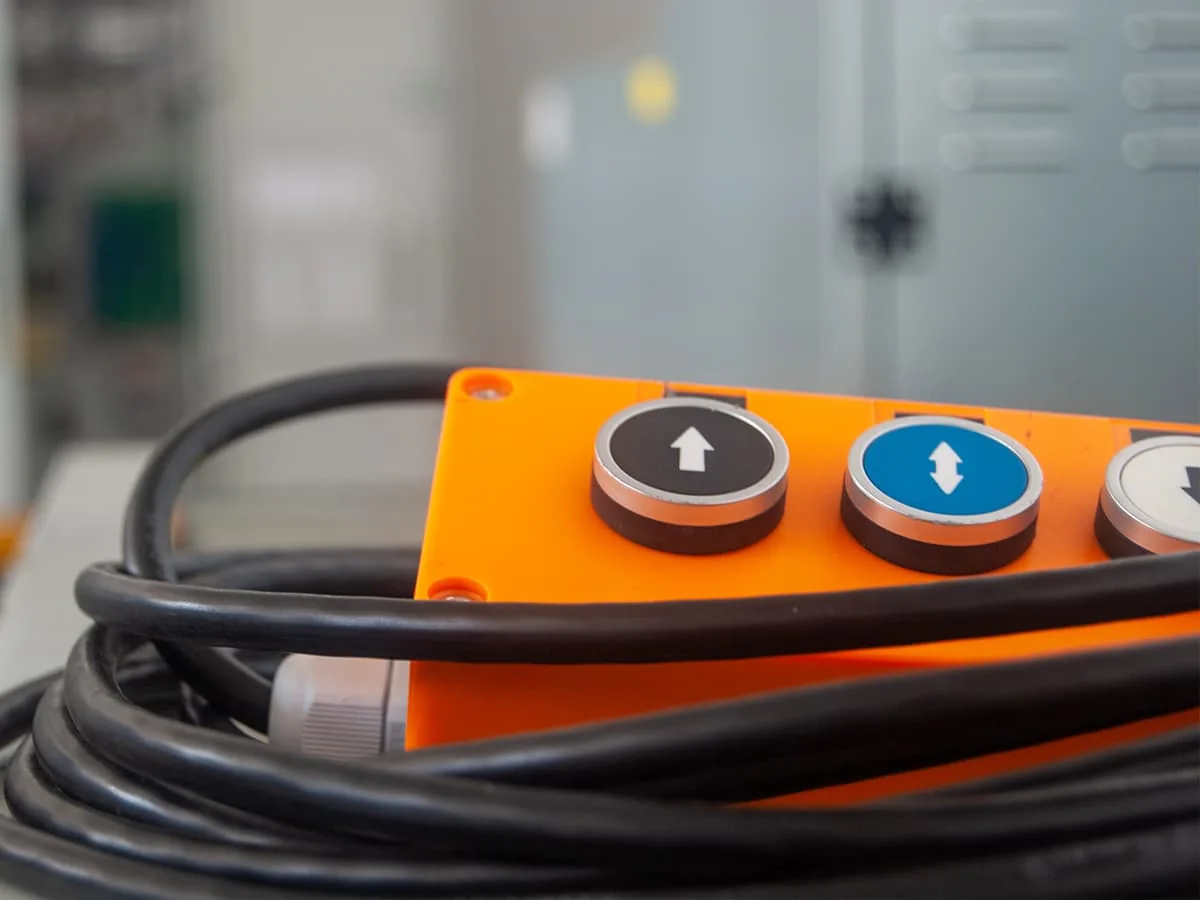
The interface group is where a dumbwaiter control system meets the people who use it, and it is where low-cost quotations cut most visibly. Four choices matter.
- Button legend language. Landing and car buttons are engraved or printed. If the operators speak Arabic, Spanish or French, ask for the legend in that language — and consider adding the floor number alongside it in a neutral font.
- Button type and rating. A standard 22 mm push button in IP54 is fine in a dry corridor. In a wash-down area the car station should be stainless steel with a sealed membrane or IP65 buttons.
- Floor indicator. A seven-segment display is the low-cost option and is what most units ship with. An LCD indicator allows text, direction arrows and simple fault codes; it is worth the small premium on a hotel or hospital unit where staff need to see status at a glance.
- Intercom or bell. A dumbwaiter moves unattended, so the car needs a way to be found. An intercom to the kitchen pass or reception is the practical choice; a simple call bell is the minimum.
Ask for the button legend and the display type to be listed on the drawing you approve, because both are fixed to the dumbwaiter control system at the factory and neither is easy to change afterwards. Changing a legend after the panel is built means new button plates, and shipping button plates is a slow way to solve a five-minute problem.
The Door Interlock and the Safety Circuit
The door interlock is the most important component in the whole dumbwaiter control system and the most frequently abused. Its job is simple: the car must not move unless every landing door and the car gate are closed and mechanically locked.
Two principles of the dumbwaiter control system are worth understanding, because between them they explain most inspection findings.
Independence. The interlock contact must not be defeatable by a maintenance switch, a bypass link or a software override. If a technician can hold the contact closed with a screwdriver and move the car, the design is non-compliant and an inspector will find it on the first walk-round.
Duplication of the terminal stops. The car must be stopped at the top and bottom floors by something other than the normal levelling system. On most units this is a mechanical limit switch plus a final stopping device, and on better designs there are two independent means.
This is the point at which the electrical specification meets the legal one. In the United States the applicable regime is ASME A17.1 with local amendments; in the European Union, EN 81-31 covers non-passenger goods lifts, and the European Commission’s lifts pages set out how member states apply the directive.
Both treat the door interlock as a safety-critical circuit, not a convenience feature. If you are unsure which regime applies to your site, the country-by-country breakdown is here: dumbwaiter regulations by market.
The recurring findings are the ones to design out at order stage: a fire-rated shaft door propped open during service because the car is slow, a certificate never posted at the equipment, a car loaded past its rating, and a shelf or control change made without approval.
None of these are control failures in the strict sense, but all four start with an operator working around the control system. A sensible dumbwaiter control system makes the correct behaviour the easy behaviour.
Enclosure Rating and Where the Panel Should Live
The panel is the only part of the dumbwaiter control system that usually sits in the building rather than in the shaft, and its life depends almost entirely on where it is mounted. Where that is, and how it is protected, is as much a part of the specification as the drive rating.
| Mounting location | Sensible rating | Watch out for |
|---|---|---|
| Dry corridor or machine cupboard | IP54 | Door must be lockable and the panel must be accessible for servicing |
| Kitchen back-of-house | IP54, stainless or painted steel | Grease, heat and wash-down spray; keep clear of fryers and dishwashers |
| Service corridor with hose-down | IP65 | Cable glands must match the enclosure rating, or the rating is cosmetic |
| External or unheated plant room | IP65 with heater | Condensation in winter, ambient temperature limits on the VFD |
Three practical rules save more dumbwaiter control systems than any rating label. Keep the panel out of the hot zone — a VFD mounted beside a range will derate and trip. Leave space for the door to open fully and for a technician to stand in front of it. And mount the panel so the VFD heat sink is vertical, because drives mounted on their side lose their convection path.
If the panel has to live in a wet area, ask for IP65 as a package: enclosure, glands, and a sealed membrane keypad. An IP65 box with IP54 glands is not IP65. Higher-rated enclosures are built to order, as on the DC-003 control cabinet.
Cable Separation and Electromagnetic Compatibility
A dumbwaiter control system shares a building with equipment that generates electrical noise — refrigeration compressors, welding sets, microwave banks, and occasionally a lift or pump in the same riser. Both of the rules below concern the wiring of the dumbwaiter control system itself rather than the building’s electrical services, and between them they prevent almost all of the resulting problems.
- Keep power and signal cables apart. Motor cables from the VFD to the traction machine should not run in the same trunking as interlock, button or intercom wiring. Where they must cross, cross at right angles.
- Earth the motor cable screen at both ends. The screen on the VFD output cable is there to return high-frequency current to the drive, not to be a decorative sleeve. Single-ended screening is a common site error and causes erratic readings on the floor indicator.
If the building has an existing electrical installation, an electrician who knows the site can usually identify the circuits that will disturb the dumbwaiter control system inside an hour. Running the dumbwaiter feed in its own conduit from the distribution board is the single most cost-effective decision available at installation stage.
In the United States the comparable requirements for workplace electrical installations are published by OSHA and adopted with local amendments.
What to Send Before We Build the Panel
Every one of these points is cheaper to answer by email before the dumbwaiter control system is built than to correct on site afterwards. This is the list to send with your enquiry.
| # | Item | Why the factory needs it |
|---|---|---|
| 1 | Country and market | Decides the standard the unit is built to |
| 2 | Supply voltage and phase | Sizes the breaker, contactor, drive and transformer |
| 3 | Frequency, 50 or 60 Hz | Sets VFD parameters and coil specification |
| 4 | Number of stops and total travel | Determines cable length and limit positions |
| 5 | Rated load in kg | Drives motor and drive sizing |
| 6 | Trips per day and typical load | Duty cycle, thermal rating |
| 7 | Panel mounting location and IP requirement | Enclosure and gland specification |
| 8 | Button legend language | Plate engraving before the panel is built |
| 9 | Display type, intercom required, extra floor provision | Controller input count and spare capacity |
Send a photograph of the distribution board as well, with the breaker ratings visible. It settles the supply question faster than any description. The car and shaft dimensions are set separately from the controls; the reference for those is our dumbwaiter dimensions guide.
Common Control Faults and What They Mean
Most service calls on a dumbwaiter control system come down to one of six faults, and four of them can be cleared without a specialist. A fault log kept beside the panel turns guesswork into pattern recognition. The first column is what the operator reports; the last column is the first thing to check.
| Symptom | Likely cause | First check |
|---|---|---|
| Car will not move, no fault code | Door interlock contact not made | Clean and reset the landing door contact; look for a door left ajar |
| Car ignores calls from one floor only | Call button or common return open | Test that button, then the common conductor on that landing |
| Repeated tripping of the overload relay | Binding guide shoe, dry rail or incorrect VFD ramp | Guide shoes, rail lubrication, acceleration ramp length |
| Drive trips on deceleration with an overvoltage fault | Deceleration ramp too short for the load | Lengthen the ramp; suspect the brake gap if the load varies |
| Car overshoots and corrects at the floor | Brake gap, or levelling sensor drift | Brake gap and the levelling vane position |
| Display shows the wrong floor | Counter drift after a manual move | Re-zero the car at the bottom terminal floor |
When a fault is a symptom, not a fault
Three of the six entries above are mechanical problems showing up inside the dumbwaiter control system rather than genuine electrical faults. A car that trips the overload relay every few trips usually has a mechanical drag, not an electrical fault, and a car that overshoots usually has a brake clearance issue. Replacing the drive will not fix either. Sort the mechanical cause first and the electrical symptom disappears.
Keeping a written log of when faults occur and what was happening is more useful than a fault code list on its own: the record of a car that fails only on the third trip of a busy service points straight at thermal or duty-cycle causes.
The routine side of this is covered in the dumbwaiter maintenance guide, and the legal examination side in the inspection and maintenance schedule.
Spare Parts to Keep With the Control System
A dumbwaiter control system cannot be repaired by a local electrician, because the two components that fail most often are also the two that are factory-specific. Order these with the unit rather than after the first breakdown. The right kit turns a week-long shutdown into an afternoon’s work.
- Controller board — the single most important spare; not locally sourceable.
- Contactors — one of each type used, since they are cheap and wear with every trip.
- Overload relay — matched to the motor rating.
- Call buttons and contact blocks — at least one of each legend used.
- Door interlock contact block — the part most often damaged during service.
- Fuses and a spare 24 V DC power supply — two items that turn a shutdown into a five-minute fix.
- VFD keypad or parameter backup — a printed parameter sheet is as good as a spare keypad, and costs nothing.
On a multi-unit installation, one dumbwaiter control system spare kit per site is usually the right balance. A full itemised spare list for a fleet is covered in our guide to choosing a dumbwaiter brand, and the mechanical wear items are listed in the maintenance guide.
Frequently Asked Questions
What voltage does a dumbwaiter control system need?
Most units accept 220 V single-phase up to about 200 kg, and 380 V three-phase above that or at high duty; the dumbwaiter control system itself is agnostic, and the panel is built to match the site. The control and safety circuits inside the panel run on 24 V DC, stepped down from the supply. Confirm both the site supply and the frequency before the panel is built.
Can you supply a dumbwaiter for a 60 Hz country?
Yes. When the unit has a variable-frequency drive — the standard build for traction dumbwaiters — the dumbwaiter control system is set to the required output frequency and the car speed is unchanged. The contactor coils and control transformer primary are specified for the destination supply. On units without a drive, the motor and sheave are selected for the target frequency instead.
Is a VFD necessary on a dumbwaiter?
On any commercial unit, yes. A drive gives smooth acceleration and levelling, and it keeps the starting current low enough for a domestic or light commercial supply. Without it, a dumbwaiter control system on a 220 V single-phase site will nuisance-trip. A direct-on-line starter is cheaper, but it starts hard, levels roughly and trips small breakers.
How is the dumbwaiter control system protected in a kitchen?
Use at minimum an IP54 enclosure in painted or stainless steel, mounted clear of fryers, dishwashers and hose-down zones, with the door opening into free space. In a wash-down corridor, specify IP65 as a package including glands and a sealed keypad.
How many spare parts should I order with the unit?
For a single unit: one controller board, one contactor of each type, one overload relay, a set of fuses, one call button and one door interlock contact block. That kit covers the great majority of service calls without air freight.
Next Step
If you have the four numbers — supply voltage and phase, frequency, control voltage and enclosure rating — you can specify a dumbwaiter control system in one email. Send them with the number of stops, the rated load and the panel location, and ask for the panel drawing before production.
Ten minutes of specification prevents the two failure modes that cost the most on a dumbwaiter control system: a panel built for the wrong supply, and a car that runs at the wrong speed.
ServLifts builds non-passenger dumbwaiters from 100 kg to 250 kg in Wujiang, Suzhou, China, with 220 V single-phase or 380 V three-phase supply, 50 Hz or 60 Hz drive parameters, and the control cabinet listed on the drawing you approve. Send your site details and we will confirm the control system specification before you place the order: contact ServLifts.
[…] Standard in restaurant and hotel installations. – Control voltage: Typically 24V DC for the control system, stepped down from the main […]
[…] like a tiny elevator: an electric motor moves a steel car up and down guide rails inside a shaft, a control system manages the calls and doors, and safety devices keep everything safe. For the full step-by-step […]