Welcome to ServLifts Official Website

Dumbwaiter Regulations: 7 Costly Mistakes US, UK & EU Buyers Must Avoid

A dumbwaiter is a small box moving between floors, so it is easy to assume nobody regulates it. That assumption fails in every major market where dumbwaiter regulations apply. Dumbwaiter regulations exist in the United States, the European Union and the United Kingdom, they are enforced by different bodies, and they demand different documents at different moments in a project.
The problem for a buyer is not that the rules are strict. It is that dumbwaiter regulations are split across several instruments, and which one applies to your unit depends on physical facts about the installation that are easy to overlook until an inspector asks. A car that a person can step into is treated differently from one that only accepts trays. A unit rated at 0.14 m/s sits in a different legal category from one rated at 0.20 m/s. Neither difference is visible on a quotation.
This guide covers the three markets where dumbwaiter regulations generate most buyer questions: the United States and Canada, the European Union, and the United Kingdom. For each one it answers three questions — who regulates it, what the rules actually require, and which documents a buyer should hold before the equipment ships. It closes with eight questions to put to any supplier and five myths that regularly cost buyers money.
Table of Contents
- Quick answer: who regulates dumbwaiters in each market
- Why dumbwaiter regulations exist at all
- United States: how ASME A17.1 governs dumbwaiters
- United States: definition thresholds and the four most common violations
- European Union: two objective gates decide which directive applies
- European Union: what changes on 20 January 2027
- United Kingdom: supply rules are only half the story
- Side by side: dumbwaiter regulations in the US, UK and EU
- Eight questions to ask a supplier before you order
- Five myths about dumbwaiter regulations
- FAQ
Quick Answer: Who Regulates Dumbwaiters in Each Market
Before the detail, here is where dumbwaiter regulations sit in each of the three markets. In all three markets the same three questions decide everything: is the unit a dumbwaiter by definition, can a person enter the car, and how fast does it travel.
| Market | Primary instrument | Enforced by | Document the buyer should hold |
|---|---|---|---|
| United States | ASME A17.1 / CSA B44 (installation); ASME A17.3 (existing units); ASME A17.4 (emergency) | State or local elevator authority (AHJ) | Certificate of inspection, renewed on the local cycle |
| Canada | CSA B44, adopted province by province | Provincial authority | Provincial inspection certificate |
| European Union | Lifts Directive 2014/33/EU or Machinery Directive 2006/42/EC, depending on two thresholds | Market surveillance authorities of each member state | EU Declaration of Conformity + CE marking + technical file reference |
| United Kingdom | Lifts Regulations 2016 or Supply of Machinery (Safety) Regulations 2008 for supply; LOLER 1998 for use | HSE and local authorities | Declaration of Conformity, then a thorough examination report under LOLER |
The single most useful line in that table is the last one. In the US and Canada, dumbwaiter regulations are enforced through periodic inspection of the installed unit. In the EU and UK, compliance is largely established before the unit is placed on the market, through a declaration and a technical file. Buyers who plan for the wrong set of dumbwaiter regulations arrive at handover without the paperwork the other side wants.
Why Dumbwaiter Regulations Exist at All
A dumbwaiter carries food, linen, documents or small parts, not people. That is the whole point of the category, and it is also why the rules around it look inconsistent. Regulators write dumbwaiter regulations around a machine that is expected to be inaccessible to people, so the safety argument shifts from protecting passengers to preventing access in the first place.
In practice, dumbwaiter regulations in every market below express three recurring themes in their own language.
- Access control. The hoistway door, the landing door and the car itself must make it hard for a person to enter. Fire-rated door assemblies, interlocks and restricted car dimensions all serve this goal.
- Predictable load behaviour. Because nobody is inside to react, the machine must not be able to lift more than it is rated for, or fail in a way that drops the car. Overspeed detection, slack-rope detection and overload protection are the usual mechanisms.
- Traceability. Somebody must be able to prove, years later, that the unit was built and installed to the rules that applied on the day it was commissioned. This is what inspection certificates and technical files are for.
There is a commercial reason to care as well, and it follows from the way dumbwaiter regulations allocate responsibility. In most of the markets covered here, the responsible party for an installed dumbwaiter is the building owner or the operator, not the factory that built it. If the paperwork is incomplete at handover, the cost of fixing it lands on the buyer. That is why the eight questions in the second half of this guide matter more than the price difference between two similar quotations.
United States: How ASME A17.1 Governs Dumbwaiters
The United States does not have a single national dumbwaiter law. It has a consensus code that states and cities adopt, usually with amendments and usually several years late. That structure explains most of the confusion buyers run into, because the answer to “what do the dumbwaiter regulations require” depends on where the building is.
Most US dumbwaiter regulations derive from a single consensus document, published jointly as ASME A17.1 and CSA B44, the Safety Code for Elevators and Escalators. The current edition is A17.1-2025 / B44-2025, the twenty-fourth edition of the code. Dumbwaiters and material lifts are addressed in their own part of the document rather than being treated as a footnote to passenger elevators. In many jurisdictions, however, the enforced edition is still 2022 or even 2019, because adoption is a legislative act rather than an automatic one — which is why dumbwaiter regulations vary so much from one state to the next.
The code family that carries US dumbwaiter regulations splits the life of a unit into three stages, and buyers routinely mix them up. Three separate documents cover new installation, existing installations, and emergency response:
| Document | Covers | Relevant when |
|---|---|---|
| ASME A17.1 / CSA B44 | Design, construction, installation, alteration | New unit, or a significant modification to an existing one |
| ASME A17.3 | Safety requirements for existing elevators and escalators, including dumbwaiters | An older unit being kept in service, or a building changing use |
| ASME A17.4 | Emergency evacuation and procedures for trapped occupants | Writing the building procedure; relevant mainly where a car is enterable |
The practical takeaway for anyone reading US dumbwaiter regulations: if you are buying new equipment, A17.1 is the document your supplier designs against. If you are refurbishing a dumbwaiter that has been in a building for twenty years, A17.3 is the one an inspector will reference, and it may impose requirements the original installation never had to meet.
Enforcement of US dumbwaiter regulations is handled by the Authority Having Jurisdiction, usually a state or municipal elevator division. A few states have no statewide programme at all, in which case the obligation falls to a city or county — or, in a few places, to nobody until a problem occurs. That gap is worth checking before you buy, because it changes what documentation the installer must produce. The installation requirements page sets out what a complete handover pack normally contains.
United States: Definition Thresholds and the Four Most Common Violations
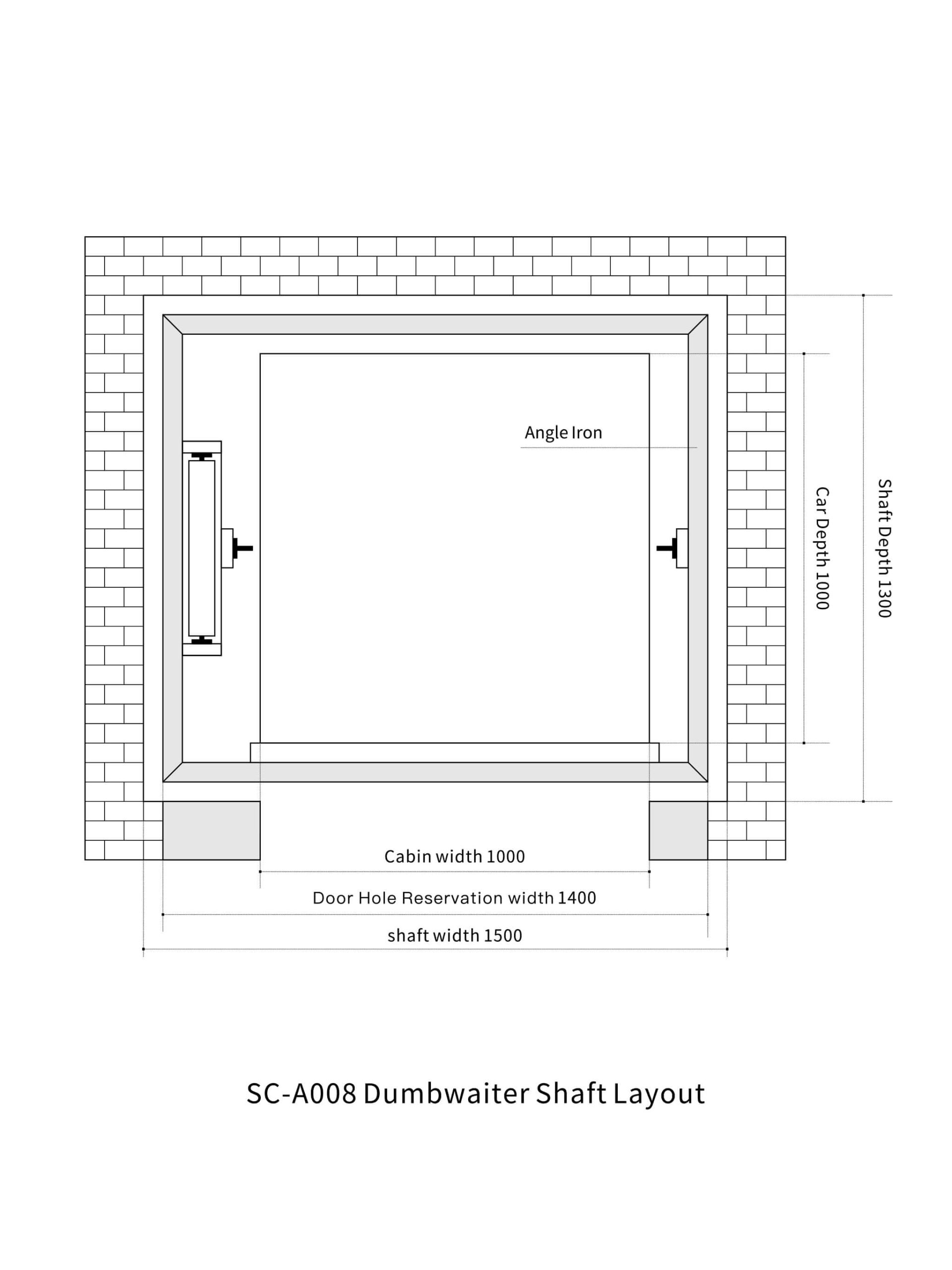
American dumbwaiter regulations are unusually concrete about what counts as a dumbwaiter, and the definition is dimensional rather than functional. Under the code, a dumbwaiter is a hoisting and lowering mechanism with a car that is limited in both floor area and height. The controlling limits are a car floor area not exceeding 9 square feet (about 0.84 m²) and a car inside height not exceeding 4 feet (about 1.2 m).
Those two numbers do a lot of legal work inside US dumbwaiter regulations. They are what keeps a dumbwaiter out of the passenger-elevator category, and they are also the first thing an inspector will measure if a unit is being used as something it was not approved as. If a supplier quotes you a car with a 1.5 m inside height and calls it a dumbwaiter, the label may not survive an inspection in a strict jurisdiction. Shaft and car dimensions are worked through in more detail in this dumbwaiter dimensions guide.
On the operating side, inspection frequency is set locally rather than by the code, so dumbwaiter regulations differ from one city to the next. A widely used baseline is an annual inspection, but dense urban jurisdictions in the United States commonly require twice a year, and a handful of states run no periodic programme of their own. The certification itself, not its frequency, is what matters commercially: without a current certificate the unit is not lawfully in service.
Across thousands of inspections, four findings come up again and again. They are worth listing because each one is a design or installation decision rather than an unlucky accident.
- The fire-rated hoistway door was removed or swapped. Because the door is the main barrier to access, substituting a lighter or non-rated assembly is treated as a safety-system failure, not a cosmetic change.
- No valid inspection certificate on file. The unit may be perfectly sound, but the building cannot demonstrate compliance, which is treated the same as non-compliance.
- Overloading. Trays, trolleys and stock are routinely heavier than the rated capacity, and overload devices are sometimes disabled because they interrupt service.
- Unauthorised modification of the car. Extending the car, adding a shelf that reduces headroom, or fitting a different door operator all invalidate the original approval.
Note the pattern: three of the four are things that happen after commissioning, often years later, usually for convenience — and two of them involve somebody treating the car as a place to stand. Whether people can lawfully ride one at all is a separate question, covered in dumbwaiter safety and legality. That is a useful frame when reading the rest of this guide, because European and British dumbwaiter regulations attack the same problem from the other direction, by trying to specify the behaviour in advance.
European Union: Two Objective Gates Decide Which Directive Applies
Europe is where the most persistent misunderstanding sits. The common assumption is that a dumbwaiter, being a small goods-only machine, automatically falls under the Machinery Directive and never touches lift law — a confusion that partly comes from how loosely the category is described elsewhere in the trade (see how dumbwaiters sit inside the wider elevator classification). That is not correct. EU dumbwaiter regulations are not a single rulebook; they are a routing decision, and the routing is done by two measurements.
The Lifts Directive, 2014/33/EU, is one of the two instruments EU dumbwaiter regulations are built from. It applies to lifts serving defined levels, with a car designed for persons or for persons and goods. The European Commission publishes the scope and guidance for lifts, which is where the exclusion wording sits. Its scope article then excludes certain machines from the definition. Whether your unit is caught by EU dumbwaiter regulations turns on how those exclusions read against the physical unit.
Gate One: Can a Person Enter the Car?
The first of the two gates that route EU dumbwaiter regulations is accessibility. A car becomes “enterable” once it passes the dimensional limits used for this test: a floor area greater than 1 square metre, a depth greater than 1 metre, or an inside height greater than 1.2 metres. Any one of those being exceeded is enough to move the unit into the enterable class.
This is why the American definition threshold of 0.84 m² is so often quoted in discussions of European dumbwaiter regulations. Both frameworks are trying to answer the same question — at what point does a box become a room — and both answer it with numbers rather than adjectives. If your car is specified near the limit, the design margin you choose is a legal choice, not just an engineering one.
Gate Two: Is the Rated Speed Above 0.15 m/s?
The second gate that routes dumbwaiter regulations in Europe is speed. The Lifts Directive excludes machines whose rated speed does not exceed 0.15 m/s. A dumbwaiter running below that figure is outside the directive’s scope regardless of other characteristics; one running above it is a candidate for the directive, subject to the first gate as well.
The logic behind a speed threshold is that a very slow machine cannot generate the same kinetic energy, so it cannot produce the same injury. The practical effect for buyers is that two units which look identical on a quotation, and differ only in rated speed, can carry different obligations under EU dumbwaiter regulations. Rated speed belongs in the specification discussion, not in the fine print.
Put the two gates together and the routing of EU dumbwaiter regulations becomes straightforward. A unit that cannot be entered and runs at or below 0.15 m/s sits outside the Lifts Directive and is handled under the general machinery framework. A unit that can be entered, or that runs above 0.15 m/s, moves into the lift framework, which brings a notified body, CE marking and a technical file with it.
Two consequences follow that buyers do not always expect. First, the classification is not the supplier’s preference — it is a function of the installation, so it can change if the building changes the speed setting or enlarges the car. Second, and more usefully, the classification is knowable in advance. Both gates can be evaluated from the specification sheet before the order is placed.
European Union: What Changes on 20 January 2027
Two separate changes to European dumbwaiter regulations take effect on the same day, and their coincidence is the part most guides miss. For buyers planning a project that will be delivered in late 2026 or 2027, this section is the one to read twice.
The first change to European dumbwaiter regulations concerns the framework legislation. The Machinery Regulation, (EU) 2023/1230, replaces the Machinery Directive 2006/42/EC from 20 January 2027. Units that were previously assessed under the directive will be assessed under the regulation, which changes the language of the declaration and the structure of the technical documentation.
The second change to European dumbwaiter regulations concerns the harmonised standard used to demonstrate conformity. EN 81-31:2010 is the standard for accessible goods-only lifts, and its presumption of conformity runs out on that same date. From then on, the reference is EN 81-31:2024, published in November 2024 and cited in the Official Journal through Implementing Decision (EU) 2025/1740.
The scope of EN 81-31:2024 is worth knowing precisely, because it defines the class of equipment rather than describing a single product. It addresses accessible goods-only lifts with a rated load above 300 kg and a rated speed of no more than 1 m/s, and it distinguishes two types within that envelope: a slower type limited to 0.30 m/s and a faster type limited to 1.0 m/s.
| Date | What happens | What it means for a project |
|---|---|---|
| Until 19 Jan 2027 | Machinery Directive 2006/42/EC and EN 81-31:2010 both in force | Declarations citing the directive and the 2010 standard are valid |
| 20 Jan 2027 | Machinery Regulation (EU) 2023/1230 applies; presumption of conformity for EN 81-31:2010 ends | Declarations must cite the regulation; technical files must reference EN 81-31:2024 |
| After Jan 2027 | EN 81-31:2024 is the harmonised reference for accessible goods-only lifts | New units should be designed and documented to the 2024 edition |
The practical guidance on dumbwaiter regulations for 2027 deliveries is simple. If your unit is being built now and installed before the end of 2026, the current framework applies. If delivery or commissioning lands in 2027 or later, ask the supplier to state which document set the technical file will follow, and get that in writing. A declaration citing a superseded directive is one of the few paperwork problems that cannot be fixed locally after the equipment arrives.
United Kingdom: Supply Rules Are Only Half the Story
British dumbwaiter regulations split cleanly into two moments, and buyers usually plan for the first while an inspector arrives asking about the second. The supply side governs putting the equipment on the market. The use side governs what happens once it is in a building and somebody is responsible for it.
On the supply side of UK dumbwaiter regulations, the Lifts Regulations 2016 apply where the equipment falls within the lift definition, essentially units designed for persons or for persons and goods. A goods-only dumbwaiter that cannot be entered and does not exceed the speed threshold generally falls outside that definition and is instead handled under the Supply of Machinery (Safety) Regulations 2008. The dividing logic is the same two gates described for the EU, which is unsurprising given the shared origin of the standards.
Whichever set of UK dumbwaiter regulations applies, the supplier must provide a Declaration of Conformity and the equipment must be marked accordingly. That document is the buyer’s evidence that the unit was lawfully placed on the market, and it is worth checking that the model designation on the declaration matches the model designation on the nameplate. A mismatch is a common and avoidable problem.
LOLER: Why a 12-Month Cycle Can Become a 6-Month Cycle
The use side is where British dumbwaiter regulations become genuinely strict, and this is the point almost nobody writes about. The Lifting Operations and Lifting Equipment Regulations 1998, known as LOLER, require lifting equipment to be thoroughly examined at specified intervals, and the interval depends on the risk.
For equipment used for lifting goods only, the default interval is 12 months. But where the equipment is used for lifting persons, or where there is a risk of a person falling from or being struck by the equipment, the interval shortens to 6 months. The regulation does not ask what the equipment was labelled as. It asks what risk actually exists.
That distinction has a direct practical effect under UK dumbwaiter regulations. A dumbwaiter installed and declared as goods-only, but which staff routinely ride because it is faster than the stairs, moves into the higher-risk category. The duty holder — normally the employer or the building operator — then needs a six-monthly examination, and the Health and Safety Executive takes a conservative view when the facts are ambiguous. A unit that was compliant on paper at handover can drift out of compliance through nothing more than habitual misuse.
The remedy is procedural rather than technical. Restricted access, unambiguous signage, and a written statement in the handover pack that the unit must not be used to carry people are all cheap, and they are the evidence a duty holder would want to produce if an incident were investigated.
What a Thorough Examination Report Must Contain
A thorough examination under LOLER is not a casual walk-past. The report required by the regulations is a structured document, and a buyer or operator should know what belongs in it. It should identify the equipment, record the safe working load, list any defects found, grade each defect by severity, state the remedial action required and the deadline for it, and give the date by which the next examination is due. It is signed by the competent person who carried it out.
Two things follow from the way British dumbwaiter regulations handle the examination report. First, the report is tied to a specific unit, so it cannot be reused across a site or transferred to replacement equipment. Second, the defects and deadlines it lists are obligations, not suggestions; an operator who ignores a stated deadline loses the protection the examination was supposed to provide. This is a different model from the American certificate-of-inspection approach, and it is why British buyers often need more paperwork per unit than their counterparts in the United States. The routine work behind that report is set out in this dumbwaiter maintenance guide.
Side by Side: Dumbwaiter Regulations in the US, UK and EU
The three sets of dumbwaiter regulations answer the same safety questions but organise the answers differently. The table below puts the differences in one place, framed around the decisions a buyer actually makes.
| Question | United States / Canada | European Union | United Kingdom |
|---|---|---|---|
| Main instrument | ASME A17.1 / CSA B44 (A17.3 for existing units) | Lifts Directive 2014/33/EU or Machinery Directive 2006/42/EC | Lifts Regulations 2016 or Supply of Machinery (Safety) Regulations 2008 |
| What separates the two routes | Not a routing decision — the code applies by definition | Car enterability and rated speed above 0.15 m/s | Same two tests as the EU |
| Dimension thresholds that matter | Car floor area ≤ 9 sq ft (0.84 m²); inside height ≤ 4 ft (1.2 m) | Enterable if floor area > 1 m², depth > 1 m or height > 1.2 m | Aligned with the EU approach |
| Conformity evidence | Inspection certificate from the AHJ | EU Declaration of Conformity, CE marking, technical file | Declaration of Conformity, then a LOLER thorough examination report |
| Ongoing obligation | Periodic inspection — commonly annual, twice-yearly in dense urban areas | Market surveillance; national periodic regimes vary | LOLER thorough examination — 12 months for goods, 6 months where persons are at risk |
| Who carries the burden | Building owner or operator | Manufacturer, importer and installer, then the user | Supplier for supply rules; employer or operator for use rules |
Read across the “ongoing obligation” row and the difference in philosophy becomes visible. Buyers sourcing from China will also want to shortlist manufacturers on the basis of the market they are shipping into, not on price alone. The American model verifies the machine periodically. The British model does the same for the installed unit but sets the interval by reference to actual risk rather than to equipment class. The European model front-loads the work into the technical file, then leaves periodic oversight to national rules that vary from state to state within the union.
None of this makes one set of dumbwaiter regulations easier than another in a way that can be exploited. It does mean that the same machine, shipped to three different countries, arrives with three different expectations attached, and the supplier should be able to name them.
Eight Questions to Ask a Supplier Before You Order
Everything above becomes actionable in a single conversation, and it sits alongside the commercial decisions covered in the dumbwaiter selection guide. These are the eight questions that separate a supplier who understands dumbwaiter regulations from one who is repeating a template. Ask them before you place a deposit, and ask for the answers in writing.
| # | Question | What a good answer looks like |
|---|---|---|
| 1 | Which standard or directive will the Declaration of Conformity cite? | A specific code and edition, such as ASME A17.1-2025, EN 81-31:2024, or the Machinery Regulation for 2027 deliveries |
| 2 | What is the rated speed of the unit you are quoting? | A number in m/s, stated on the specification sheet, with the car dimensions alongside it |
| 3 | What is the car floor area and inside height? | Dimensions in both metric and imperial, so they can be checked against the local threshold |
| 4 | Does the car meet the enterability test in our market? | A direct answer, and if the answer is no, the design feature that makes it so |
| 5 | What documents ship with the equipment? | Declaration of Conformity, test certificates, wiring and layout drawings, maintenance manual |
| 6 | What inspection interval will our market require? | A statement of the local rule, including any shorter interval triggered by risk |
| 7 | Can you supply the technical file or its index? | At minimum a document list that a notified body or inspector can follow |
| 8 | Who handles the conformity work for a 2027 delivery? | A clear statement of which framework applies and who is responsible for the assessment |
Question four deserves emphasis and sits at the centre of all three sets of dumbwaiter regulations. It is the one that decides which legal route the unit travels, and it is answerable at the quotation stage. A supplier who cannot answer it is either unfamiliar with the market’s dumbwaiter regulations or is assuming a classification without checking. Either way, the risk transfers to you.
Question eight matters more each month. If you are still at the shortlisting stage, the checks in this supplier verification guide are worth running first. Any project commissioned from 2027 onward sits under the new European framework, and the standard that supports it has already changed. A supplier still answering with the previous directive is working from an outdated template.
Five Myths About Dumbwaiter Regulations
Specification errors around dumbwaiter regulations tend to come from a small set of assumptions that sound reasonable and are wrong. These are the five that appear most often in buyer questions.
Myth one: because it carries goods, it is not regulated. In every market covered here, dumbwaiter regulations apply to the installed unit. The category determines which rules apply, not whether any apply. A goods-only classification usually produces a lighter regime, not an empty one.
Myth two: a slow machine is always exempt. A speed below 0.15 m/s matters for the European routing test, but it is one gate of two. A slow car that a person can enter still moves into the lift framework. Treating the speed threshold as a general exemption under dumbwaiter regulations is the most expensive of the five assumptions.
Myth three: the CE mark on the machine is the end of the story. A CE mark on a component or a machine is evidence about supply. It says nothing about whether the completed installation, in that building, with those doors, satisfies the periodic obligations that follow. Conformity travels with the product; compliance with dumbwaiter regulations is a property of the installed system.
Myth four: the certificate lasts forever. Inspection certificates expire on a cycle, and the cycle is set locally in North America and by risk category in the United Kingdom. A certificate issued at handover is a starting point, not a lifetime pass.
Myth five: the supplier’s home-country approval is enough. Approvals are territorial. A unit certified for one market may need additional work to satisfy another, and the differences are not always cosmetic. The documentation that satisfies dumbwaiter regulations in the United States will not satisfy the European framework, and the reverse is equally true.
The common thread is that all five treat a compliance question as a product property. In practice, compliance with dumbwaiter regulations is a property of the installation, the documents and the usage pattern together, which is why the questions in the previous section are worth asking before a deposit rather than after delivery.
FAQ
Do I need a certified dumbwaiter for a restaurant?
Almost always, yes, in the sense that the installed unit must satisfy whatever dumbwaiter regulations your jurisdiction enforces and must be able to demonstrate it. Restaurants are also the setting where misuse is most likely, since staff are tempted to ride a food lift across a short vertical distance. Choosing a car that fails the enterability test, and labelling it clearly, reduces that risk at the design stage rather than relying on discipline later.
Is a dumbwaiter the same as a service lift under these rules?
Not exactly, and the difference matters in Europe more than in North America. “Food lift”, “service lift” and “dumbwaiter” are used loosely in the trade, but regulatory scope follows dimensions, access and speed rather than the label on the quotation. Two units described with different words can land in the same legal category, and the same words can land in different ones — the naming problem is unpacked in food lift vs service lift vs dumbwaiter.
How often will the unit need to be examined?
Under North American dumbwaiter regulations, expect a local cycle that is commonly annual and sometimes twice-yearly. In the United Kingdom, LOLER sets 12 months for goods-only use, shortening to 6 months where a person could fall from or be struck by the equipment, or where it is used to lift persons. In the European Union, the interval depends on the national regime of the member state where the building sits.
Can I avoid the heavier rules by choosing a slower model?
Under EU dumbwaiter regulations, speed is one gate, not a switch. Keeping the rated speed at or below 0.15 m/s addresses the European speed test, but a car that a person can enter still falls inside the lift framework. If your aim is the lighter route, the car dimensions and the access design have to be part of the decision as well.
What happens to projects delivered in 2027?
For European destinations, the Machinery Regulation (EU) 2023/1230 replaces the Machinery Directive from 20 January 2027, and the presumption of conformity for EN 81-31:2010 ends on the same date, moving the reference to EN 81-31:2024. Ask your supplier to confirm which document set the technical file will follow and to state that in writing before the order is placed.
Conclusion
Dumbwaiter regulations reward preparation more than any other part of a food lift project. The rules themselves are not hostile to small goods-only equipment; they simply ask that the classification be decided deliberately rather than assumed. Two measurements decide most of it — whether a person could get inside, and how fast the car travels — and both are visible on a specification sheet long before a deposit is paid.
The buyer’s checklist under all three sets of dumbwaiter regulations is short. Confirm the code or directive that will appear on the declaration. Confirm the car dimensions against the local threshold. Confirm the examination cycle your operator will inherit. Confirm who owns the conformity work if delivery lands after January 2027. Get all four in writing. When the equipment is sourced from China, the import process determines when those documents are actually needed.
If you want help reading a specification against the requirements of a particular market, or want the dimensions and rated speed of a specific model confirmed for your building, you can talk to us directly.

[…] to apply to any supplier you are considering. For the compliance side of the same question, the dumbwaiter regulations overview collects the codes that apply in the EU, the UK and North America in one place. Between them the […]
[…] buyer must hold are decided long before delivery. The market-by-market breakdown is in our guide to dumbwaiter regulations, and the supplier-side paperwork — what to ask for and what a genuine answer looks like […]