Welcome to ServLifts Official Website

How Does a Dumbwaiter Work? The Simple Mechanics Explained (2026)

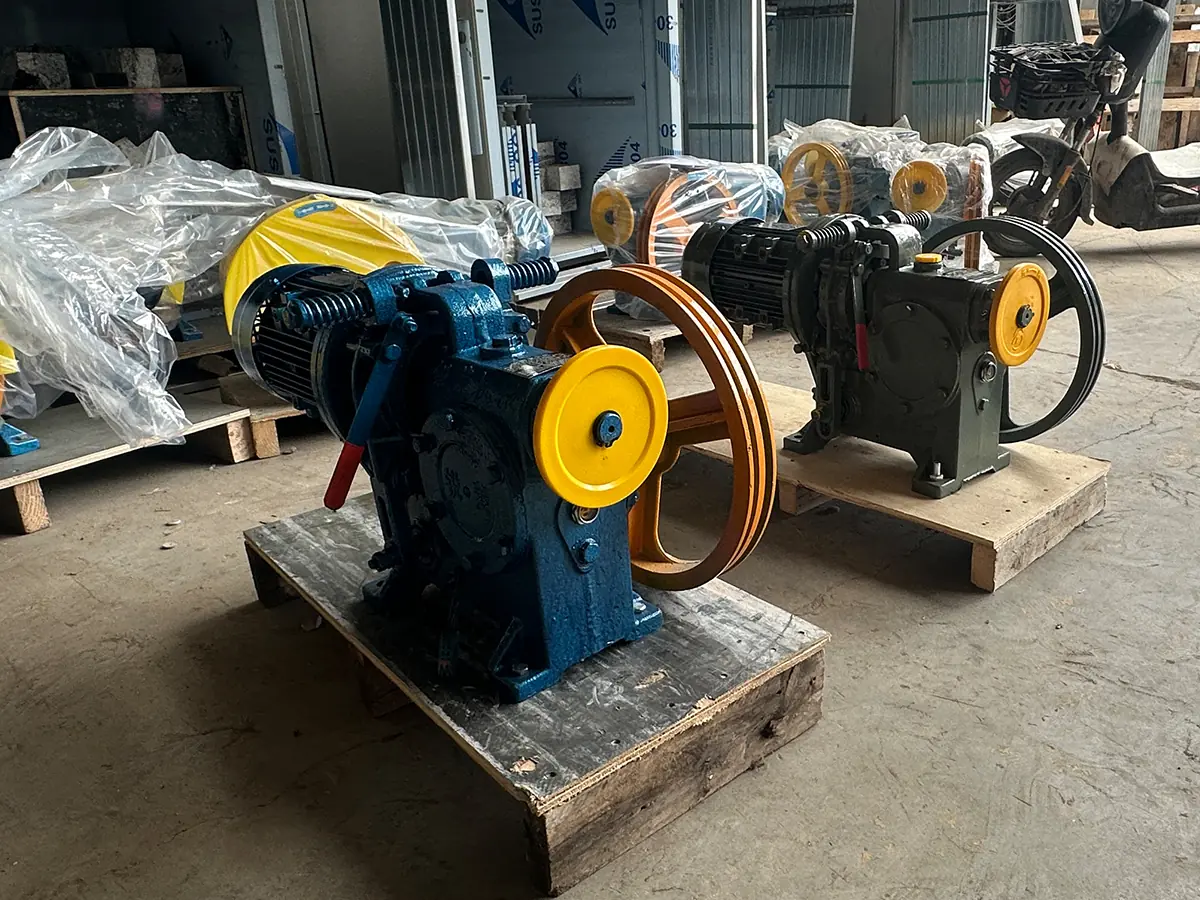
Table of Contents
A dumbwaiter — also called a food lift or service lift — is a small electric lift that carries goods, not people, between floors. But how does a dumbwaiter work? The honest answer is simpler than most people expect: it is a scaled-down version of a passenger elevator, built around the same four core systems — a motor, a car, guide rails, and a control panel. This guide explains the mechanics step by step, with photos from a real dumbwaiter factory, so you know exactly what you are buying and how it runs.
How Does a Dumbwaiter Work: The Basic Idea
Every dumbwaiter has the same job: move a small box (the car) safely up and down a vertical shaft. To do that it uses:
- A drive system — usually a traction motor with ropes, sometimes hydraulic.
- A car — the box that holds the goods.
- Guide rails — keep the car moving in a straight line.
- A control system — receives button presses, controls the motor, and enforces safety rules.
- Safety devices — interlocks, overload protection, and limit switches.
That is the whole machine. Every model on the market is a variation of these five parts.
The Traction System
The most common drive for a dumbwaiter is a traction system: an electric motor turns a grooved sheave (pulley), and steel ropes run over it — one end to the car, the other to a counterweight. The counterweight balances roughly half the car’s load, so the motor only needs to overcome the difference, not the full weight. That makes traction dumbwaiters efficient, smooth, and quiet.
This is a real traction machine from the ServLifts factory — the motor, sheave, and brake assembly that lift the car. Modern units use a machine-in-shaft or compact machine design, which needs very little overhead space and only a shallow pit, making retrofits practical.
The Car & Guide Rails
The car is a steel box, often finished in stainless steel (SS 304) for food-contact and hygiene applications. It rides on guide rails fixed inside the shaft, which keep it perfectly vertical and absorb the load so the building structure is not stressed unevenly. Cars typically range from 60×60 cm to 100×100 cm, carrying 100–250 kg — sized for trays, carts, linen, or documents, never for people.
The Control System & Call Buttons
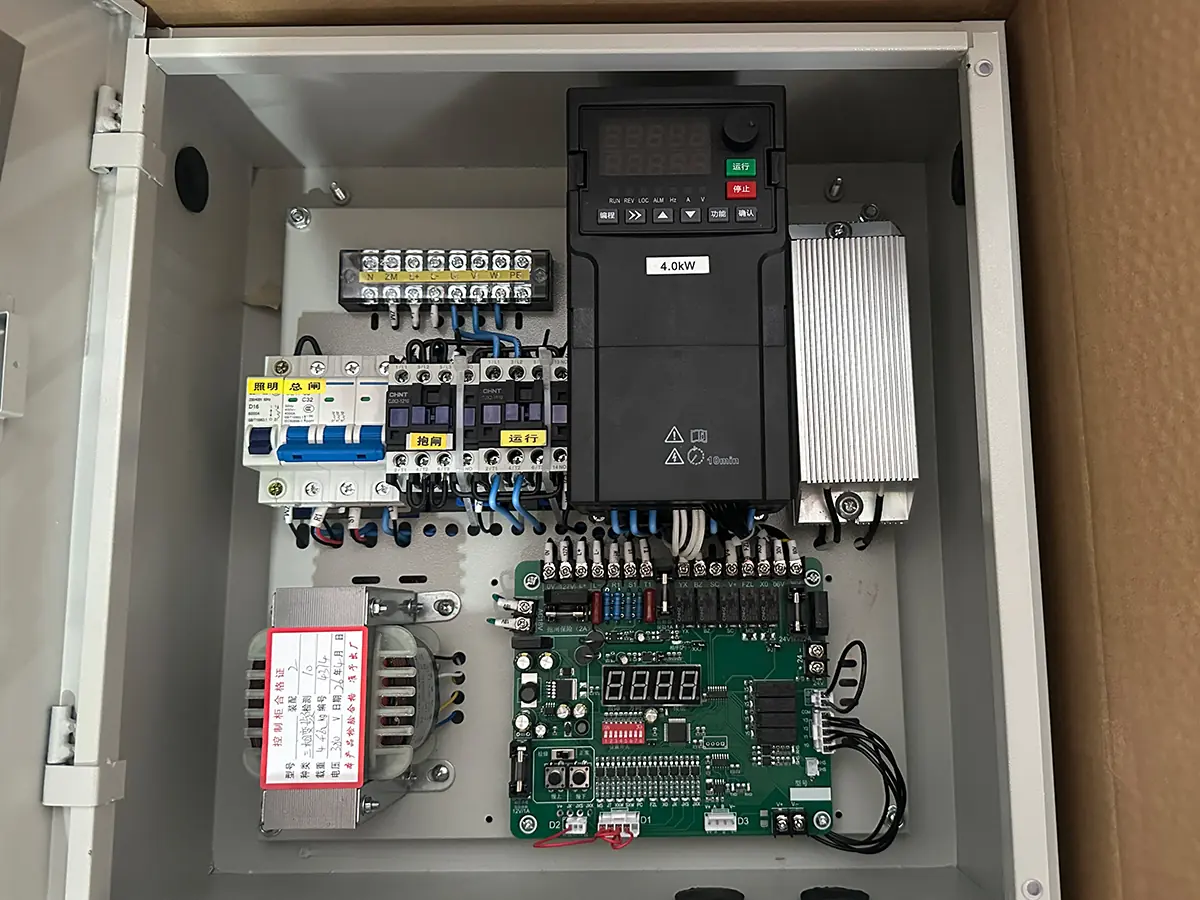
At each floor there is a small call panel with buttons for the floors. Inside the machine space, a control system (a programmable controller) decides what happens next:
- Which floor the car should travel to.
- Which direction to go.
- When to open or close the interlocked doors.
- Whether the safety conditions are met before moving.
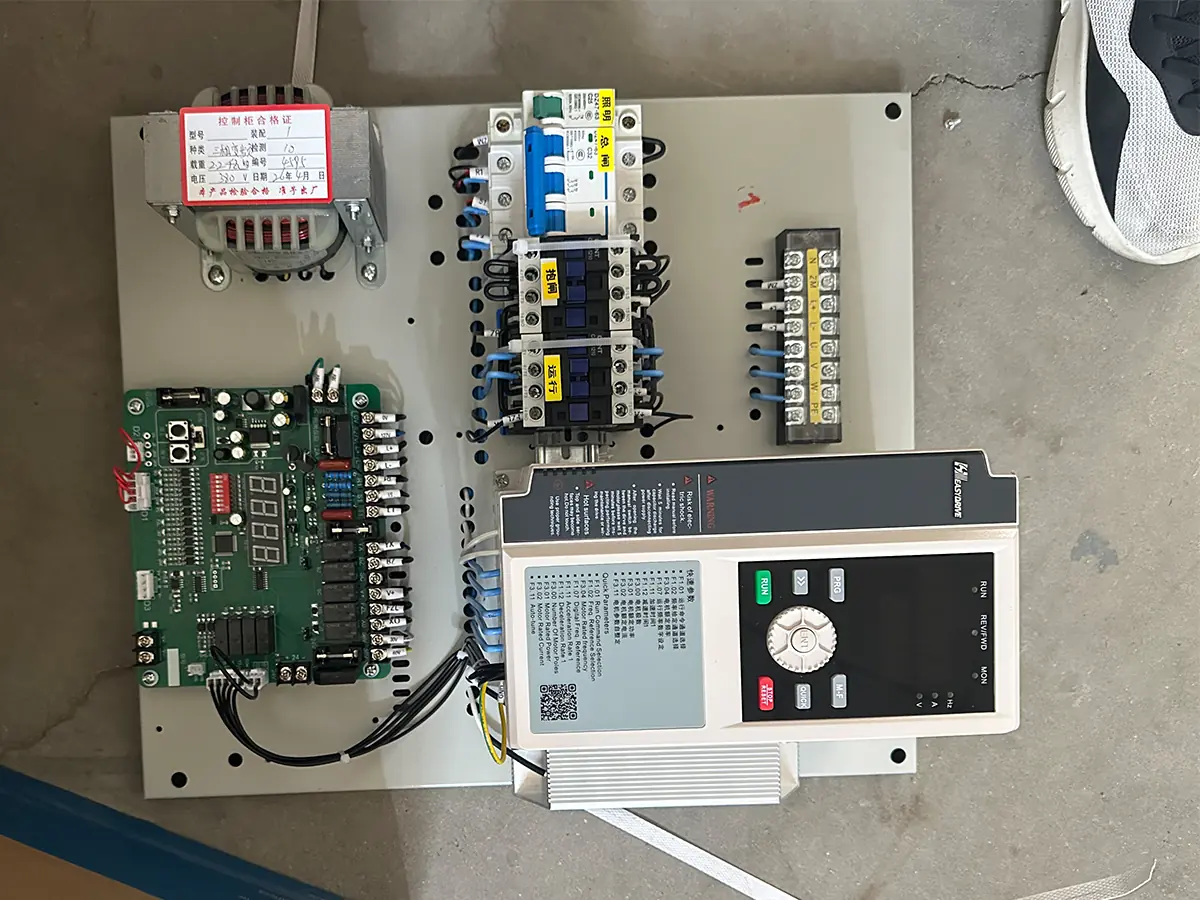
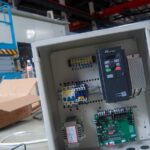
This is the control system unit at the ServLifts factory — the “brain” that coordinates the motor, doors, and safety devices on every unit we build.
Safety Mechanisms
A dumbwaiter is designed to be safe around staff and guests. The key devices:
- Interlocked doors — the car will not move while any door is open; the door will not open while the car is moving.
- Overload protection — the unit refuses to run if the load exceeds its rating.
- Limit switches — stop the car accurately at each floor and prevent over-travel.
- Emergency stop and a manual lowering option for power loss.
- Quiet, cushioned operation so the unit is unobtrusive in guest-facing buildings.
A credible manufacturer builds to recognized safety and design standards and ships the documentation with the unit.
What Happens When You Press the Button
Here is how does a dumbwaiter work on a single trip, second by second:
- You press floor 2 on the call panel and load the car.
- The control system checks that the door is closed and the load is within limits.
- The brake releases and the motor turns, moving the car up the guide rails.
- As the car approaches floor 2, limit switches slow it down.
- The motor stops, the brake engages, and the car levels exactly with the floor.
- The interlock releases and the door opens — you unload, and the car waits for the next call.
The whole trip typically takes seconds. That is all there is to it.
Traction vs Hydraulic vs Screw
We compared all three drive systems in detail in our traction vs hydraulic vs screw guide. The short version: traction is the best default for most food, laundry, and document lifts — no hydraulic oil, low standby power, quiet, and easy inspection. Hydraulic suits very heavy loads; screw drives are niche for this category.
Testing Before Delivery
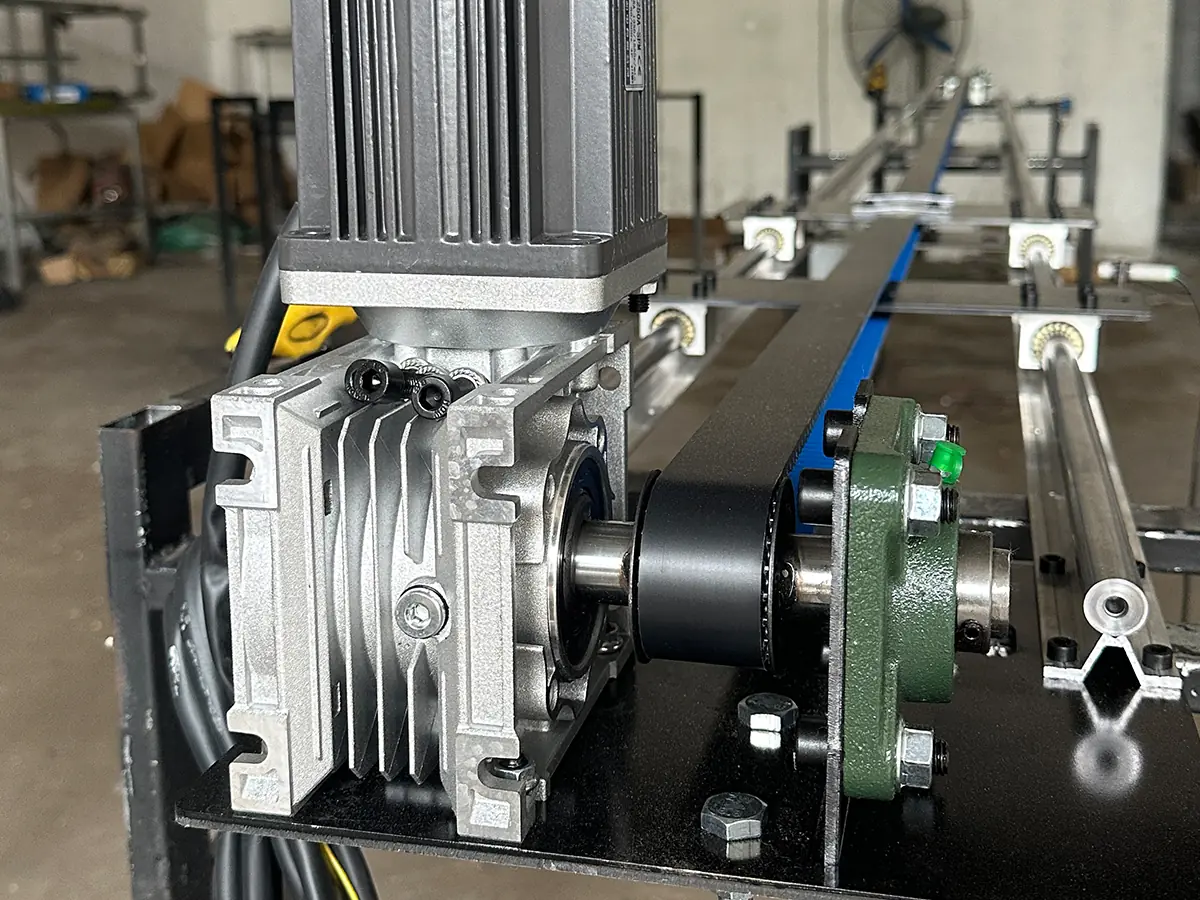
Before any unit leaves the factory it is load-tested and run through its full control cycle — doors, calls, safety devices — so what you install is what was proven on the factory floor. If a manufacturer cannot show you this step, that is a warning sign. Our China dumbwaiter factory guide explains how to verify the factory and its QC process.
How to Choose the Right One
Once you understand the mechanics, choosing is straightforward: match the car size to your busiest load, pick traction for most applications, and buy from a manufacturer that builds this category exclusively. Our food lift vs service lift vs dumbwaiter guide clarifies the terminology, and the manufacturer guide covers how to evaluate suppliers. Global majors such as Otis and Hitachi focus on passenger elevators; a specialized maker is usually the better fit for a small goods lift.
Frequently Asked Questions
How does a dumbwaiter work in simple terms?
In simple terms, a dumbwaiter works like a tiny elevator: an electric motor moves a steel car up and down guide rails inside a shaft, a control system manages the calls and doors, and safety devices keep it safe. You load it, press a button, and the car travels to the floor you chose in seconds.
Is a dumbwaiter an elevator?
Essentially yes — it is a small goods elevator. It uses the same principles (motor, car, rails, control panel) as a passenger elevator, scaled down for goods only.
How much weight can a dumbwaiter carry?
Typical units carry 100–250 kg depending on car size and configuration. Choose the rating that covers your busiest realistic load.
Can a dumbwaiter carry people?
No. Dumbwaiters are designed for goods only, with cars too small for a person. Passenger use requires a residential or passenger elevator.
How long does a dumbwaiter take between floors?
Usually just a few seconds per trip, depending on travel distance and drive speed. For a typical two- or three-floor installation, a full cycle takes seconds.
Conclusion
A dumbwaiter is a simple, reliable machine: a motor moves a car on guide rails, a control system manages the calls and safety, and interlocked doors keep everyone safe. Now that you know how does a dumbwaiter work, you can specify one with confidence. Browse the ServLifts range or contact us with your load and car size for a direct-from-factory quote.
[…] requirements; a dumbwaiter is a compact appliance-like installation. See what a dumbwaiter is and how it works for the full […]
[…] ServLifts is a Suzhou, China-based factory that builds only traction dumbwaiters and small service lifts. We help you budget accurately from day one: clear FOB pricing, construction drawings so your contractor knows the shaft dimensions, remote video commissioning to cut local labor time, and honest guidance on what you can install locally versus what needs a technician. Global elevator majors such as Otis and Hitachi typically sell through installation contractors with bundled pricing; a specialized factory like ServLifts lets you see each cost line and decide where to spend. See how the equipment works in our how does a dumbwaiter work guide. […]
[…] A dumbwaiter elevator works like a tiny elevator: an electric motor moves a steel car up and down guide rails inside a shaft, a control system manages the calls and doors, and safety devices keep everything safe. For the full step-by-step breakdown — including the traction system, counterweight, and control panel — see our how does a dumbwaiter work guide. […]
[…] paso a paso — sistema de tracción, contrapeso y panel de control — puedes leer nuestra guía de funcionamiento del montaplatos (en […]