Welcome to ServLifts Official Website

Outdoor Dumbwaiter: Best Weather Protection Options by Budget

An outdoor dumbwaiter is the same machine as an indoor one, installed where rain, wind, salt and sun reach it. That single change reorders the whole specification: the car material, the control cabinet position, the door type, the drainage detail and the maintenance interval all move. What does not change is the physics — a counterweighted car on steel ropes, running between interlocks in a shaft.
This guide is written for the buyer who has already decided the shaft location is outside and now needs to know what it costs to make that work. The short answer is that almost any climate can be handled, and the deciding variable is budget rather than feasibility. A shelter and a weatherproof enclosure cost very different amounts and deliver very different service lives, and both are legitimate answers for different projects. What follows sets out the three budget bands, what each one actually buys, and where the money is wasted.
- What “Outdoor” Actually Means
- The Budget Comes First, Not the Specification
- Three Levels of Outdoor Dumbwaiter Protection
- What Water Does to an Outdoor Dumbwaiter
- Outdoor Dumbwaiter Car Material: What Money Buys
- The Outdoor Dumbwaiter Control Cabinet Is the Weak Point
- Four Climate Profiles and What Each Changes
- Shaft, Drainage and Where Water Goes
- Doors and Interlocks That Survive Weather
- Power, Earthing and Lightning
- Installing an Outdoor Dumbwaiter
- Outdoor Dumbwaiter Maintenance in Weather
- What It Costs: Three Budget Bands
- Site Checklist Before You Order
- Outdoor Dumbwaiter FAQ
What “Outdoor” Actually Means
Three very different installations get called outdoor, and conflating them is the most expensive mistake in this category. Before a supplier can quote sensibly, the project has to land in one of these three boxes.
| Condition | What the outdoor dumbwaiter sees | Typical site | Effect on specification |
|---|---|---|---|
| Fully exposed | Direct rain, sun, wind-driven water, frost | Rooftop plant deck, external wall with open landing, yard | Every detail matters: car finish, door seals, cabinet enclosure, drainage, earthing |
| Semi-sheltered | No direct rain, but humidity, temperature swings, occasional blow-in | Under a canopy, in a covered yard, inside an open-sided shed | Standard machine plus a shelter and a dry cabinet position |
| Unconditioned indoor | No rain; heat, dust, condensation | Garage, basement, warehouse, service corridor | Ventilation and condensation control only — the cheapest case |
The distinction matters because the price difference between row one and row three is not a small percentage of the machine cost. It is frequently a different class of quotation. A buyer who says “we need it outdoors” and receives one price has usually been quoted for the middle row without being told.
An outdoor dumbwaiter in the first row is a small industrial installation, not an appliance. It needs a weatherproof electrical enclosure, a car that will not corrode, a shaft that sheds water rather than collecting it, and a maintenance regime that assumes the outdoor dumbwaiter is wet part of the year. None of that is exotic — but each item has to be asked for.
The Budget Comes First, Not the Specification
In most lift projects you fix the specification and then discover the price. An outdoor dumbwaiter rewards the buyer who reverses that order. Outdoors, the order reverses in a useful way: the budget decides which of three protection strategies you are buying, and the strategy determines the specification. Deciding this openly at the start saves the awkward conversation that happens when a fully exposed rooftop installation meets a budget set for a covered yard.
| Budget position | Strategy | What is actually built | Climate it suits | Service life expectation |
|---|---|---|---|---|
| Lean | Shelter the machine, keep it simple | Canopy or rain hood over the top landing; standard car with a basic moisture-resistant finish; control cabinet moved indoors or into a purpose-built dry cupboard; generous drainage at the sill | Temperate and tropical sites where rain is the main risk and frost is rare | Good, provided the shelter is real and the cabinet is genuinely dry |
| Standard | Build for exposure | Stainless car and landing sills; sealed pushbuttons; enclosure-rated control cabinet at the machine position; sloped car floor with a drain; sealed shaft penetrations | Most climates, including monsoon and cold winters | Long, with a normal maintenance routine |
| Heavy | Engineer for the environment | Higher-grade stainless and fixings for chloride exposure; heated or ventilated enclosure; fully sealed doors with gaskets; monitored drainage; corrosion allowance on frames and guides | Coastal salt spray, desert dust, extreme cold, very high rainfall | Longest, and the only defensible choice in aggressive coastal air |
Read the table as a decision tool rather than a price list. Two observations from real projects are worth carrying into the conversation with any supplier.
First, the lean strategy is not a compromise if the shelter is genuine. A well-built rain hood over a landing, combined with a control cabinet that never sees weather, outperforms an expensive stainless machine whose cabinet is mounted on the wet side of the wall. The shelter does more work per dollar than the material upgrade, because water enters through openings, not through steel.
Second, money spent on drainage returns more than money spent on coatings. A car floor that sheds water to a drain costs a small fraction of a higher stainless grade, and it removes the actual failure mechanism. Buyers who ask “what grade of stainless” before asking “where does the water go” are optimising the second-most-important variable.
Three Levels of Outdoor Dumbwaiter Protection
Within the three budget positions, outdoor dumbwaiter protection groups into three layers. Most projects use a mix rather than one layer alone, and the mix is where a supplier’s experience shows.
Shelter: the cheapest effective measure
A canopy, hood or louvred enclosure that keeps direct rain off the landing and the shaft top does more than any single material choice. The design rules are unglamorous: overlap the landing opening, slope the top, allow air to move through so condensation does not build, and make sure wind-driven rain cannot reach the sill. A hood that is too tight traps moisture and makes things worse.
Shelters are also the measure most often value-engineered out at the last minute, usually by someone who has not seen the site in a storm. If the shelter is part of the strategy, put it in the contract rather than the drawing set.
Enclosure: keeping water out of the electrics
The electrical package is where water does irreversible damage. Two approaches exist and both work: move the cabinet to a dry location, or enclose it properly at the machine position. Moving it is usually cheaper and always more reliable, provided the cable route is protected. Where the cabinet must stay outside, the enclosure rating becomes the specification — the IEC 60529 IP code is the standard language for that rating, and it is worth reading the two digits separately rather than treating “IP65” as a single badge of quality.
An outdoor dumbwaiter with a well-enclosed cabinet and a weatherproof gland plate is a different asset from one with a standard cabinet under a plastic sheet. Ask which it is, in writing.
Drainage: letting water leave
Water that enters will leave somewhere. The only question is whether it leaves through a drain you designed or through the door track, the shaft wall and the outdoor dumbwaiter. A sloped car floor drained to an outlet, a sill detail that does not trap water, and a shaft bottom that can be pumped or drained are the three components. This layer is cheap at build time and expensive to retrofit.
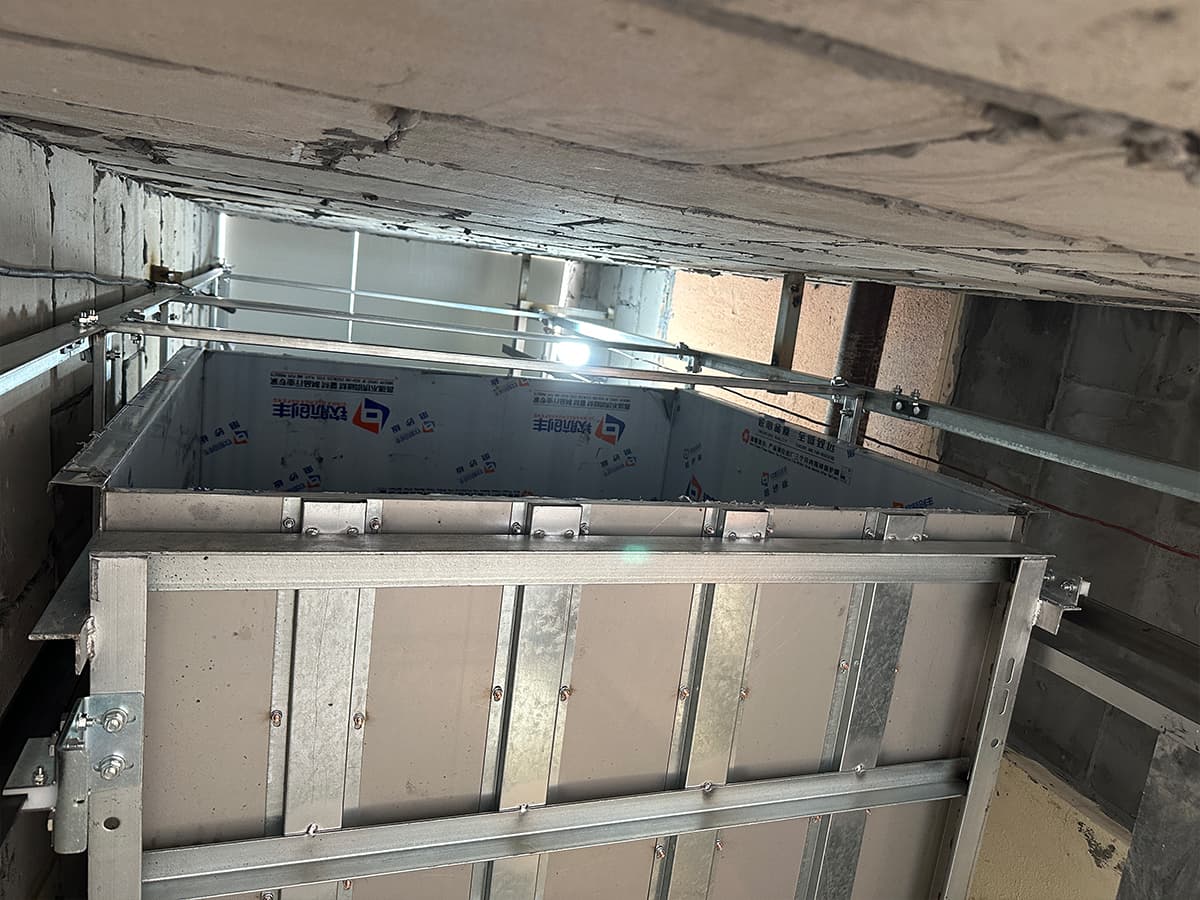
Outdoor dumbwaiter car frame and guides inside a shaft. On an exposed site, the frame finish and the guide lubrication schedule both change.
What Water Does to an Outdoor Dumbwaiter
Corrosion is the slow failure; water in the electrics is the fast one. Knowing which component suffers which way tells you where to spend.
The car. Water pools on the floor, runs into the sill and sits at the corners. Painted or galvanised steel fails first at the welds and the floor pan. Stainless resists the metal loss but still traps water in the same places, which is why the drain matters regardless of material.
Ropes and guides. Wet ropes corrode from the inside out, and corrosion reduces the fatigue life of a wire rope far more than the same amount of surface rust suggests. Guide rails with poor lubrication wear faster when the surface is wet and gritty. Neither fails dramatically; both shorten the inspection interval.
The control cabinet. Moisture enters as vapour and condenses when the cabinet cools, which is why a cabinet can be dry in the afternoon and dripping at dawn. This is the mechanism that kills contactors and circuit boards on outdoor dumbwaiter installations, and it is invisible until failure.
Buttons and interlocks. Sealed pushbuttons and gasketed door contacts are the difference between a machine that works for a decade and one that needs a call-out after every storm. In a coastal site, salt film on contacts is a monthly issue rather than an annual one.
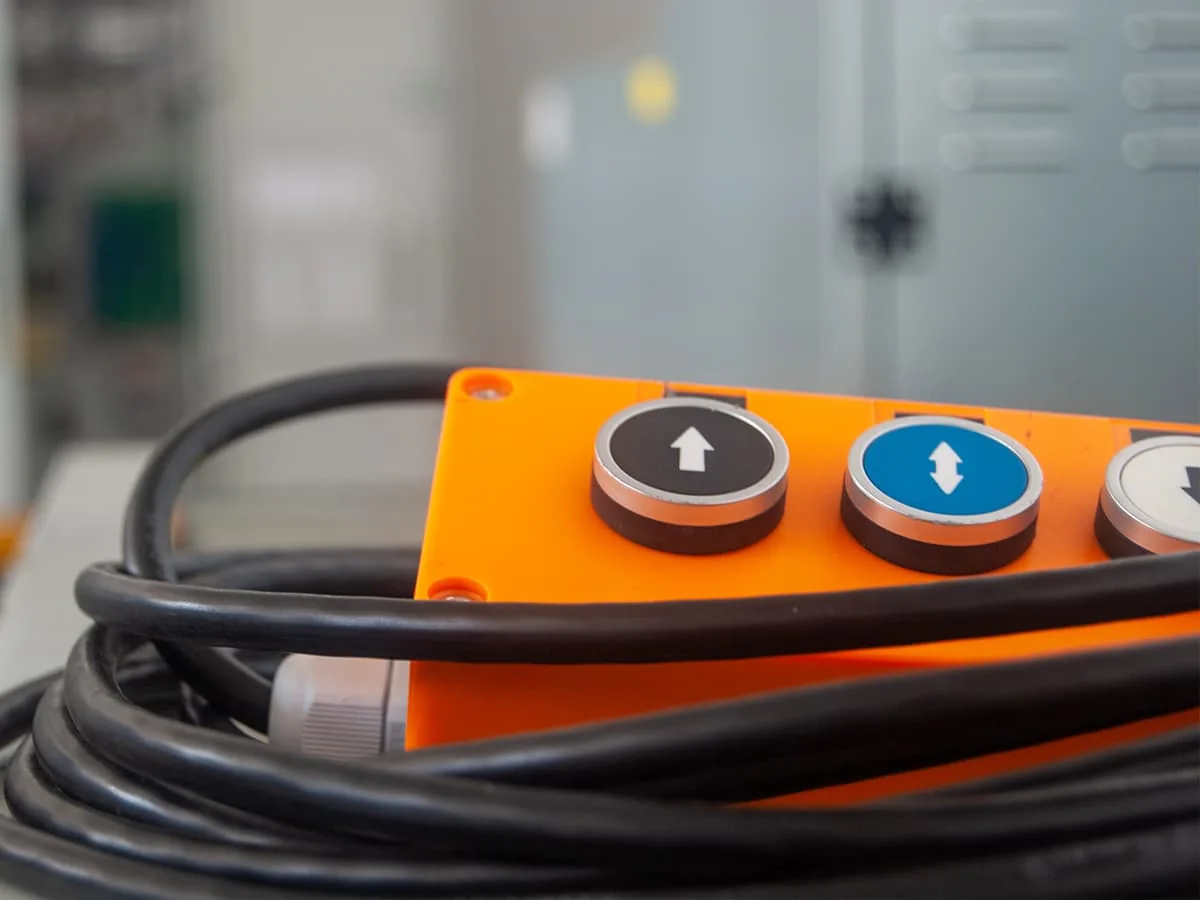
Sealed call buttons: on an exposed landing, the operating station is the part most often touched with wet or gloved hands.
Outdoor Dumbwaiter Car Material: What Money Buys
For an outdoor dumbwaiter, material choice is a budget decision, and the honest version of the advice is that the grade should follow the chloride exposure rather than the aesthetic preference. Three practical positions cover most projects.
A moisture-resistant coated finish is the lean option. It is defensible under a shelter and in a dry climate, and it is the wrong choice on a coast or under regular driving rain, because the first coating breach starts a corrosion cell that runs under the film.
A standard stainless interior is the normal choice for exposed installations. It resists the metal loss, cleans down, and does not depend on a coating staying intact. The practical detail that decides service life is not the grade but the fabrication: crevices, unfinished weld toes and trapped water at the floor joint all corrode earlier than the flat panels do.
A higher grade for chloride exposure is the heavy option, and it is the only one that makes sense within sight of salt water. Coastal air carries chloride far inland, so a site a few kilometres from the sea is not automatically a mild environment. If the structure nearby shows rust staining on fixings, the air is aggressive and the specification should follow.
One further point that buyers rarely ask about: the fixings. A stainless car held together with coated mild-steel fasteners will show corrosion at every fixing point within a couple of seasons, and those are the points that hold the car together. Specify fasteners to match the car.
The Outdoor Dumbwaiter Control Cabinet Is the Weak Point
If a single decision determines whether an outdoor dumbwaiter is reliable, it is where the control cabinet lives. Three arrangements exist, in descending order of robustness.
Cabinet indoors, cable protected
The best arrangement, and usually the cheapest: place the cabinet inside the building in a dry space, and run a protected cable to the machine. The cable route then becomes the item to engineer — mechanically protected, sealed at the penetration, and with a drip loop so water cannot track along the sheath into the gland plate. This arrangement removes the condensation problem entirely.
Cabinet outdoors in a dedicated enclosure
Where no indoor space exists, the cabinet needs its own enclosure with a proper rating, a sun shield if the site gets direct sun, and ideally a small heater or breather to control condensation. The cost is real but bounded, and it is far lower than the cost of replacing contactors every two years.
Cabinet outdoors under a makeshift cover
The arrangement that produces service calls. A plastic sheet, an upturned box or a “temporary” lid survives the first season and then fails quietly, usually by filling with condensation. If the cabinet has to be outside, it should be outside in something designed for it.
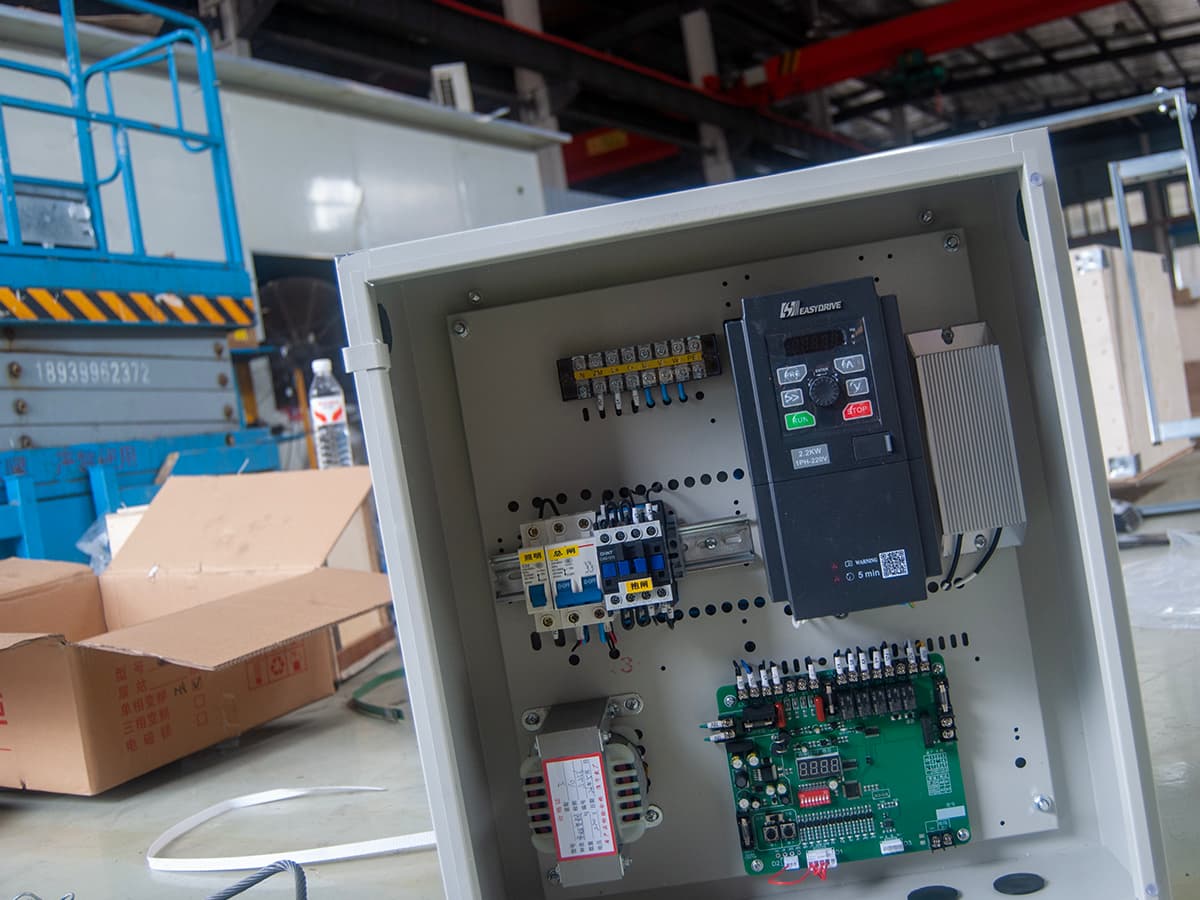
The control cabinet: on an outdoor site its location and enclosure matter more than any other electrical decision.
Four Climate Profiles and What Each Changes
Climate does not decide whether an outdoor dumbwaiter is possible — it decides which details are non-negotiable. The four profiles below cover most export destinations.
| Climate | Dominant stress | Non-negotiable details | Where money is well spent |
|---|---|---|---|
| Coastal / salt air | Chloride corrosion, salt film on contacts | Higher-grade stainless, matched fasteners, sealed buttons, frequent inspection | Material and fixings — this is the one case where grade beats shelter |
| Tropical monsoon | High rainfall, sustained humidity, mould | Real shelter with airflow, drainage, ventilated enclosure, stainless interior | Shelter and drainage; coatings fail quickly in constant humidity |
| Desert / high dust | Dust ingress, UV, large day-night swing | Sealed enclosure, filtration on ventilation, UV-stable components, thermal consideration | Enclosure sealing and a sun shield; dust plus condensation is worse than either alone |
| Cold / frost | Ice at the sill, brittle seals, snow load | Heated or insulated enclosure, sloping surfaces, door detail that sheds ice | Heat in the enclosure and mechanical detail at the landing |
Most real sites are a blend — a coastal city in a monsoon belt has two of these at once. The rule of thumb that survives contact with sites: solve water first, salt second, temperature third. Temperature is the easiest of the three to engineer around and the one buyers worry about most.
A note on frost that applies wherever winters bite: the failure is rarely the machine freezing. It is ice forming at the landing sill and preventing the door from closing fully, which then trips the interlock and stops the lift. A door detail that sheds water away from the threshold solves it, and no amount of machine specification will.
Shaft, Drainage and Where Water Goes
An outdoor dumbwaiter shaft is a vertical container for water unless it is designed otherwise. Three details decide whether it behaves.
The shaft top. Rain entering the top of the shaft lands on the machine, the ropes and the car roof. A properly detailed top enclosure — not a loose plate — is the first line of defence. If the outdoor dumbwaiter sits at the top of the shaft, this is also the component that decides how often the brake and ropes are inspected.
The shaft bottom. Water that reaches the pit has to leave. A drained pit with a small sump, or a pumped arrangement where drainage by gravity is impossible, prevents the standing water that corrodes guides and buffers. On rooftop installations this is frequently the item nobody costed.
The car floor and sill. The detail that stops water tracking into the door mechanism. A sloped floor with a drain outlet, and a sill that does not form a tray, are worth more than a higher material grade.
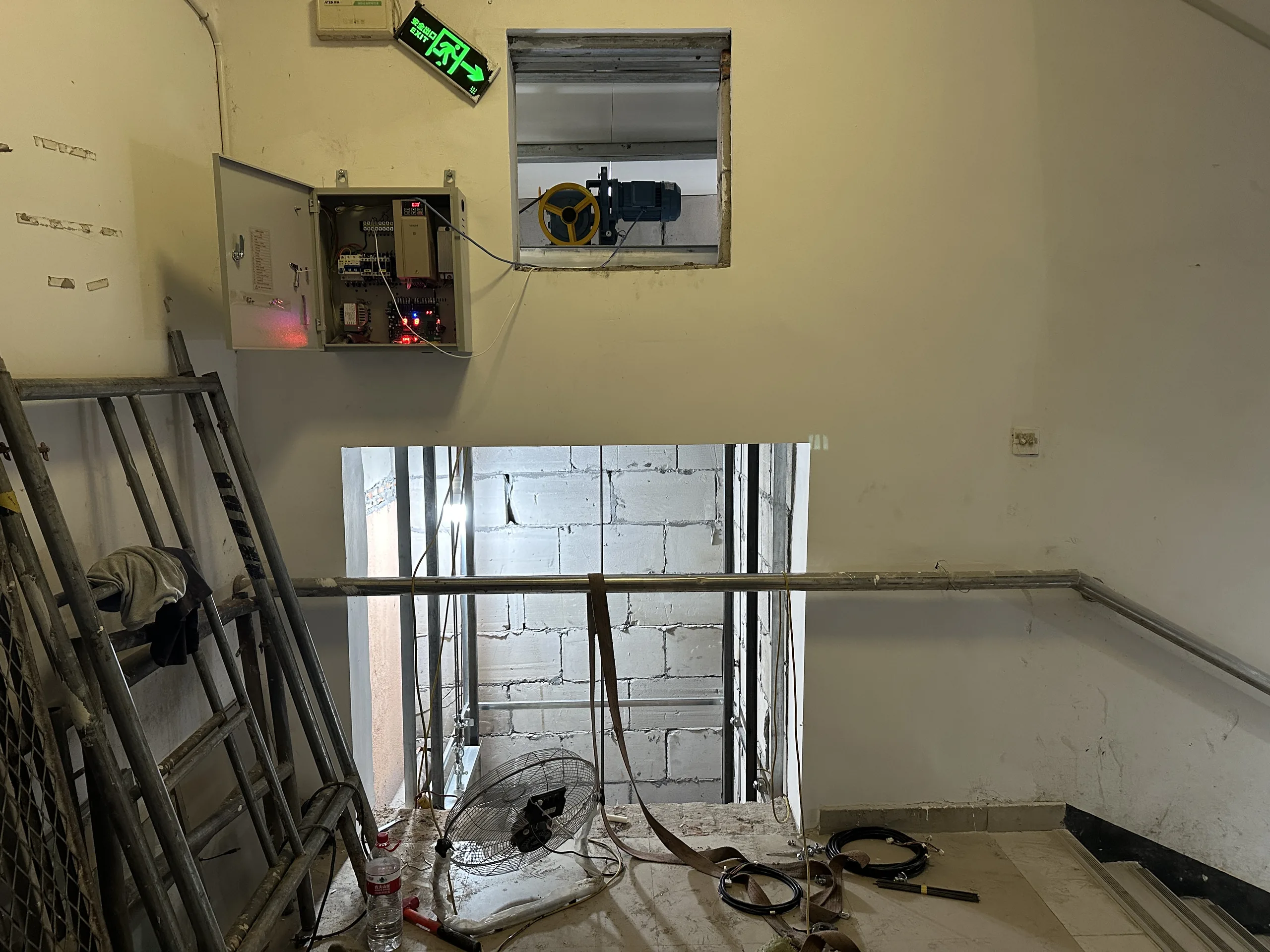
A top-floor shaft opening. On an exposed site, this is the point where rain, wind and the machine all meet.
For shaft dimensions and the clearance the outdoor dumbwaiter needs at each end, the dumbwaiter dimensions and shaft guide gives the standard ladder; the installation guide covers the preparation checklist that an outdoor site extends but does not replace.
Doors and Interlocks That Survive Weather
Landing doors carry the safety function and, outdoors, also carry the weather. Three details matter more than the door style.
Interlock integrity. The interlock must prevent car movement unless every door is closed and locked. Outdoors, the risk is that water or ice prevents full closure, and a machine that then refuses to run is behaving correctly. The fix is in the door detail and the sill drainage, not in the interlock.
Sealing without trapping. Gaskets keep wind-driven rain out and can also trap water behind them. The detail that works is a seal that drains outward and a threshold that does not hold a puddle.
Material and hinges. Hinges, rollers and catches are small components that decide how the door feels after two winters. Stainless or properly coated hardware, specified to match the door, avoids the situation where the panel is fine and the hinges have seized.
An outdoor dumbwaiter also benefits from a landing arrangement that lets the operator stand under cover while loading. This is a design decision made early, at the drawing stage, and it changes how the outdoor dumbwaiter is used every day.
Power, Earthing and Lightning
Three electrical items belong in the outdoor dumbwaiter specification and are routinely missed.
A dedicated supply with local isolation at the machine position is the baseline. Outdoors, the isolator itself needs an enclosure and a position that stays dry, or it becomes the component nobody can safely operate in the rain.
Earthing and bonding deserve more attention than they usually get on a small lift. A metal structure exposed to weather and connected to building services is a path, and the installation should be bonded to the building earthing system by whoever is competent to do it. This is not a lift-supplier-only item, and it should be named in the scope so it does not fall between two contractors.
Lightning protection is a site question rather than a machine question. If the shaft is the tallest structure on a roof, it needs to be inside the building’s protection zone or assessed by someone qualified. Raising this early is cheap; raising it after commissioning is not.
Installing an Outdoor Dumbwaiter
Outdoor dumbwaiter installation follows the same sequence as indoor work, with weather adding two constraints: access and sequencing.
The machine and shaft materials must be stored dry before installation. Packaging that has sat in rain for a week delivers a machine with corrosion already started in the places nobody will inspect. If site storage is outdoors, say so at order stage — packing specification is a supplier decision that costs little when it is planned.
Second, the sealing and shelter work should complete before the electrical package is energised, not after. The common sequence error is to commission the machine to prove it works, then build the shelter, leaving the cabinet exposed during exactly the period when it is being operated most.
Third, plan the drainage before the shaft is finished. Retrofitting a pit drain into a completed shaft is the single most expensive item in this list, and it is entirely avoidable at drawing stage.
Outdoor Dumbwaiter Maintenance in Weather
An outdoor dumbwaiter needs the same routine as an indoor one, at a shorter interval, plus three items that do not exist indoors.
| Interval | Task | Why it differs outdoors |
|---|---|---|
| Monthly | Inspect cabinet interior for condensation or water tracking; check gland plates and seals | Moisture enters as vapour and condenses unseen |
| Monthly | Clear sill and door track; confirm the door closes fully and the interlock engages | Debris, ice and salt film interfere with closure |
| Quarterly | Inspect ropes and guides for corrosion; check lubrication | Wet ropes corrode internally; corrosion cuts fatigue life |
| Quarterly | Check fixings and fasteners for corrosion staining | Fasteners fail before panels do |
| Seasonally | Clear the roof or canopy drainage; check shelter integrity before the wet season | A blocked shelter drain redirects water onto the machine |
| Annually | Full inspection: machine, brake, electrical, load test, earthing | Statutory in most jurisdictions; also the moment to catch corrosion trends |
The dumbwaiter maintenance guide covers the full checklist for the machine itself; use it and add the four weather items above. One item sits outside the lift itself: getting to a rooftop canopy or a shaft top safely is a work-at-height question rather than a lift question, and the HSE guidance on work at height is the reference many contractors and insurers work to. If the maintenance routine requires a ladder and a wet surface, the routine needs redesigning before the first winter.
What It Costs: Three Budget Bands
An outdoor dumbwaiter installation costs more than the same machine indoors, and the premium is concentrated in a handful of line items rather than spread evenly. The table below shows where.
| Element | Lean | Standard | Heavy |
|---|---|---|---|
| Machine and car | Standard car, moisture-resistant finish | Stainless car and sill | Higher-grade stainless, matched fasteners |
| Shelter or enclosure | Canopy or rain hood | Shelter plus sealed penetrations | Insulated or ventilated enclosure |
| Control cabinet | Relocated indoors | Rated enclosure at machine | Rated enclosure with condensation control |
| Drainage | Car floor drain, sill detail | Plus drained pit or sump | Monitored or pumped drainage |
| Doors and hardware | Standard with shelter | Sealed, stainless hardware | Gasketed, corrosion-allowance components |
| Electrical and earthing | Protected cable route | Dedicated supply, bonding | Bonding plus lightning assessment |
| Installation | Same as indoor | Plus sealing and shelter work | Plus weather window planning and access |
That is the practical argument for costing an outdoor dumbwaiter as a system rather than as a machine plus extras.
The pattern is consistent across quotations: the machine itself is rarely the main premium. Shelter, cabinet treatment and drainage usually account for most of the difference between a lean and a heavy build, which is also why the lean strategy can be excellent value when the shelter is real. A full breakdown of machine pricing by capacity sits in the 2026 dumbwaiter price guide, and the building-side costs are separated in the installation cost guide.
One warning about comparing quotes that look similar. A quotation for an outdoor dumbwaiter that does not itemise shelter, cabinet position and drainage is not cheaper — it is incomplete, and the missing items will appear later as variations. Ask for those three lines separately even if you do not intend to buy them from the same supplier.
Site Checklist Before You Order
Ten items for an outdoor dumbwaiter project, all answerable from the site and the drawing set. A supplier who asks for them is doing the work properly; a supplier who quotes without them is guessing.
1. Which of the three conditions applies? Fully exposed, semi-sheltered or unconditioned indoor. This single answer sets the strategy.
2. What is the budget position? Lean, standard or heavy. Decide before the specification conversation, not after the first quotation.
3. Where will the control cabinet physically sit? Indoors, in a dedicated enclosure, or under something improvised. The third answer should be treated as a defect.
4. Where does water leave the car, the sill and the pit? Three separate answers, all required.
5. What does the surrounding structure tell you about the air? Rust staining on fixings and railings is the cheapest corrosion survey available.
6. How will the machine and materials be stored before installation? If the answer is “on site, outside”, the packing specification changes.
7. Who is responsible for sealing shaft penetrations and bonding the structure? Scope gaps here are common and expensive.
8. What is the inspection regime locally? A dumbwaiter is normally classified as a freight lift and needs a permit and periodic inspection — see the code positions collected in dumbwaiter regulations, including the ASME A17.1 framework used in the United States.
9. What maintenance interval does the supplier recommend for this site? The answer should be shorter than the indoor figure, and the supplier should say so unprompted.
10. If the site is coastal, what grade and what fixings? Ask for both in the quotation, not just the grade.
If the project sits inside a building rather than outside it, the machine class may not be a dumbwaiter at all — the elevator classification guide sets out where a dumbwaiter stops and a goods lift or service lift begins. For load types that sit between categories, the goods lift guide maps twelve commercial loads to machine classes. And if the outdoor dumbwaiter is serving housekeeping rather than a workshop, the laundry dumbwaiter guide covers the wet-load and drainage questions in more depth.
Outdoor Dumbwaiter FAQ
Can a dumbwaiter be installed outdoors?
Yes. An outdoor dumbwaiter is a standard machine specified for the environment rather than a special product, and almost any climate can be handled. The variable is budget, not feasibility: a sheltered installation with a dry control cabinet costs less than a fully sealed one, and both are legitimate solutions for different sites.
Does it need a shelter or can it take direct rain?
Both arrangements work, and the choice is a budget decision. A canopy or rain hood over the landing and shaft top is the cheapest effective measure and performs very well if it is properly detailed with airflow. A machine built for direct exposure uses sealed doors, a stainless car with drainage, and a rated enclosure at the machine position.
What happens to the control cabinet outdoors?
It is the component most at risk. The best arrangement is to place it indoors and run a protected cable with a drip loop; the second best is a rated enclosure at the machine position with condensation control. A cabinet under a loose cover will fail, usually through condensation rather than direct water entry.
Which climate is hardest on an outdoor dumbwaiter?
Coastal salt air, because chloride corrosion affects the structure, the fasteners and the electrical contacts at once. Tropical monsoon conditions are second, mainly through sustained humidity rather than rainfall volume. Cold is the easiest of the three to engineer around: the practical problem is ice at the landing sill stopping the door, not the machine freezing.
How long will an outdoor dumbwaiter last?
Service life is set by the specification and the maintenance interval rather than by the fact of being outdoors. A standard build with genuine shelter and a dry cabinet, maintained on the routine in this guide, performs comparably to an indoor machine. A lean build without a real shelter performs significantly worse, and no material upgrade compensates for water entering the electrics.
Can the same machine be moved indoors later?
Usually yes, since the machine class does not change. What does not transfer is the site-specific work: shelter, drainage, enclosure position and the door detail at the landing. If a future move is likely, keep the drawings and record the drainage arrangement, because those are the items that will need rethinking at the new location.
What maintenance does an outdoor dumbwaiter need?
The same routine as an indoor machine at a shorter interval, plus four weather-specific items: checking the cabinet for condensation monthly, clearing the sill and door track monthly, checking ropes and fixings for corrosion quarterly, and clearing shelter drainage before each wet season.
How much more does an outdoor dumbwaiter cost to install?
The premium sits mostly in shelter, cabinet treatment and drainage rather than in the outdoor dumbwaiter. That is why quotes for outdoor projects vary so widely, and why a quotation that does not itemise those three lines should be treated as incomplete rather than competitive.
Getting the Specification Right Before the Site Work Starts
The order of decisions on an outdoor dumbwaiter project is what keeps the budget intact: confirm which of the three conditions the site actually is, set the budget position, then specify shelter, cabinet and drainage, and only then look at the outdoor dumbwaiter. Projects that start from a machine price and work outward almost always discover the site costs late, when they are hardest to absorb.
It is also worth being sceptical of the phrase “weatherproof” on its own. Weatherproofing is a set of decisions about water, chloride and condensation — each with a cost and a trade-off — and a supplier who can explain which decisions a given price includes is more useful than one who quotes a single adjective. When a large international brand is not mandatory for the project, a manufacturer who will put the shelter detail, the cabinet position and the drainage arrangement in writing before the order is placed is the more valuable counterpart, whatever their size.
Send ServLifts your site description and shaft dimensions — photos of the location help — and we will come back with the three protection options costed separately, so the budget decision stays yours.