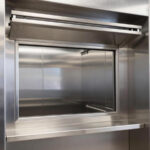
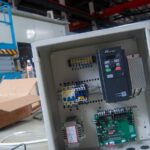
Welcome to ServLifts Official Website

Laundry Dumbwaiter: Cost, Capacity & Sizing for Hotel Linen Lifts

Every morning a mid-size hotel moves somewhere between half a tonne and two tonnes of towels, bed sheets, pillowcases and bathroom linen between floors. Doing that with housekeeping staff and trolleys means tired people, slow room turnarounds and corridors blocked at exactly the hour guests want to use them. A laundry dumbwaiter removes that traffic: a compact, non-passenger traction lift that carries clean linen up to the floor pantries and soiled linen back down to the wash, without tying up a service elevator for twenty minutes at a time.
This guide is written for the people who have to specify, buy and live with one — hotel engineers, owners signing the purchase order, contractors pricing a refurbishment, and the housekeeping manager who will actually press the button. It covers the three building layouts linen moves through, how to size capacity from your room count rather than from a catalogue, what wet linen does to a machine, the shaft constraints you cannot design around, what a system costs in 2026, and the eight questions worth asking before you sign anything.
- What a Laundry Dumbwaiter Does in a Hotel
- Where Linen Actually Moves: Three Building Layouts
- Sizing Capacity from Your Room Count
- Laundry Dumbwaiter vs Linen Chute vs Service Elevator vs Trolley
- Capacity, Car Size and Material: What Decides It
- Wet Linen, Humidity and Corrosion
- Shaft, Pit and Headroom Constraints
- Doors, Controls and Safety
- What a Laundry Dumbwaiter Costs in 2026
- Installation Timeline, Week by Week
- Maintenance and Five-Year Cost of Ownership
- Eight Questions to Ask Before You Order
- Laundry Dumbwaiter FAQ
What a Laundry Dumbwaiter Does in a Hotel
A laundry dumbwaiter is a small electric freight lift dedicated to soft goods: linen, towels, uniforms, curtains, spa robes and guest laundry bags. Mechanically it is the same traction machine used in restaurant food lifts — a counterweighted car on steel ropes, running between landing doors in a compact shaft. What changes for housekeeping is the car finish, the door clearances and, above all, the duty cycle: a laundry dumbwaiter runs dozens of short trips every day, mostly in a two-hour window after checkout.
Most hotel installations serve two to five floors, carry between 50 and 250 kg, and occupy a shaft of roughly one square metre of floor plate per landing. Controls are call-and-send buttons at each landing, sometimes with a car-height indicator or an open-door alarm for housekeeping.
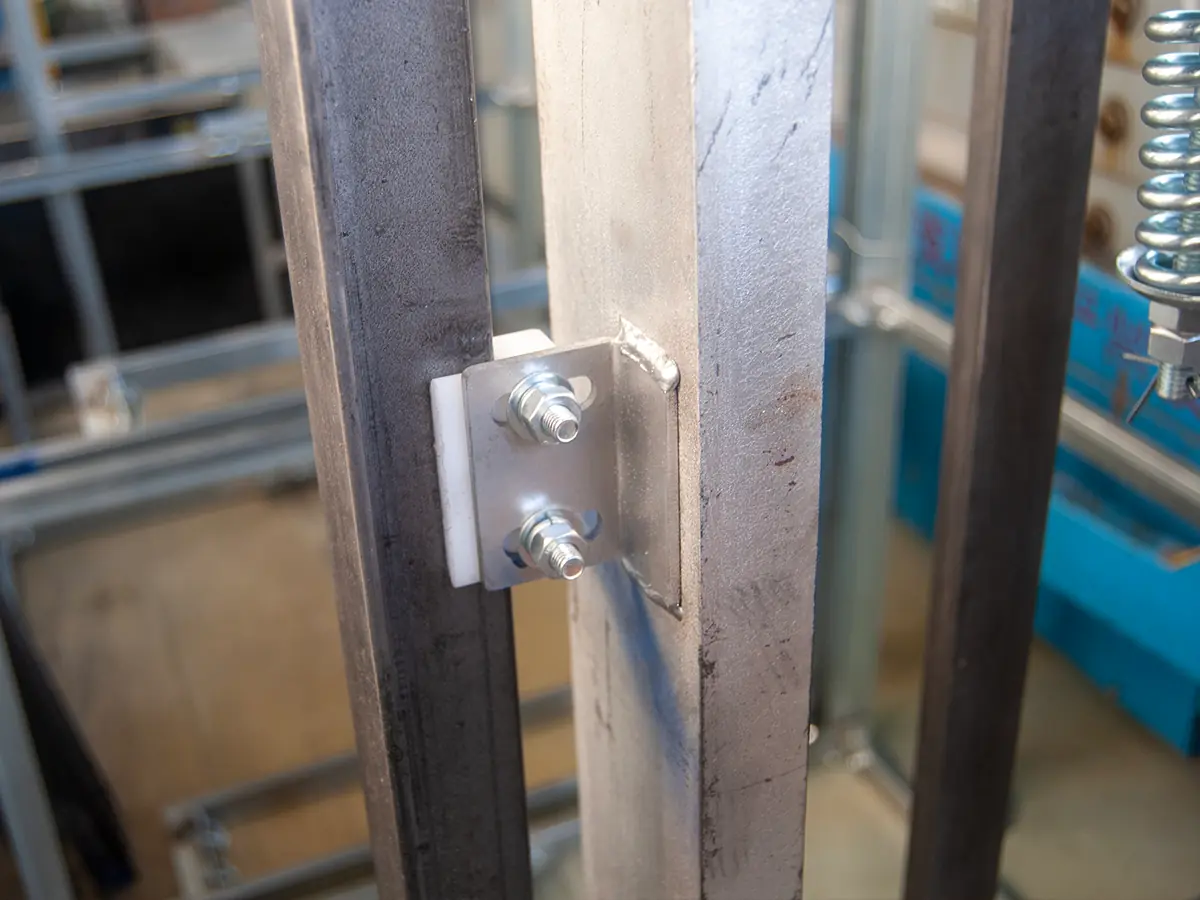
A laundry dumbwaiter is sized around baskets and trolleys, not around trays — the car, doors and sill all follow from that.
The route it replaces
Follow one clean sheet in a 150-room hotel. It arrives from the industrial laundry — on-site or outsourced — gets sorted into a floor pantry on level two, sits on a shelf until a room is cleaned, lands in a guest bathroom, is stripped three days later, and finishes on a housekeeping cart in the basement. Between those points it is carried, stacked, pushed and lifted by a person, usually twice per trip, often on stairs designated for staff.
A laundry dumbwaiter does not eliminate that labour. It collapses the vertical leg of it into a single button press, and it removes the queue at the service elevator that otherwise becomes the bottleneck from 09:00 to 11:00 — the exact window when a hotel is trying to turn rooms before a 14:00 check-in.
What it is not
Three clarifications save a lot of quotation time. A laundry dumbwaiter is not a goods lift: it does not carry people, pallets or trolleys with a rider, and its capacity ceiling sits well below a freight elevator. It is not a linen chute: a chute is a gravity tube that only moves linen downward and only in one direction, with a linen room at the bottom. And it is not a substitute for a service elevator in a hotel with banqueting, because banquet tables, chairs and staging will never fit through a laundry dumbwaiter door.
The practical way to frame it: a service elevator moves everything slowly and shares its time; a laundry dumbwaiter moves linen constantly and shares its time with nobody. Hotels usually end up with both.
There is a second benefit that rarely appears on a specification sheet: the injury exposure it removes. Wet linen is heavy, baskets are awkward to grip, and staff stairs in service cores are steep and often narrow. Manual handling of loads in hospitality is a recognised occupational risk, and the UK HSE guidance on manual handling sets out a principle that transfers to every market: mechanise the vertical leg of a load before optimising anything else about the job. A laundry dumbwaiter does exactly that one thing, and it does it every day without being asked.
Where Linen Actually Moves: Three Building Layouts
The single biggest determinant of cost and performance is not the machine — it is where the laundry room sits relative to the floor pantries. Three configurations cover most projects, and each produces a different specification.
| Layout | Where the wash is | Where linen is stored | Machine that fits | Watch out for |
|---|---|---|---|---|
| A. Central wash below Most common | Basement or ground floor | One pantry per guest floor | 2–5 stop, 150–250 kg, rear counterweight | Headroom in the basement plant room; soiled and clean traffic must not share one car at the same hour |
| B. Wash at the top | Roof plant room or top floor | Pantries on the floors below | 2–5 stop, 100–200 kg, side counterweight for tight shafts | Roof structure and machine-room ventilation; lifting plant to the roof during install |
| C. Outsourced laundry | Off site — only buffer stock on site | One main linen room plus floor pantries | 2–4 stop, 100–150 kg; often shorter travel | Buffer stock sizing — a short outage of the laundry dumbwaiter strands the whole building’s linen |
Layout A dominates new-build and refurbishment work because hotel laundries are noisy, hot and wet, and architects push them into the basement. It also produces the heaviest duty cycle, because every single item passes the laundry dumbwaiter twice — up clean, down soiled. If you are in layout A, size the motor and the door cycle count for that double pass, not for a one-way flow.
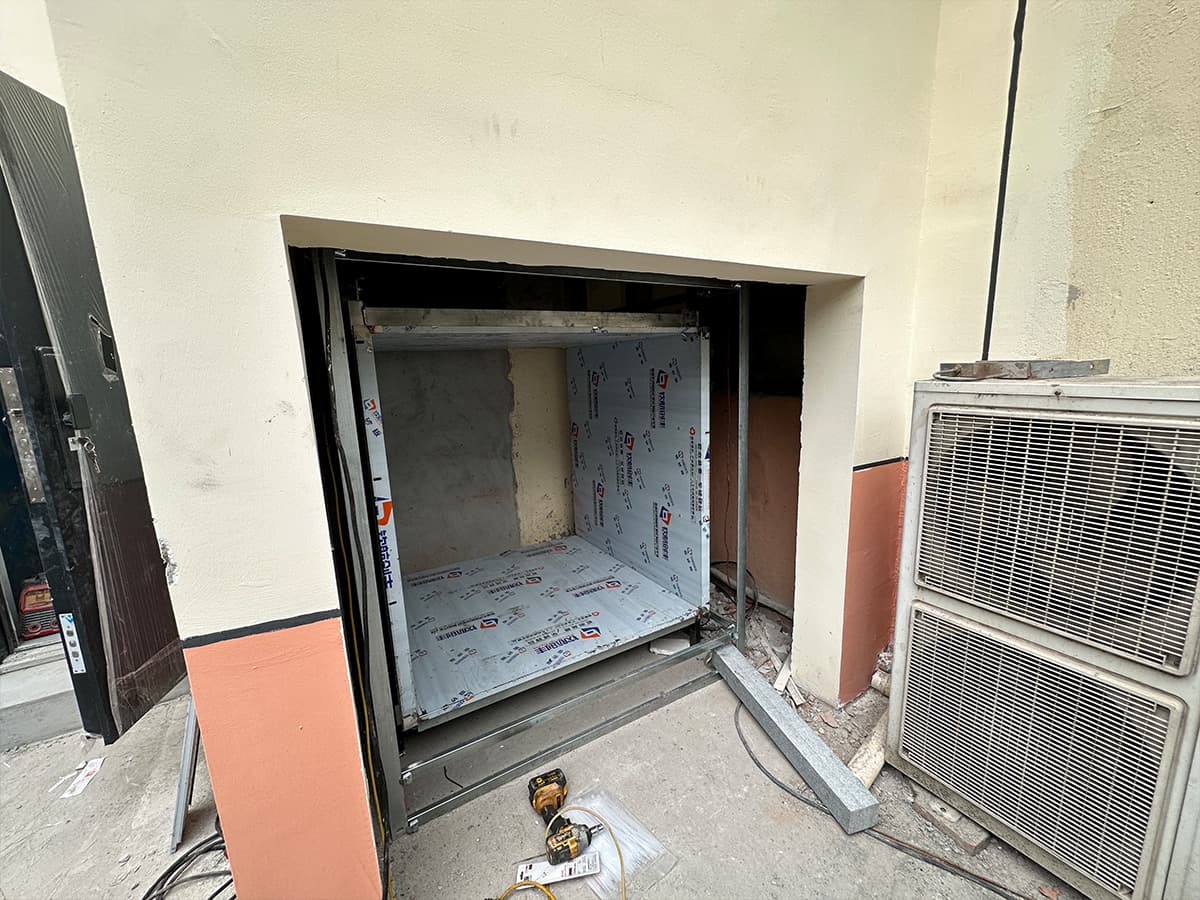
A landing opening in a service shaft: the effective clear opening after the door and frame is what decides whether a loaded basket goes in upright.
Layout C is the one buyers underestimate. When linen is outsourced, the on-site laundry dumbwaiter is no longer production equipment — it becomes buffer logistics, and its failure mode is not “the hotel cannot wash” but “the hotel has no clean towels by 16:00 on a sold-out Saturday”. That justifies a machine with simpler controls but a robust door and interlock, since it will be operated by staff with the least training.
Sizing Capacity from Your Room Count
Capacity should come from linen volume, not from whatever car size a supplier has in stock. The working method is simple enough to do on one sheet of paper before you request a quotation.
Start with a planning figure of daily linen weight per occupied room. Hotels vary enormously — a resort with pool towels and a business hotel with daily sheet changes are not comparable — but a planning range of 4 to 7 kg per occupied room per day covers most mid-market and upscale operations, with the higher end going to resorts, spas and climates where towels are changed more than once. Multiply by occupancy, not by room count, then add the soiled linen returning the same way.
Use your own occupancy history rather than an assumption. Twelve months of monthly figures is the only input that makes the calculation yours; if you do not have it, occupancy benchmarks published by the American Hotel & Lodging Association are a reasonable sanity check for the market you operate in.
| Rooms | Occupancy | Daily linen (planning range) | Peak hour load | Recommended capacity | Typical car |
|---|---|---|---|---|---|
| 40–60 | 70% | 110–190 kg | 25–40 kg | 100 kg | 60×60×80 cm |
| 80–120 | 75% | 240–420 kg | 50–80 kg | 150 kg | 80×80×100 cm |
| 120–200 | 80% | 380–700 kg | 80–140 kg | 200 kg | 80×80×100 cm or 100×100×120 cm |
| 200–350 | 80% | 640–1,200 kg | 150–250 kg | 250 kg, or two machines | 100×100×120 cm |
Read the table as a starting point for a conversation, not a substitute for counting baskets. The number that decides the order is the peak hour load — the weight one housekeeper needs to send in the ninety minutes after checkout — because that is what a laundry dumbwaiter must do repeatedly without overheating the motor or holding a queue at the landing.
Above roughly 250 kg, most manufacturers stop calling the machine a dumbwaiter and start calling it a service or goods lift, because the codes, door requirements and inspection regime change. If your numbers push past that line, the honest answer is usually two dumbwaiters in two shafts rather than one oversized unit — it also gives you redundancy, which a single machine never does.
Why wet linen changes the number
A soiled bundle coming down from a floor pantry is heavier than the same bundle went up, because towels come back damp. Fabric holds a substantial share of its own weight in water, so the return trip is the one that stresses capacity — and it does so in a car whose interior is now wet every single trip. Size for the wet return, not the dry delivery.
This is also the reason a laundry dumbwaiter in layout A should be specified with a drainage path from the car sill, even at the cost of a small extra fabrication item. Water that cannot leave the car leaves through the door track and the shaft instead, and that is where corrosion starts.
Laundry Dumbwaiter vs Linen Chute vs Service Elevator vs Trolley
Four options appear in almost every hotel design meeting. They are not interchangeable, and the one thing that separates them most cleanly is direction.
| Factor | Manual trolley | Linen chute | Service elevator | Laundry dumbwaiter |
|---|---|---|---|---|
| Direction | Both, by hand | Down only, gravity | Both | Both, powered |
| Staff per trip | 1–2, physical | 1 to load, none to send | 1, plus waiting | None after loading |
| Clean linen delivery | Yes | No — cannot lift | Yes | Yes |
| Floor space | Corridor traffic | Small chute + bottom room | Full shaft + machine room | ~1 m² shaft |
| Relative capex | Lowest | Low–moderate | Highest | Low–moderate |
| Fire compartmentation | None | Must be sealed at each floor | Designed in | Designed in via door and shaft |
| Main failure mode | Injury, delay | Blockage, smell, fire path | Congestion at peak | Door interlock fault |
| Best fit | Small B&B | Soiled-only, high-rise | Large hotel with banqueting | Boutique to 350-key hotels, resorts, serviced apartments |
A chute only moves linen downward, which means it halves the problem and doubles the awkwardness: clean linen still has to come up by trolley or elevator, and the chute has to be fire-stopped at every floor penetration. A laundry dumbwaiter solves both directions with one shaft. A service elevator solves both directions too, but it is shared with luggage, banquet staging, room service and maintenance — and linen always loses that argument at 10:00.
Where hotels get this wrong is treating the laundry dumbwaiter as a cheap alternative to a service elevator. It is not cheaper in the same category; it is a different category. The economics work because it removes trips from the elevator and hours from housekeeping, not because it replaces a freight machine.
Capacity, Car Size and Material: What Decides It
Once capacity is set, three specification decisions determine whether the laundry dumbwaiter is pleasant to live with for fifteen years or a daily irritation. Confirm all three in writing before ordering, because they are expensive to change later.
Load capacity
For linen-only duty, 100–200 kg is the practical range. The number that matters on the floor is not the tonnage but whether one fully loaded housekeeping basket or trolley goes in without splitting the load. A 200 kg car usually closes that gap; a 100 kg car usually does not, and staff respond by making two trips where one was planned.
Car size
A car around 800 × 800 × 1000 mm (W × D × H) is the common starting point for hotel linen because it takes a standard laundry basket flat on the floor. Measure your actual baskets, hampers and folded-towel stacks before you fix this — a 50 mm shortfall in internal height turns every trip into a diagonal-loading operation. See the dumbwaiter dimensions and shaft guide for the standard size ladder and the shaft each one needs.
Cabinet material
Stainless steel interiors resist the moisture that damp linen brings, clean down easily, and do not hold odour. Galvanised steel is defensible only for genuinely dry goods, which hotel linen never is. If the car will also carry chemicals, cleaning carts or pool towels, specify stainless without debating it further.
Counterweight arrangement
A rear counterweight uses the full car width for loading and fits more easily into narrow existing shafts, which is why it is the default in refurbishments. A side counterweight suits shafts with a wider plan and can simplify the machine position. The choice follows your floor plan, not a preference.
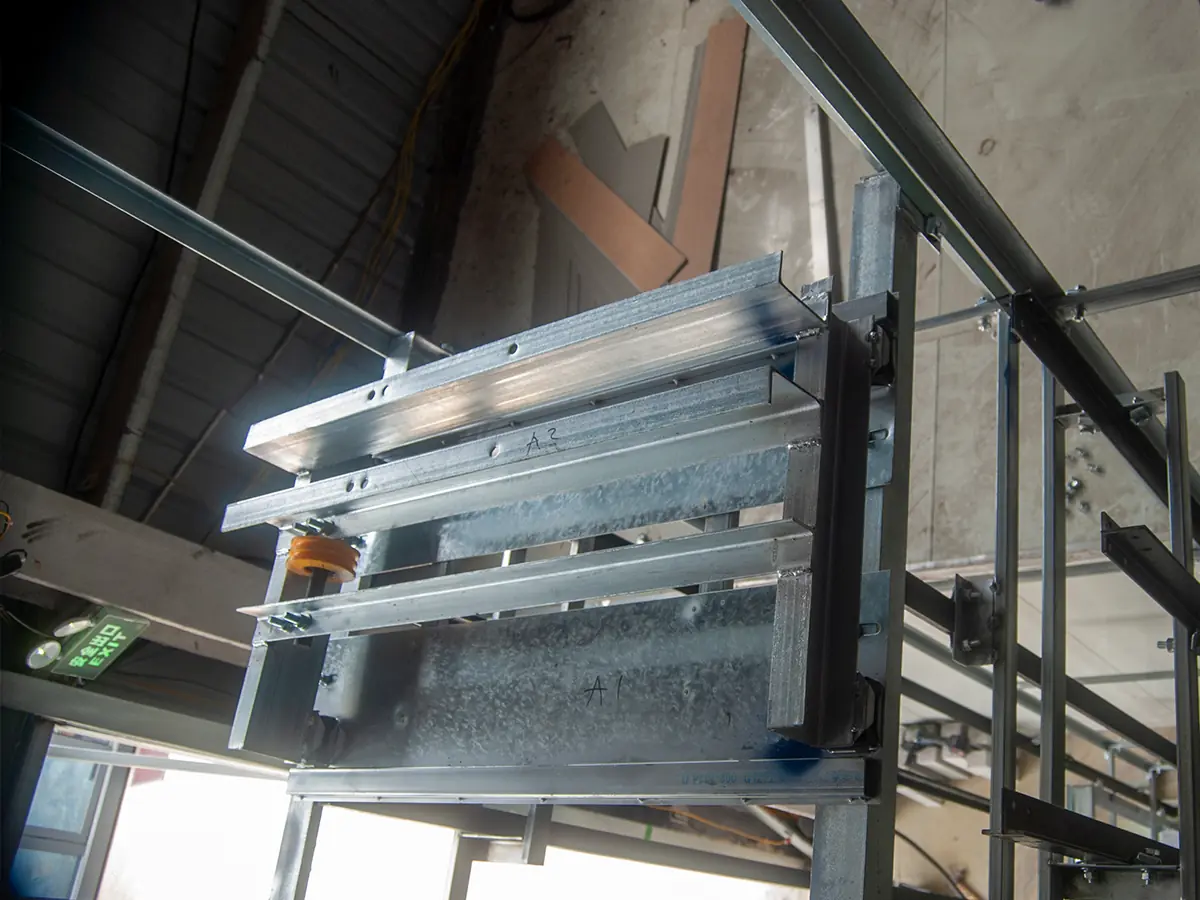
The laundry dumbwaiter car shell and sill detail matter more in laundry duty than in food service: this is the surface that stays wet.
A fourth item belongs on this list even though it is not a dimension: whether the car will later be repurposed. A hotel that converts a floor to F&B, or opens a club lounge, often wants the same shaft to carry food. Stainless interiors and a slightly larger car cost little at order time and make that conversion possible. If a food application is a realistic future, mention it now — the goods lift guide covers how load types map to machine classes when one shaft has to serve several.
Wet Linen, Humidity and Corrosion
Linen dust and moisture are the two things that shorten a laundry dumbwaiter’s life, and both arrive with the load rather than with the building. Three mechanisms do the damage.
Water pooling in the car. Damp towels drip onto the car floor, and the sill is the lowest point. Without a drainage path, water sits against the door threshold and works into the track, where lint collects and holds it. A sloped car floor drained to a small outlet, or a removable drip tray under the sill, solves this at trivial cost.
Humidity in the shaft and machine space. A laundry dumbwaiter shaft is a vertical duct, and in a basement laundry it can behave like a chimney for warm moist air. Electrical components do not fail immediately from humidity; they fail two years later, at the contacts. Keep the machine space ventilated and dry, and do not place the controller on a wall that sweats.
Lint at the switches. Linen lint is fine, airborne and slightly adhesive. It settles on landing buttons, door contacts and sills, and eventually interferes with the interlock. Sealed pushbuttons and a weekly wipe of the sills remove this failure mode entirely — it is the cheapest reliability measure available on a laundry dumbwaiter.
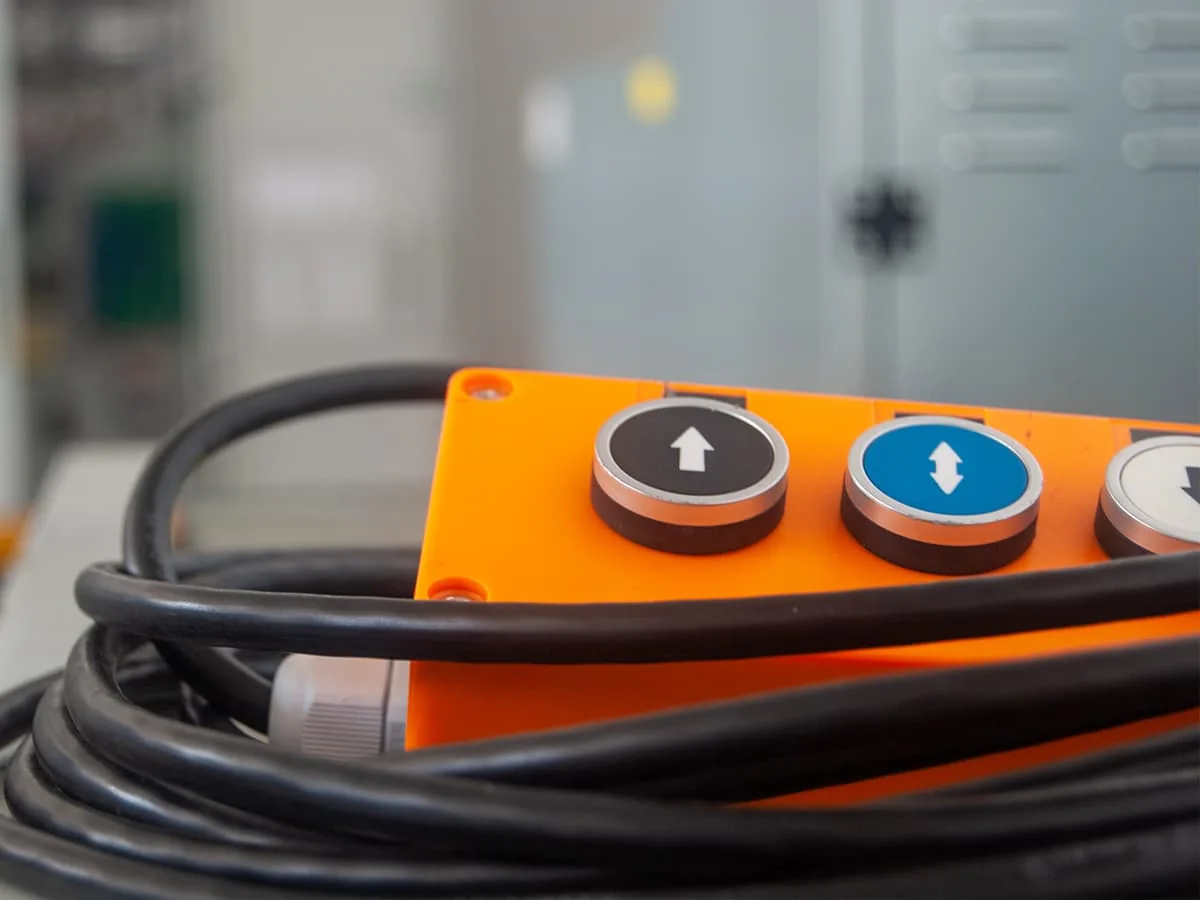
Sealed call buttons on the car operating station: in a laundry environment, lint at the contacts is a maintenance item, not an accident.
Two decisions follow from this section and are worth settling early. First, specify a stainless car with a drainage detail rather than accepting the standard dry-goods car. Second, decide where the control cabinet sits — inside the laundry where it is convenient, or outside where it is dry. Convenience wins arguments at commissioning and loses them at year three.
Shaft, Pit and Headroom Constraints
A laundry dumbwaiter needs a continuous vertical shaft from the lowest to the highest served floor, and the building usually decides the geometry before the laundry dumbwaiter does. Three measurements govern everything.
Shaft size
Plan dimensions come from the car plus the counterweight and guide rails. A rear-counterweight machine needs depth for the weight behind the car; a side-counterweight machine needs width beside it. In an existing building, the shaft is whatever the structure allows — an old service duct, a sealed chimney breast, a slice taken out of a corridor — so measure first and choose the model second.
Headroom and pit
Overhead clearance accommodates the machine, sheaves and any maintenance access; the pit accommodates the buffer and the car’s lowest position. Light-duty dumbwaiters have modest requirements compared with passenger lifts, but they are not zero, and low-headroom situations are exactly where a standard model stops fitting. If you are short on headroom, say so at enquiry rather than after the drawing is issued — the dumbwaiter installation guide sets out the shaft preparation checklist and the dimension ranges.
Power, drainage and ventilation
Three building services are easy to forget and awkward to add afterwards: a dedicated supply at the machine position, a drainage route for the car sill in wet duty, and ventilation for the shaft top and machine space. In a basement laundry, drainage is frequently the item that delays commissioning by a week.
None of this is exotic. The failure pattern is consistent, though: projects that measure the shaft after ordering a laundry dumbwaiter end up paying for a special car, and projects that measure first buy a standard one.
Doors, Controls and Safety
Landing doors are where a laundry dumbwaiter becomes a building element rather than a machine, and they carry most of the safety function.
Interlocks. Every landing door must be mechanically and electrically interlocked so the car cannot move unless all doors are closed and locked, and no door can be opened unless the car is at that landing. This is not an optional refinement; on a non-passenger lift it is the primary protection for staff reaching into a shaft.
Emergency lowering. If the building loses power while the car is between floors, staff need a way to bring it to a landing and open the door. Confirm the method and who is trained to use it — an emergency device nobody knows how to operate is decoration.
Door type and clear opening. Up-and-over, vertical sliding and hinged doors all exist in this class. What matters for linen is the effective clear opening after the door and frame, and whether a loaded basket passes through it without being tilted. A door that forces a tilt spills water on the floor every trip.
Controls and indication. Call-and-send buttons at each landing, a car-height indicator, and a door-open alarm for staff are the useful options. Anything that requires a key is a liability in a department with rotating shifts and agency staff.
What a Laundry Dumbwaiter Costs in 2026
Cost is driven by capacity, travel, car material, door type and — more than any machine specification — how much building work the shaft needs. A complete 100–200 kg hotel linen laundry dumbwaiter, supplied and installed, generally lands between roughly USD 5,000 and USD 15,000 depending on configuration and freight. The spread inside that band is explained by the line items below.
| Cost element | Lower end | Mid | Higher end | What moves it |
|---|---|---|---|---|
| Machine: car, frame, ropes, traction unit | 100 kg, galvanised, rear counterweight | 150–200 kg, stainless car | 250 kg, stainless, special car size | Capacity and car material |
| Landing doors and frames | 2 stops, standard | 3–4 stops, standard | 5 stops, fire-rated or clad | Stop count and finish |
| Controls and wiring | Basic call-send | Call-send, indicator, alarm | Addressable, BMS interface | Options specified |
| Shaft and civil works | Existing shaft reused | New block or stud shaft indoors | New shaft through occupied floors | Usually the largest single item |
| Installation and commissioning | 2–3 days, easy access | 3–4 days per shaft | 5+ days, restricted access or occupied building | Site access, working hours |
| Freight, duties, VAT | Regional, consolidated | Container with other equipment | Single LCL shipment, remote site | Destination and shipping mode |
Two observations from real quotations. First, in refurbishments the civil work regularly exceeds the machine cost, so a budget built from a machine price alone will be wrong by a wide margin — the installation cost guide breaks down the building side separately. Second, the difference between the 100 kg and 200 kg variants is far smaller than the difference caused by adding one more floor, because every additional stop means another door, another interlock and another set of landing works.
For a full breakdown of machine pricing across capacities and configurations, see the 2026 dumbwaiter price guide. Both guides are written for the same class of machine, so the figures can be read together.
Installation Timeline, Week by Week
Most hotels are told “two to four days” and then discover the job takes six weeks. Both numbers are true — they describe different things. The laundry dumbwaiter installs in days; the shaft takes weeks.
Weeks 1–2: survey and drawings. Shaft measurement, door positions, power and drainage points, and a layout drawing for approval. Everything downstream depends on this being right, and it is the stage most often compressed to save time on paper.
Weeks 2–4: shaft and openings. Blockwork or a stud shaft, floor openings, lintels, and making good. In an occupied hotel this is the disruptive phase — noise, dust and closed corridors.
Weeks 4–5: doors, frames and services. Landing doors set and plumbed, electrical supply run, drainage connected, shaft topped out for headroom clearance.
Week 5: machine installation. Frame, guides, car, ropes, counterweight, and the traction unit set at the top. Two to four days per shaft with clear access.
Week 6: commissioning and handover. Interlock testing at every landing, load test, emergency lowering demonstration, operator briefing for housekeeping supervisors, and the documents the inspector will ask for.
Two scheduling notes worth acting on. Do not install a laundry dumbwaiter in the same week as floor sanding or wet trades on the served floors, because the shaft will collect everything. And book the inspection before the shaft is closed up, not after — reopening finished walls to show a concealed component is an avoidable cost.
Maintenance and Five-Year Cost of Ownership
A laundry dumbwaiter is a low-stress machine that is usually maintained badly, which is how a fifteen-year asset becomes a seven-year one. The routine below is the whole of it, and none of it requires specialist tools.
| Interval | Task | Who | Why it matters in laundry duty |
|---|---|---|---|
| Weekly | Wipe car interior, sills and door tracks; clear lint | Housekeeping | Lint at the sill is the leading cause of interlock faults |
| Monthly | Check door interlocks at every landing; test emergency lowering | Maintenance | Interlock failure stops the machine for safety, usually on a sold-out weekend |
| Quarterly | Inspect ropes, sheaves and counterweight guides; check car floor drainage | Technician | Wet duty accelerates rope and guide wear |
| Annually | Full inspection: traction machine, brake, electrical, load test | Technician / inspector | Statutory in most jurisdictions; also the moment to catch brake wear |
| Annually | Paint or treat any bare steel in the shaft; check ventilation | Maintenance | Moisture in the shaft is the slowest and most expensive failure |
Budget the maintenance as a small annual line, not a contingency. The dumbwaiter maintenance guide expands each row into a checklist, and the failure modes it lists are the ones that actually appear in hotels rather than the ones that look impressive in a service contract.
Over five years, the pattern in a well-run hotel is roughly this: routine cleaning in-house, two technician visits a year, one rope or brake adjustment, and no major component replacement. The hotels that spend more are almost always the ones where the laundry dumbwaiter was specified for dry goods, the sill has no drainage, or the controller sits in a humid basement corner.
Eight Questions to Ask Before You Order
These are the questions that separate a quotation you can build against from one you will renegotiate during installation.
1. How many trips per hour will this machine do in our peak window? Linen duty is a cycle-count problem before it is a weight problem. A machine rated for 150 kg but built for occasional use will struggle with forty trips between 09:00 and 11:00.
2. What is the effective clear opening, not the nominal door size? Ask for the finished dimension after frame and door. This single number decides whether baskets go in upright.
3. Is the car built for wet goods, and where does the water go? A stainless interior is the minimum. A drainage path from the sill is the difference between a dry shaft and a corroding one.
4. What shaft dimensions does this exact model need, and what happens if ours is 50 mm short? Get the answer in writing with the drawing, before the shaft exists.
5. Who supplies and sets the landing doors, and are they in your scope? Door supply is the most common scope gap between a lift supplier and a main contractor.
6. What documentation comes with delivery? Test certificates, wiring diagrams, the maintenance manual and the inspection documents your local authority will ask for.
7. What is the lead time, and what is the realistic site date including freight? Ask for both, and separate manufacturing from shipping.
8. If we later convert this shaft to food service, what would have to change? The answer tells you whether the laundry dumbwaiter you are buying has any future beyond linen.
If the comparison is between several suppliers, the useful next step is not another brochure — it is a drawing against your own shaft. That is also where a manufacturer’s real capability shows: whether they will produce a layout for a shaft they cannot see. ServLifts publishes its approach to the machine class in the dumbwaiter manufacturer in China overview, and the differences between lift types are set out in the classification guide if your project is still deciding between a dumbwaiter, a goods lift and a service lift.
Two regulatory points belong in this list even though they are not questions for a supplier. Most jurisdictions classify a laundry dumbwaiter as a freight lift, requiring a permit, inspection and periodic re-inspection — check the local requirement before the shaft is built, not after. And in buildings with fire compartmentation, the shaft and doors are part of that strategy; dumbwaiter regulations collects the code positions most often raised by inspectors, including the ASME A17.1 framework used in the United States.
Laundry Dumbwaiter FAQ
Can a laundry dumbwaiter carry wet towels?
Yes, and in most hotels a laundry dumbwaiter will do so every trip. Two things must be specified: a stainless steel car interior, and a drainage path from the car sill so water does not sit against the door track. Wet loads are heavier than the same load dry, so size capacity for the wet return trip rather than the clean delivery.
How much linen can one hotel laundry dumbwaiter move per day?
Capacity per trip and capacity per day are different limits. A 150 kg laundry dumbwaiter making forty trips is not moving 6,000 kg of linen — it is moving whatever one housekeeper loads each time, typically 20–40 kg. The realistic daily throughput of a single machine in a 150-key hotel is comfortably sufficient, provided the peak-hour cycle count suits the motor and door duty.
Do I need a building permit for a laundry dumbwaiter?
In most jurisdictions, yes. A laundry dumbwaiter is normally classified as a freight lift, which brings a permit application, an installation inspection and periodic re-inspection. Requirements vary by country and sometimes by city, so confirm with your local authority or lift contractor before the shaft is built. The ASME codes and standards portal is the reference point for the US framework.
How many floors can a laundry dumbwaiter serve?
Two to five floors covers the overwhelming majority of hotel laundry dumbwaiter installations. Higher travel is possible with the appropriate machine, rope length and control configuration, but at some point the economics and the code treatment shift toward a different machine class. Tell the supplier your full travel height at enquiry stage rather than assuming a standard machine will reach.
What size car do I need for hotel laundry baskets?
A laundry dumbwaiter car of roughly 800 × 800 × 1000 mm takes a standard hotel laundry basket flat on the floor, which is the practical test. Measure the baskets, hampers and trolleys you actually use — including the height of a stacked load — before fixing the car size. A car that is 50 mm short in internal height forces every load to be tilted, and tilted loads spill water.
Can the same dumbwaiter be used for food later?
Yes. A laundry dumbwaiter and a food dumbwaiter share the same traction technology, so a shaft can be repurposed if the car is stainless and the landing heights suit the new use. Decide this at order time, because the car size and finish cost little to change then and a great deal to change later.
Why not just use a linen chute?
Because a chute only works in one direction. Gravity takes soiled linen down, but clean linen still has to be carried up by trolley or service elevator — the gap a laundry dumbwaiter fills — and the chute must be fire-stopped at every floor penetration. A laundry dumbwaiter moves linen both ways in one shaft, which is why refurbishments with an existing shaft usually prefer it.
How long does installation take in an operating hotel?
Allow roughly six weeks end to end for a laundry dumbwaiter, of which the machine itself takes two to four days per shaft. The rest is survey, shaft work, doors, services and commissioning. Phasing the shaft work around occupancy is possible and normal, but it extends the calendar programme rather than compressing it.
Choosing a Supplier Without Overpaying for a Name
The laundry dumbwaiter market has a small number of very large brands and a long tail of regional manufacturers. The large brands bring global service networks, standard documentation and a price to match. Regional manufacturers — particularly those building their own traction machines and cars rather than assembling bought-in parts — bring the same duty cycle at a materially lower price, with the trade-off being that you have to check their drawings and documentation more carefully yourself.
The decision is usually about project profile rather than quality. For a single 80-key boutique hotel in a market where service calls are easy, the price difference funds a great deal of maintenance. For a 400-key resort with a brand standard to satisfy, the service network may be worth the premium. When a big name is not mandatory, a manufacturer who will issue a layout drawing against your shaft, quote the civil scope separately, and put the door and drainage details in writing is worth a serious look — and that is a test you can run before spending anything.
If you take one thing from this guide, take the order of the decisions: measure the shaft, count the baskets, size the laundry dumbwaiter for the wet return trip, and only then price it. Every expensive mistake in this category comes from doing those four things in a different sequence.
Start with what you can measure: room count, occupancy, basket dimensions, floor-to-floor height and the shaft you have. Send ServLifts your floor plan or shaft dimensions and we will come back with a recommended car size, capacity and landing arrangement — including the shaft drawing you can hand to your contractor.