Welcome to ServLifts Official Website

Goods Lift Guide 2026: What 12 Commercial Loads Actually Need

A goods lift is the machine you buy when a load is too heavy to carry up a stair and too small, too frequent, or too awkward for a passenger elevator. Buyers rarely choose it that way. Most start from the building — there is a shaft here, a riser there — and work backwards into a specification that fits the hole and not the job.
This page reverses the order. It starts from twelve commercial loads that repeat every working day, matches each one to a machine class, and only then checks the building. Along the way it covers the five standard car sizes from 50 to 300 kg, the 300 kg line where the governing standard changes, and the site details that decide whether a quotation survives contact with the installation.
- What a Goods Lift Is
- Why the Load Decides the Machine
- The Load Matrix: 12 Loads and 12 Machines
- Laboratory and Clinical Loads
- Hospital, Clinic and Care Loads
- Factory and Workshop Loads
- School, University and Library Loads
- Retail, Venue and Entertainment Loads
- Sizing: Five Cars From 50 to 300 kg
- The 300 kg Line and What It Changes
- Site Checks and Price Drivers
- Goods Lift FAQ
What a Goods Lift Is
In the UK, Ireland, India, Southeast Asia and most of Africa, a goods lift is any lift installed to carry goods rather than people. The word is deliberately broad: it covers a 50 kg tray lift behind a restaurant wall and a three-tonne freight lift with a drive-in loading bay. Both are goods lifts. They share a vocabulary and almost nothing else.
In North America the same equipment is usually called a service elevator, and the smallest versions are dumbwaiters. That naming difference matters when you buy, because a supplier quoting a “goods lift” may be pricing a 100 kg tray unit or a pallet-rated machine, and the two are not interchangeable in cost, in structural load, or in which standard applies. Where the smallest units are concerned, the definition of a dumbwaiter elevator sets the background.
Goods Lift, Service Lift, Freight Lift: Three Words, Three Duties
The three terms overlap in everyday speech and separate cleanly once you look at what loads them. The distinction below is the one the trade actually uses when a quotation has to be defended to an inspector, a landlord or an insurer.
| Term | What it means in the trade | Typical rated load | How it is loaded |
|---|---|---|---|
| Goods lift | Umbrella term. Goods-only, no attendant, short travel, doors that open onto a service area rather than a lobby | 50–2,000 kg depending on class | By hand or by trolley |
| Service lift | The small end of the same family: trays, linen, documents, samples. Often the same machine sold as a dumbwaiter | 50–300 kg | Tray stack or light trolley |
| Freight lift | A lift built around pallet and truck traffic, with a car floor rated for a pallet truck and a lobby deep enough to turn in | 1,000–5,000 kg | Pallet truck, roll cage, forklift in some designs |
A 100 kg service lift and a 3,000 kg freight lift are both goods lifts and have nothing in common beyond the name: different drive, different door, different structural loads, different inspection regime. When the difference between service lift and food lift also matters to your project, the comparison in food lift vs service lift vs dumbwaiter covers that pair directly.
Why the Load Decides the Machine
Three properties of the load set the specification before the building gets a vote. The first is the footprint of whatever the goods arrive on. A laundry bag and a bag trolley weigh the same order of magnitude; only one of them needs a car 1,200 mm deep. Car length is a trolley decision, not a weight decision.
The second is peak duty. Two buildings can move the same tonnage per day and need different machines, because one spreads it over ten hours and the other compresses it into a single meal service. Motor heating and brake wear follow the peak, not the total.
The third is what the load does to the machine. Damp linen leaves salt on a car floor. Reagents leave a spill that must be washed out without a drain. Sterile trays cannot pass a used tray in the same car. Each of those is a car finish, a door type or a routing decision, and none of them appears on a load chart.
Specify from the load up, then check the building. Specifying from the shaft down gives you a car that fits the hole and fails the job — and the failure usually surfaces at the first busy service, not at commissioning.
The Load Matrix: 12 Loads and 12 Machines
The table below is the short version of this page. Each row is a load that repeats every working day in a commercial building, the machine class that suits it, and the single detail that most often turns an enquiry into a re-quote. Loads are per trip, including whatever the goods sit on. If you are choosing by building rather than by load, the dumbwaiter building applications route covers that order of work instead.
| Load | Weight per trip | Where it moves | Machine class | The detail that decides it |
|---|---|---|---|---|
| Plated meals, tray stacks | 25–60 kg | Hospital ward floors, school and staff canteens | 50–100 kg service lift | Tray stack height; a car 800 mm high clears a full stack with the cover on |
| Sterile instrument tray sets | 30–80 kg | Theatre and CSSD floors, clinic back-of-house | 100–150 kg, stainless car | Clean and used sets must not share a car; two-door or pass-through layout |
| Specimens, reagents, cold-chain boxes | 10–40 kg | Laboratory floors, sample reception | 50–100 kg | Dedicated use: nothing else goes in the car, and the drive is kept out of the car envelope |
| Pharmacy and medicine totes | 20–50 kg | Pharmacy to ward floors | 50–100 kg | A lockable landing door, and trip logging if the site audits chain of custody |
| Damp linen, laundry bags | 80–150 kg | Basement laundry to guest or ward floors | 150–250 kg | Car height for a bag trolley; a floor that drains rather than a floor that pools |
| Archive boxes, files | 60–120 kg | Records floors, basement registry | 150–200 kg | Trolley length, and floor loading where the shelving stands at each landing |
| Library books, returns carts | 80–150 kg | Stack floors, staff and public levels | 150–250 kg | Cart width, and a car floor level enough that a loaded cart rolls out without a lip |
| Tools, dies, spare parts | 100–300 kg | Workshop mezzanines, plant levels | 250–300 kg | Loading height at each level: a car floor standing 20 mm proud is a lift-and-drop every trip |
| Material samples, QC batches | 50–100 kg | Plant to laboratory | 100–150 kg | Washable car, and a door wide enough for the sample crate rather than the sample |
| Retail stock, shelf totes | 60–150 kg | Stockroom to sales floor | 150–250 kg | Landing door security, since one side opens onto a public sales area |
| Bar stock, kegs, glassware | 60–120 kg | Cellar to bar level | 150–250 kg | A full 50-litre keg weighs around 60 kg; two per trip sets the floor |
| Stage props, AV gear, furniture | 50–150 kg | Stage to mezzanine, store to hall | 150–250 kg | Car length for props, and noise: an adjacent hall is in use during the load-in |
Read the last column rather than the first two. Weight and machine class are what buyers ask about; the detail in the last column is what actually makes the difference between a unit that runs for fifteen years and one that is replaced in three.
Laboratory and Clinical Loads
Laboratories were not an obvious market for goods lifts until sample volumes grew, and they are now one of the clearest cases for a dedicated unit. What makes them different is not the weight — most laboratory loads are under 40 kg — but the fact that the car is part of a chain of custody.
Specimens, Reagents and Cold-Chain Boxes
A specimen that leaves a controlled environment and arrives warm is a specimen that has to be re-taken. The unit itself does not refrigerate anything, but three design choices keep the trip short and predictable: the drive and control gear sit outside the car envelope so the car interior stays close to room temperature, the travel is direct rather than staged, and the door closes rather than standing open between trips.
Reagents add a materials question. A 304 stainless car handles routine cleaning; a spill of a corrosive reagent is the case for a 316 interior and a floor without a drain penetration. Where the same unit also serves a teaching laboratory, the landing door needs to be lockable, because a goods lift that any student can call is a lift that will be called for reasons nobody documented.
Sterile Trays and the CSSD Loop
The central sterile services department loop is a two-way flow that must not cross: clean sets going out to theatres, used sets coming back. One car can do both jobs only if the trips are separated in time and the car is cleaned between them, which in practice costs more in labour than a second small unit costs to buy.
Where a second unit is not possible, a two-door car with a pass-through layout is the compromise: it loads on the clean side and unloads on the used side without the trolley turning around inside the car. Either way the car is sized to the instrument trolley, not to the tray, because the trolley is what has to fit.
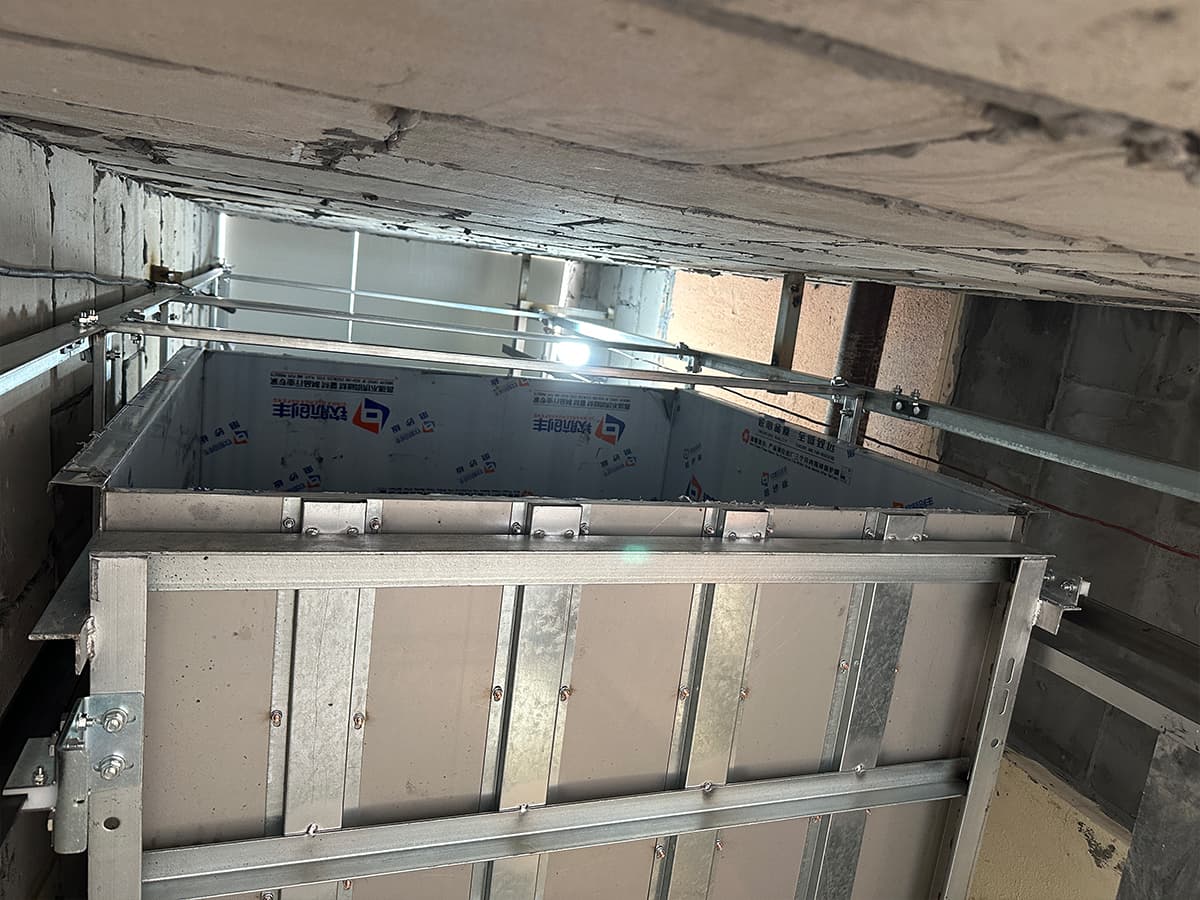
The photograph above is a car frame going into a shaft before the enclosure is closed. The interior clear dimensions are fixed at this stage, and they are the numbers a laboratory or a sterile department should be asked about in millimetres rather than in “small” or “standard”.
Hospital, Clinic and Care Loads
A hospital does not have one goods lift problem. It has three streams that run in parallel all day: meals going up, linen going down, and waste going out. Each has a different peak, a different tolerance for delay, and a different hygiene requirement, and the most common specification mistake is to size a single unit for the sum of all three.
Meals, Linen and Waste Must Not Share a Car
Meal service is a hard deadline: several hundred trays leave a central kitchen within a window, and the last ward served sets the acceptable cycle time. Linen runs are bulkier and can be moved off-peak. Waste is the stream that must never share a car with food, and in most modern hospitals it does not — it has a dedicated route, often a chute rather than a lift.
Where one unit has to serve both meals and linen, the car is sized to the larger of the two, which is nearly always the linen trolley, and the schedule separates them. The clinical background to this sizing is covered in our hospital dumbwaiter guide, including the hygiene points that inspectors ask about.
Two regulatory details belong at the quotation stage rather than the handover stage. In the UK, goods-carrying lifting equipment falls under LOLER and is normally inspected at six-monthly intervals, so the examination regime needs an owner from day one. And a car that opens onto a ward corridor inherits the fire rating of the wall it interrupts, which is a door specification and not an accessory.
Factory and Workshop Loads
Factories are where a goods lift stops being a convenience and becomes part of the process. The loads are heavier, the duty is more punishing, and the unit is usually installed in an existing building where the floor levels were never designed for a lift.
Tools, Dies and Spares Between Levels
A die set that weighs 200 kg does not travel often, but it travels at the worst possible moment: during a changeover, when the line is down and every minute is counted. That combination — infrequent, heavy, urgent — is the case for a 250–300 kg unit with a floor-level loading height at both stops rather than a small unit with a step.
The second factory load is smaller and more frequent: spares, jigs and sample batches moving between a plant floor and a quality laboratory. That traffic suits a 100–150 kg car, and the practical requirement is a washable floor, because a car that collects swarf and coolant becomes a slipping hazard within a month.
Loading height is the detail that factories regret. A car floor standing 20 mm above the landing means every heavy load is lifted and dropped rather than rolled, and the impact goes into the car frame, the guides and the rope termination. Because the car and landing are aligned at commissioning, small misalignments are easy to accept on the day and expensive to live with. The 300 kg factory build is described in more detail in industrial dumbwaiter lift.

A traction machine mounted at the base of the shaft, as above, keeps the headroom requirement down and puts the wear parts where a technician can reach them. In a factory the machine position also decides whether a service visit needs a scaffold or a step ladder.
School, University and Library Loads
Educational buildings have the most extreme duty profile of any group on this list. A canteen serving a whole school in one sitting produces a peak that looks like a much larger building, followed by hours of complete idleness. That pattern is harder on a machine than steady traffic, because heat builds in the motor and the brake does a shift of work in an hour.
Books, Archive Boxes and AV Carts
A library or an archive is the opposite case: a steady trickle of loaded carts, all day, with a load that is heavier than it looks. Books are dense. A returns cart at 80–150 kg is normal, and the constraint is usually the cart width rather than the weight, because a cart has to be pushed in and pulled out without turning.
Archive storage adds a floor-loading question that a lift supplier cannot answer alone. Boxes accumulate at each landing while they wait to go up, and the point load at that landing is a structural question for the building, not for the lift. The dimension side — car sizes, shaft sizes and headroom for each load class — is set out in the dumbwaiter dimensions guide.
For campus buildings that need more than two stops, the control system starts to matter as much as the drive: floor-to-floor service, call registration at each landing, and a car that parks at the level where the next call is most likely. Those settings are cheap at order and awkward to retrofit, which is why they belong in the specification rather than in a later upgrade request.

A control cabinet for a multi-stop unit, with the landing call terminals along the bottom rail. Each additional stop is one more cable run into this cabinet, which is why the stop count belongs in the original order.
Retail, Venue and Entertainment Loads
Retail units, bars, clubs, theatres and event venues share a structural problem: the space the public sees is on the valuable floor, and everything that serves it is squeezed into a basement, a mezzanine or a back corridor. That is exactly the geometry a small goods lift solves, and it is why this group buys on footprint rather than on capacity.
Bars, Props and Stock Runs
A cellar-to-bar unit is defined by the keg. A full 50-litre keg weighs around 60 kg, and a two-keg trip is the normal specification, which puts the floor at 120–150 kg plus the trolley. Glassware and bottled stock travel on the same route, so the car floor needs a lip and a washable finish rather than a flat painted deck.
Venues add two requirements that retail does not. The first is noise: a lift shaft that shares a wall with a hall in use cannot be the loudest thing in the building at load-in, which argues for a drive and door arrangement chosen for sound rather than for price. The second is timing: props and AV gear move in a narrow window before doors open, so the unit is judged on cycle time under load, not on rated speed empty.
Retail is the security case. One landing opens onto a public sales floor, so the door needs to lock, and the call station on that side needs to be either key-operated or out of reach. A goods lift with an unsecured public-side landing is a stock-loss route with a motor attached.
Sizing: Five Cars From 50 to 300 kg
The standard range runs from 50 to 300 kg, and in practice it resolves into five car sizes. Each row below is a working size, not a theoretical maximum: the car dimensions are the clear internal space, and the shaft figures are the finished opening you need to find or form.
| Car W×D×H (mm) | Rated load | Finished shaft W×D (mm) | Overhead above top floor | Loads it suits |
|---|---|---|---|---|
| 600 × 600 × 800 | 50–100 kg | 850 × 850 | 200–250 cm | Documents, tray stacks, samples, pharmacy totes |
| 700 × 700 × 1000 | 100–150 kg | 950 × 950 | 200–250 cm | Plated meals, small stock runs, laboratory crates |
| 800 × 800 × 1200 | 150–200 kg | 1050 × 1050 | 200–250 cm | Standard meal and tray service, archive boxes |
| 1000 × 1000 × 1200 | 200–250 kg | 1250 × 1250 | 200–250 cm | Library carts, damp linen, bar stock, retail totes |
| 1200 × 1200 × 1400 | 250–300 kg | 1450 × 1450 | 200–250 cm | Tools and dies, heavy laundry, hospital supplies, props |
Two rules keep this table honest. The rated load includes the trolley, the tray stack and the bag — not just the goods. And the car height is driven by what has to stand up inside it, so a unit that clears 150 kg on the scales can still be the wrong purchase if the trolley is 1,250 mm long and the car is 1,000 mm deep.
Standard production covers the range up to 250 kg; a 300 kg unit is a custom build, normally at 1200 × 1200 × 1400 mm. Above that, the equipment changes class, which is the subject of the next section.
The 300 kg Line and What It Changes
Three hundred kilograms is not a marketing number. It is roughly where the European standards stop treating a goods-only lift as a small machine and start applying the requirements written for accessible goods lifts, and it is the line most buyers cross without noticing when they round a specification up for safety.
Below it, goods-only units sit under the service-lift standard, EN 81-30. Above it, accessible goods-only lifts up to 1 m/s fall under EN 81-31, which brings requirements on the car, the doors and the access that a 300 kg tray lift was never designed against. Buyers who ask for “400 kg to be safe” are not buying a bigger version of the same machine; they are buying a different machine with a different standard and a different price base.
The second gate is speed, and it routes the whole project rather than one component. Equipment above 0.15 m/s falls under the Lifts Directive, Directive 2014/33/EU, while slower equipment is handled under the general machinery framework. The European Commission keeps the current lifts legislation overview that both routes are read against, and the machinery side moves to Regulation 2023/1230 from 20 January 2027.
Our position on this is narrow and worth stating plainly: we build goods-only units from 50 to 300 kg, and above 300 kg we are the wrong supplier. A 500 kg goods lift is a freight-lift project with a freight-lift structural load, door set and inspection regime. The full regulatory picture, including the US and UK positions, is set out in dumbwaiter regulations.
Site Checks and Price Drivers
Once the load is fixed, six site measurements decide whether the unit can be installed at all. They are cheap to take and expensive to discover late, and every one of them sits outside the supplier control once the unit ships.
| Check | What to measure | Why it decides the project |
|---|---|---|
| Footprint at each landing | Clear width and depth in front of the door, and the turning space for a loaded trolley | A car that fits the shaft is useless if the trolley cannot be manoeuvred into it |
| Headroom above the top stop | Floor to the lowest obstruction, not floor to ceiling | 200–250 cm is the working range; a beam or duct at 190 cm rules the standard layout out |
| Pit or floor-level threshold | Depth of any existing pit, and the step at the lowest landing | A pit-less layout changes the drive arrangement and the loading height |
| Power available | Single-phase or three-phase, and the cable route to the machine position | Three-phase at the machine is the cheaper installation; a long single-phase run is not |
| Landing door and fire rating | The wall the door interrupts, and whether the landing is a corridor or a service area | A fire-rated door onto a corridor is a different purchase from a service hatch |
| Loading height at every stop | Finished floor level relative to each landing | A car floor 20 mm proud turns every heavy load into a lift and a drop |
Price follows the same logic. Rated load, stop count, shaft condition and door type are the four variables that move a quotation, and the destination adds freight and any certification the importing country requires. Rather than a headline figure that will be wrong for most readers, the cost structure for this equipment class is broken down in the price guide.
One more item belongs on the site list even though it is not a measurement: who maintains the unit. A goods lift is a long-lived machine with wear parts — rope, guides, door rollers, brake — and a maintenance schedule agreed at handover costs less than a repair negotiated in an emergency.
Goods Lift FAQ
Five questions that come up in almost every enquiry, answered the way we answer them on the phone.
Is a goods lift the same thing as a dumbwaiter? In British and Asian trade usage a goods lift is the umbrella term, and a dumbwaiter is the small end of it: goods-only, 50 to 300 kg, short travel, no attendant. If the load is under 300 kg and nobody rides, the two words describe the same machine. Above that weight the equipment changes class and a goods lift stops being a dumbwaiter.
Can people ride in a goods lift? Not in a goods-only unit. A car rated for goods has no passenger-rated platform, no safety gear sized for people, and landing doors that do not meet passenger criteria. Riding in one during maintenance or a stock run is the single most common cause of serious injury on this class of equipment, and interlocks that stop the car whenever a landing door is open are the reason the rule exists.
How much does a goods lift cost? Four things move the number: rated load, number of stops, shaft condition, and landing door type. A two-stop 100 kg unit in an existing shaft is a different purchase from a five-stop 300 kg unit with fire-rated doors, even though both are described as goods lifts. The published breakdown for this class of equipment is in our price guide rather than a headline figure here.
How many floors can a goods lift serve? Most installations run two to six stops, and eight is the practical ceiling for a traction unit under 300 kg without stepping up to a different drive. Every extra stop adds a landing door, a set of interlocks and a floor-level tolerance, so the door package — not the car — is what extends the price as stops go up.
Who certifies and maintains it? A local lift contractor licensed for the equipment class handles both, or the factory sends a supervisor to guide your own mechanical crew. In the UK, inspection falls under LOLER and is normally required at six-monthly intervals for equipment carrying goods. Settle who signs the installation certificate before the order, because a supervisor can guide work and usually cannot certify it.
If your load is on the matrix above and the site checks come back clean, the next step is a layout drawing against your actual shaft dimensions rather than a catalogue page. Send the measurements through our contact page and we will return a drawing with the car size, door type and drive that fit them — built in Wujiang, Suzhou, and shipped as one unit.
[…] budget. Where the same equipment is bought under the goods lift name, the twelve-load matrix in the goods lift guide starts from the load instead of the […]
[…] A dumbwaiter elevator is a compact, reliable, low-cost way to move goods between floors — the same category of equipment as a food lift or service lift, sized for cargo rather than people. Now that you know what it is and how it works, you can specify one with confidence. Browse the ServLifts range or contact us with your load and car size for a direct-from-factory quote. Buyers who know the equipment under the goods lift name will find it covered load by load in the goods lift guide. […]