Welcome to ServLifts Official Website

Where Does The Name Dumbwaiter Come From

To modern English speakers, the term “dumbwaiter” can sound puzzling, even absurd. At first glance, it seems to describe a foolish or unskilled server, which has no connection with the small, handy freight lift used to carry food, tableware, and household goods between floors. In fact, this centuries-old word is a perfect example of how English vocabulary evolves with social life and technological progress. Its origin has nothing to do with “stupidity”. Instead, it combines archaic word meanings, 18th-century European household culture, and early mechanical innovation. By tracing its etymology, historical usage, and semantic evolution, we can fully uncover the true story behind the name “dumbwaiter”.
Dumbwaiter History: Core Etymology — Breaking the Misunderstanding of “Dumb”
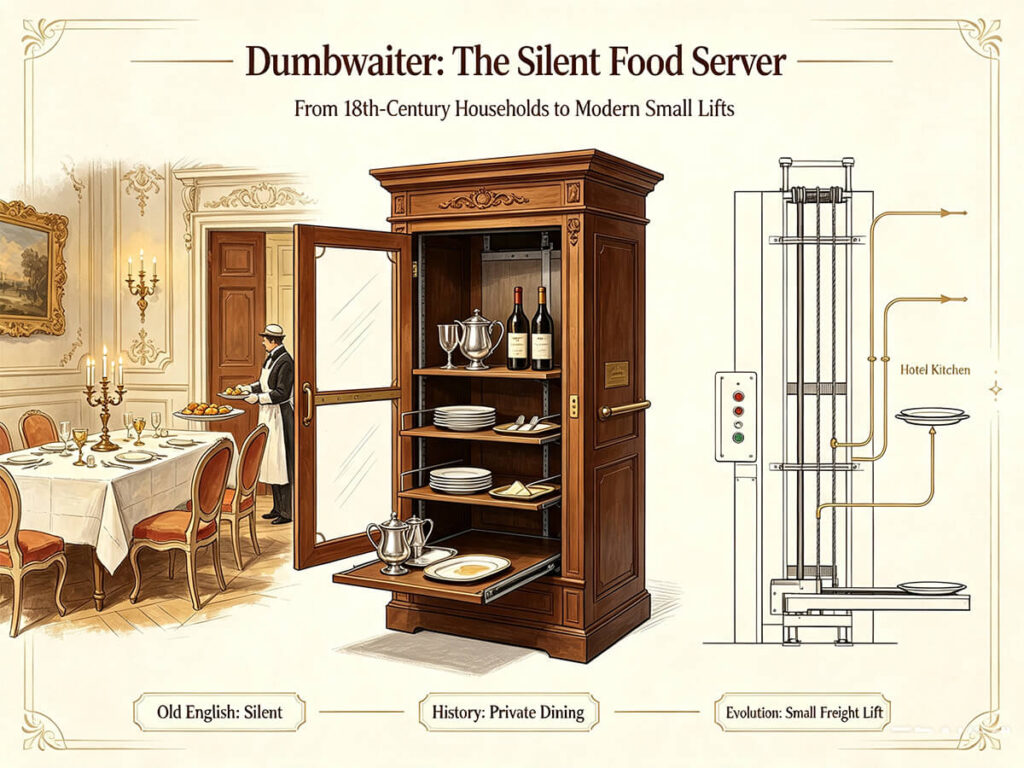
The Core Etymology: Breaking the Misunderstanding of “Dumb”
The biggest misconception about “dumbwaiter” lies in the modern definition of the word “dumb”. Today, “dumb” is widely used in informal contexts to mean “foolish, silly, or lacking intelligence”. However, this was not its original and classical meaning. According to the authoritative Online Etymology Dictionary, the adjective “dumb” derives from Old English, where its primary definition was “speechless, silent, or unable to speak” rather than “stupid” .
This ancient meaning was mainstream in English from the Middle Ages through the 19th century and can still be seen in many classic fixed phrases. For example, “dumbstruck” means being so shocked that one cannot speak; “dumb mute” refers to a person who is unable to speak. Even the fitness term “dumbbell” shares the same root: it was named “dumb” because the early exercise weight had no bell and made no sound during use, unlike ringing training equipment .
The second part of the word, “waiter”, retains its original literal meaning: a person who serves food, delivers tableware, and attends to dining needs. Combining the two parts, “dumbwaiter” literally means a silent servant who performs waiting duties. It is a mechanical substitute for human waiters—one that works tirelessly, makes no noise, and requires no verbal communication . This core definition, recorded as early as 1749 in formal English documents, is the authentic origin of the term, confirmed by Wikipedia.
Historical Background: The Birth of the Term in Elite European Households
The emergence of the dumbwaiter and its official naming was closely tied to the dining etiquette and privacy needs of European and American upper-class families in the 18th century. At that time, wealthy families usually designed independent kitchens, often located in basements or separate annexes, far from the formal dining rooms on the main floor. Traditional manual food delivery required servants to shuttle back and forth between floors, which was not only labor-intensive but also disrupted the quiet and elegant dining atmosphere of banquets.
To solve this problem, early families invented a simple shelf-type transmission device: a wooden frame with layered shelves installed in the wall gap between the kitchen and dining room. Chefs could place meals and tableware on the shelves, and diners or kitchen staff could push and pull the frame to complete vertical and horizontal delivery. This device could complete all food serving work silently, completely replacing the frequent entry and exit of human waiters .
For the upper class of that era, this “silent servant” had an additional social value: it protected the privacy of family dinners and avoided the embarrassment of servants overhearing private conversations. Especially in high-end banquets involving political and business exchanges, the dumbwaiter isolated contact between servants and guests, becoming an indispensable household facility in noble mansions. It was precisely based on this silent service function that people officially named the device “dumbwaiter” in the mid-18th century .
Evolution of Definition: From Simple Shelf Tool to Specialized Small Lift
The semantic scope of “dumbwaiter” has expanded with technological upgrades, and its definition has undergone two clear evolutionary stages. The earliest definition in 1749 referred exclusively to the fixed wall-mounted shelf transmission frame between kitchen and dining room, which was a purely manual auxiliary tool with no lifting power device .
By 1847, with the development of mechanical transmission technology, the dumbwaiter evolved into a movable vertical lifting platform that could shuttle between different floors. It was no longer limited to wall gaps between adjacent rooms but could run through multiple floors of buildings, specializing in transporting light loads such as food, tableware, and sundries . In 1887, American inventor George W. Cannon officially obtained the formal patent for the modern dumbwaiter, standardizing its mechanical structure and laying the foundation for its widespread popularization .
After more than a century of iteration, modern dumbwaiters have developed into professional small freight elevators with independent traction systems, safety braking devices, and intelligent control systems. However, the original name has been completely retained. The industry and daily life still use “dumbwaiter” to name this equipment, inheriting the core connotation of “silent service”.
Dumbwaiter History: Cultural Dissemination — How the Term Became Globally Famous
Cultural Dissemination: How the Term Became Globally Famous
Although “dumbwaiter” was born in the 18th century, it only belonged to a niche household term for a long time, known only to European and American upper-class groups. Its global popularity and entry into mainstream public vision benefited from the famous one-act play The Dumb Waiter written by British playwright Harold Pinter in 1957 .
In this classic drama, the dumbwaiter in the basement kitchen continuously sends mysterious food orders, becoming an important symbolic prop that promotes the plot and implies the absurdity and power imbalance of the situation. With the worldwide performance and academic research of Pinter’s works, the term “dumbwaiter” has spread across languages and regions, becoming a well-known English vocabulary. Many people’s first impression of this word even comes from this drama rather than mechanical equipment. Modern installations follow ASME A17.1 elevator safety standards.
Dumbwaiter History Conclusion: The Linguistic and Historical Value of the Name
Conclusion: The Linguistic and Historical Value of the Name
In short, the name “dumbwaiter” is not a random creation, but a linguistic fossil carrying the marks of the times. The word “dumb” adheres to the ancient English meaning of “silent and speechless”, abandoning the modern derogatory meaning of “stupid”; the word “waiter” accurately summarizes its core function of serving and delivering goods. From the manual shelf for elite family banquets in the 18th century to the intelligent small lifting equipment widely used in modern restaurants, hotels, and residential buildings, the form of the dumbwaiter has been constantly updated, but the naming logic rooted in historical culture has never changed. Explore modern dumbwaiter models.
Understanding the origin of “dumbwaiter” not only corrects the common semantic misunderstanding but also allows us to perceive the close connection between language evolution, social life, and technological progress—every ordinary English word hides a unique historical story.
That older sense of the word is why the name still trips buyers up today. Modern searches arrive as “dumb elevator”, “dump waiter” or “dumbbell elevator”, and each one returns a slightly different set of pages. We decoded all twelve names in current use — including the two that describe a genuinely different machine — on our dumb elevator and the other eleven names page.
If you are searching for durable, custom-built dumbwaiters and service lifts for commercial use, ServLifts Dumbwaiter Lift delivers professional lifting solutions built on decades of industry experience.

[…] between different floors. The name itself goes back much further than most buyers expect, as our history of the dumbwaiter explains. Unlike large passenger elevators and heavy-duty freight elevators, dumbwaiter lifts are […]
[…] The dictionary trail is worth one more line, because it answers a question buyers ask constantly: is “dumb elevator” wrong? It is not wrong. It is simply newer and more descriptive than the standard term. A supplier who refuses to quote for a dumb elevator because of the wording is not a supplier worth using. The full history of the word, including how it moved from a dining-room stand to a machine in a shaft, is covered in the history of the dumbwaiter name. […]